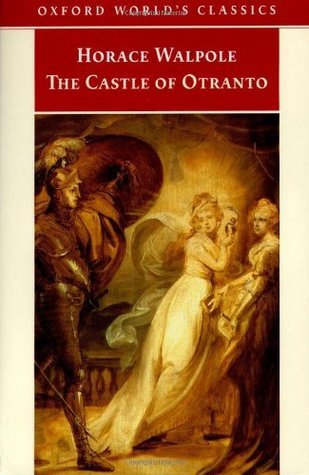
The Castle of Otranto
Novel by Horace WalpoleWikipedia
49
MENTIONS
27
EPISODES
22
PODCASTS
Search complete. 49 mentions across 27 episodes found for "The Castle of Otranto".
Oct 29, 2026

Ryan DunsGUEST
So we teach the haunted palace at the beginning, it's read in the middle, and then we revisit it at the end, sort of like the summary synthesis of the story.
Ryan DunsGUEST
To your point about Gothic, it never ceases to amaze me You have Horace Walpole in 1764 who writes The Castle of Toronto.
Ryan DunsGUEST
And then only two decades later, Immanuel Kant, What is Enlightenment? And he's really extolling the high noon of reason that casts away superstition and shadows and everything will be made clear and apparent.
Ryan DunsGUEST
But that enlightenment confidence is taking place just at the moment and the birth of this other form of narration and storytelling that is the exact opposite of what Kant thinks is going to take hold over the world.

Caroline CramptonHOST
emerges
Alex ClarkGUEST
in the middle of the 18th century and It comes through with works like Horace Walpole's Castle of Otranto would be one of the early works, and Radcliffe's Mysteries of Adolfo.
Alex ClarkGUEST
It's already very well established by the end of the 18th century, and it's not until the 19th century that we start to see what we think of as the classics of the Gothic.
Alex ClarkGUEST
You've got Frankenstein would be...
8 MINS LATER
Alex ClarkGUEST
But at the time, Gothic is being dismissed as monstrous, immature, and cheap thrills.
Alex ClarkGUEST
But if they can link themselves to Shakespeare... then suddenly they become legitimate.
Alex ClarkGUEST
In The Castle of Otranto by Horace Walpole, which is one of those really early Gothic texts from the middle of the 18th century, he is openly referencing Hamlet.
Alex ClarkGUEST
He uses bits of the plot of Hamlet, and he references it in his foreword to the book, saying this is a homage to Shakespeare.

Andrew WyattHOST
I think it's worth spoiling a little bit to emphasize this is not a supernatural horror film.
Andrew WyattHOST
It's a true gothic in the sort of, again, the Bronte or Castle of Otranto sense that it's a film about secrets and lies and horrible family melodrama and buried shames.
Andrew WyattHOST
It's not about ghosts per se, but there is an overarching mood of horror that sort of what I would call the sort of the Poe mood or the Bronte mood of of goth of a sort of gothic desolation I think and it's an important part of the the way that the film looks and feels there's a scene where there's a hedge like a hedge maze or a hedge garden and at the center of this hedge maze the colonialist like patriarch of this family has created a perfect reconstruction of a marley like whaling lodge hidden inside the center of his hedge maze in yorkshire
Joshua RayHOST
Hmm.

Tracy V. WilsonHOST
because Montague Summers wrote numerous books on witches and werewolves and vampires and black magic and ghosts, all things that we've talked about on the show.
Tracy V. WilsonHOST
And he edited and published works like Balius Maleficarum or The Hammer of Witches and Matthew Hopkins' The Discovery of Witches and Horace Walpole's gothic novel The Castle of Otranto.
Tracy V. WilsonHOST
These are all also things that we have talked about on the show before.
Tracy V. WilsonHOST
And he wrote books on past podcast subjects Anne Radcliffe and Jane Austen.
6 MINS LATER
Holly FreyHOST
That was a self-published collection titled Antinous and Other Poems.
Holly FreyHOST
Antinous was one of the lovers of Roman Emperor Hadrian.
Holly FreyHOST
and the book was dedicated to French novelist and poet Baron Jacques d'Alsphard Fertson, who had been found guilty of indecency with minors in 1903 and had long-term relationships with other men, including art model Nino Cesarini.
Tracy V. WilsonHOST
This collection is described as controversial, decadent, and homoerotic, with one of its poems to a dead acolyte sometimes interpreted as referring to a satanic Black mass, although that interpretation has been debated.

BrianHOST
Indeed.
BrianHOST
So Gothic horror in literature goes back to Horace Walpole's The Castle of Otranto in 1764.
BrianHOST
So it goes back quite a ways.
BrianHOST
But it's something that we think of very much in 19th century literature, where it became very popular with Frankenstein and with Dracula, also the picture of Dorian Gray and Strange Case of Dr. Jekyll and Mr. Hyde.

Jay CraftHOST
Now, the first scary story ever, now the first recognized horror story, first recognized horror novel, I guess you could probably, fucking people told scary stories at campfires and shit like that, but this is the first one ever written, and first one ever written down that people bought and read.
Jay CraftHOST
The first recognized horror novel is The Castle of Otranto by Horace Walpole.
Jay CraftHOST
That was published in 1764.
Jay CraftHOST
It was also the very first time that the trope of the moving portrait was used.

John DoyleHOST
And some of these entities or forces exist.
John DoyleHOST
basically have it out for us as mankind and this is not just with christendom this is true for primitive cultures of the past you know native american tribes for example african tribes but this is also true for cultures of antiquity right this is of course true for christian civilization so despite our long-standing belief in you know the evil and in the supernatural the actual genre of horror itself is a relatively recent creation um in 1764 The British politician and writer Horace Walpole published a book titled The Castle of Otranto.
John DoyleHOST
This is widely considered to be the first horror novel, and it features a medieval setting and supernatural themes.
John DoyleHOST
And this is also considered the first Gothic novel, which is actually quite revealing because the term Gothic, like to the modern enlightened mind, invokes a past chapter of human history that's defined by darkness and superstition.
John DoyleHOST
This is something that apparently we have overcome.
John DoyleHOST
Apparently we are no longer in the dark.
John DoyleHOST
That's what people are getting out of it.
John DoyleHOST
The horror genre basically says, okay, tough guy, yeah, you've done away with superstition, with evil, with the supernatural, but these things haven't done away with you, have they? Think about it.

Barbara PetersHOST
I mean, the Moors are good for background.
Barbara PetersHOST
But, you know, if you think about Rebecca or the fall of the House of Usher or, you know, Otranto, all of those.
Barbara PetersHOST
Martin Edwards has actually been writing a gothic series set in the 1930s.
Barbara PetersHOST
Oh, really? Yeah.

Jay UnderwoodHOST
You were talking about history before, Sandra.
Jay UnderwoodHOST
You put its origins into pieces called, like, the Castle of Otranto and Melmoth.
speaker_1UNKNOWN
Yes.
Jay UnderwoodHOST
By Maturin, things like that, as, like, real, kind of, like, almost, like, proto-Gothic works.
17 more episodes mention The Castle of Otranto.
Create an account to see the whole feed, search across every transcript, and follow the entities you care about.