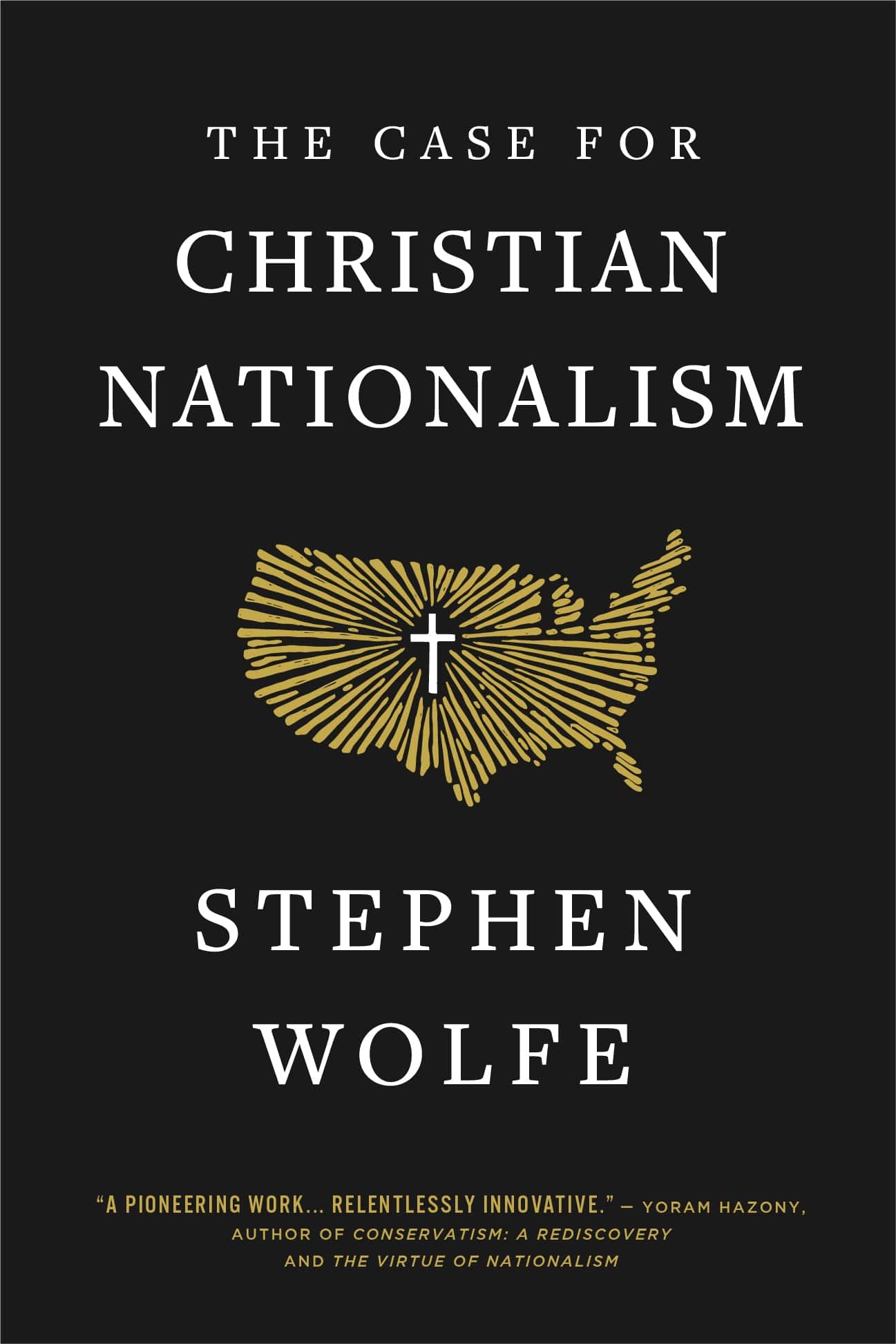
The Case for Christian Nationalism
BookWikipedia
15
MENTIONS
9
EPISODES
9
PODCASTS
Search complete. 15 mentions across 9 episodes found for "The Case for Christian Nationalism".
Oct 17, 2026

Stephen K. BannonHOST
First off, um, I'm the least controversial speaker you have today.
Stephen K. BannonHOST
You have, [laughs] you have Stephen Wolfe, the author of The Rise of Christian Na- or The Case for Christian Nationalism.
Stephen K. BannonHOST
Absolutely brilliant.
Stephen K. BannonHOST
You've got Beau French, you've got Mike Howe, others, a whole slate of others.

Steve BannonHOST
First off, um, I'm the least controversial speaker you have today.
Steve BannonHOST
You have, [laughs] you have Stephen Wolfe, the author of The Rise of Christian Na- or The Case for Christian Nationalism.
Steve BannonHOST
Absolutely brilliant.
Steve BannonHOST
You've got Beau French, you've got Mike Howe, others, a whole slate of others.

Michael RegilioHOST
And then I'm gonna play you a clip of, um, Abdul Al Saeed talking about his religion, and I was like, "Now there's the take I wanna hear." And he is of a different religion.
Michael RegilioHOST
But let's start with a Christian philosopher and author of the book, The Case for Christian Nationalism-
Travis ClyburnHOST
No
Michael RegilioHOST
...
1 HR 18 MINS LATER
Michael RegilioHOST
...
Michael RegilioHOST
Soviet intelligence cultivated Trump during his visits to Moscow.
Michael RegilioHOST
Shvets was a source of Craig Unger's book, American, uh, Compromat, which examined allegations of longstanding Russian intelligence interest in Trump.
Michael RegilioHOST
I absolutely 100% believe that, by the way.

Will WrightHOST
And, and, and then it's like in both of those situations that, that the author talks about in, in his book, it's almost like the same thing, right? It's like a person that was willing to meet them on their terms and not judge them or view them as crazy, right? Um, it's, it's one of the things we do a lot on this show.
Will WrightHOST
Like we talk to all kinds of people, you know, the, the co-founder of the Satanic Temple, um, you know, Kevin Roberts, um, all kinds of people, um, the, uh, the author of the, uh, "The Case for Christian Nationalism," you know, people that like I would not agree with like on the surface, but I can have a man-to-man conversation with them.
Will WrightHOST
Like, "Yeah, tell me why did you write that?" You know? And it seems like for you, that was sort of like the thing, the thing that sort of like that made you have a second thought about the way you were treating people or at least the views you had about people.
Will WrightHOST
Um, like I, I'd love to get your thoughts on that, on whether or not like, like w- was that a, an effective strategy sort of tailor-made for you, or have you actually seen this sort of like play out in other sort of forms, especially with like your, your, um, your organization that, that you have, um, going right now?

Josh HowardHOST
And then as you were having this debate, he compared David Van Drunen to Stephen Wolfe.
Josh HowardHOST
Stephen Wolfe wrote The Case for Christian Nationalism, which Moscow, Idaho published a couple of years ago now.
Josh HowardHOST
And it obviously took this whole conversation by storm.
Josh HowardHOST
And people are still debating over that book and all those things.

Josh HowardHOST
And then as you were having this debate, he compared David Van Drunen to Stephen Wolfe.
Josh HowardHOST
Stephen Wolfe wrote The Case for Christian Nationalism, which Moscow, Idaho published a couple years ago now, and it obviously took this whole conversation by storm, and people are still debating over that book and all those things.
Josh HowardHOST
But he said essentially the conception of two kingdoms that you find from Wolfe, who would describe himself as a classical two-kingdom guy, and that the two-kingdom theology you find from David Van Drunen are the same.
James BairdHOST
Yeah.

Sara GonzalesHOST
a theocratic monarchy, right? That's not what I'm saying.
Sara GonzalesHOST
I would instead like to summarize how Stephen Wolfe, the author of The Case for Christian Nationalism, defines the term.
Sara GonzalesHOST
So Of course, when you have a conversation, you need to all be in agreement of what the definition of these terms means.
Sara GonzalesHOST
So let me just go ahead and do that so that this can't be misconstrued.

Eric TeetselHOST
According to Paul Miller, I'm probably a Christian nationalist.
Eric TeetselHOST
And then you use Stephen Wolfe in his book, The Case for Christian Nationalism, as the primary foil for your basic argument.
Eric TeetselHOST
And you say, according to that person's definition, I'm definitely not a Christian nationalist.
Eric TeetselHOST
My criticism is Stephen Wolfe's definition, as important as it is, as serious a scholar and as impressive the work that his book is, is not the final word on what Christian nationalism means.
Eric TeetselHOST
And in fact – I'm going to let you finish.
Eric TeetselHOST
No, no, no. You're good.
Eric TeetselHOST
I'm just kidding.
Eric TeetselHOST
In fact – The fact that we just had yet another book, a very important and terrific book that we've previously talked about, written by numerous authors, including Al Mohler, Rusty Reno, Paul Miller, Doug Wilson, and Joe Rigney, illustrates that there are still a very vibrant conversation to be had about what exactly it is that we are trying to talk about and how we get there.

Antonio GriffithHOST
... just to be clear.
Antonio GriffithHOST
But the criticism of, like, we're taking two steps from scripture, and by the way, the biblical hermeneutic that we, we've talked about, also the natural, the natural revelation, right? The, uh, uh, cr- you know, Stephen Wolfe makes this argument at the beginning of The Case for Christian Nationalism where he talks about how we can from nature determine man's telos, and it's actually from how he's created and what he does.
Antonio GriffithHOST
In other words, God has made man for a pers- particular purpose.
Antonio GriffithHOST
Therefore, by, by observing, interestingly enough, observing how man acts, we can actually determine what he's meant for.