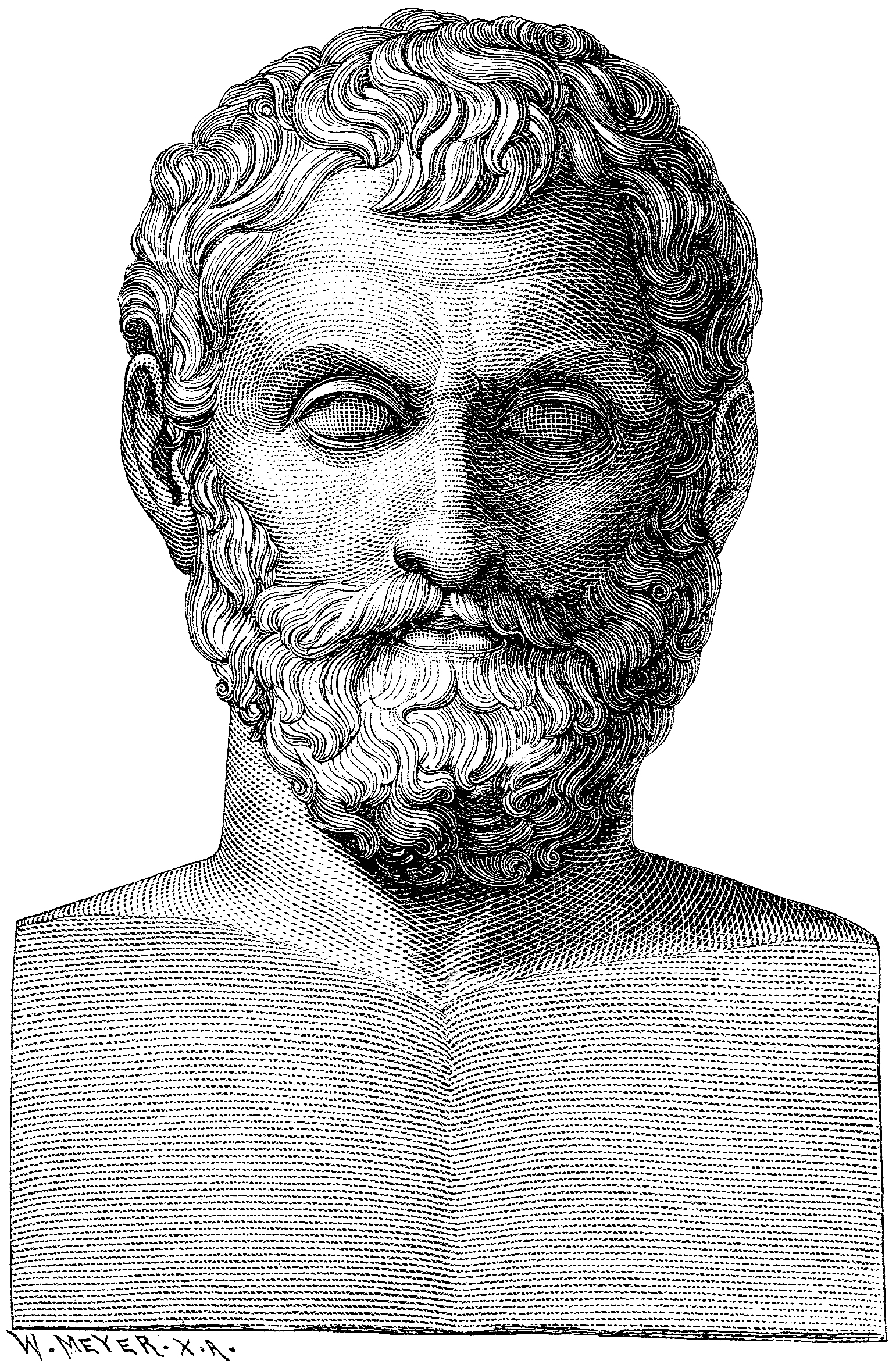
Thales of Miletus
PhilosopherWikipedia
172
MENTIONS
30
EPISODES
27
PODCASTS
Search complete. 172 mentions across 30 episodes found for "Thales of Miletus".
Nov 1, 2026

Beth ThomasNARRATOR
Thus, as he poetically expressed it, time brought its revenges, and for the wrongdoing of existence all things paid the penalty of death.
Beth ThomasNARRATOR
The momentary resting place of Thales on the confines of the familiar world of things, in his formulation of water as the principle of existence, is thus immediately removed.
Beth ThomasNARRATOR
We get, as it were, to the earliest conception of things as we find it in Genesis, before the heavens were, or earth, or the waters under the earth, or light, or sun, or moon, or grass, or the beast of the field, when the earth was without form and void, and darkness was upon the face of the deep.
Beth ThomasNARRATOR
only be it observed that while in the primitive biblical idea this formless void precedes in time an ordered universe in anaximander's conception this formless infinitude is always here is in fact the only reality which ever is here something without beginning or ending underlying all enwrapping all governing all to modern criticism this may seem to be little better than verbiage having perhaps some possibilities of poetic treatment but certainly very unsatisfactory if regarded as science but to this we have to reply that one is not called upon to regard it as science behind science as much to-day when our knowledge of the details of phenomena is so enormously increased as in the times when science had hardly begun there lies a world of mystery which we cannot pierce and yet which we are compelled to assume no scientific treatise can begin without assuming matter and force as data and however much we may have learned about the relations of forces and the affinities of things matter and force as such remain very much the same dim infinities that the originative infinite was to anaximander it is to be noted however that while modern science assumes necessarily two correlative data or originative principles force namely as well as matter alexander seems to have been content with the formulation of but one and perhaps it is just here that a kinship still remains between him and thales and other philosophers of the school he no more than they seems to have definitely raised the question how are we to account for or formulate the principle of difference or change what is it that causes things to come into being out of or recalls them back from being into the infinite void it is to be confessed however that our accounts on this point are somewhat conflicting one authority actually says that he formulated motion as eternal also so far as he attempted to grasp the idea of difference in relation to that of unity he seems to have regarded the principle of change or difference as inhering in the infinite itself aristotle in this connection contrasts his doctrine with that of anaxagoras who formulated two principles of existence matter and mind anaximander he points out found all he wanted in the one As a mathematician, Anaximander must have been familiar in various aspects with the functions of the infinite or indefinable in the organization of thought.
Beth ThomasNARRATOR
The word husk or bark, Greek phloios, seems to have been a favourite one with him, as implying and depicting a conception of interior and necessary development in things.
Beth ThomasNARRATOR
thus he seems to have postulated an inherent tendency or law in the infinite which compelled it to develop contrary characters as hot and cold dry and moist in consequence of this fundamental tendency an envelope of fire he says came into being encircling another envelope of air which latter in turn enveloped the sphere of earth each being like the husk of the other or like the bark which encloses the tree this concentric system he conceives as having in some way been parted up into various systems represented by the sun the moon the stars and the earth the last he figured as hanging in space and deriving its stability from the inherent and perfect balance or relation of its parts then again as to the origin of man he seems to have in like manner taught a theory of development from lower forms of life in his view the first living creatures must have come into being in moisture thus recalling the theory of thales as time went on and these forms of life reached their fuller possibilities they came to be transferred to the dry land casting off their older nature like a husk or bark more particularly he insists that man must have developed out of other and lower forms of life because of his exceptional need under present conditions of care and nursing in his earlier years had he come into being at once as a human creature he could never have survived the analogies of these theories with modern speculations are obvious and interesting but without enlarging on these one has only to say in conclusion that suggestive and interesting as many of these poor fragments these disiecti membra poetae are individually they leave us more and more impressed with a sense of incompleteness in our knowledge of anaximander's theory as a whole it may be that as a consistent and perfected system the theory never was worked out it may be that it never was properly understood By some authorities it is stated that Anaximander, the second philosopher of this school, was the first to use the word archae in the philosophic sense.
Beth ThomasNARRATOR
Whether this be so or not, Thales certainly had the idea.
Beth ThomasNARRATOR
chapter two the school of miletus concluded three an this philosopher was also a native of miletus and is said to have been a hearer or pupil of anaximander as we have said the tendency of the later members of the school was towards emphasising the motive side of the supposed underlying principle of nature and accordingly anaximenes chose air as the element which best represented or symbolised that principle its fluidity readiness of movement wide extension and absolute neutrality of character as regards colour taste smell form etc were obvious suggestions the breath also whose very name to the ancients implied an identity with the life or soul was nothing but air and the identification of air with life supplied just that principle of productiveness and movement which was felt to be necessary in the primal element of being the process of existence then he conceived as consisting in a certain concentration of this diffused life-giving element into more or less solidified forms and the ultimate separation and expansion of these back into the formless air again The contrary forces previously used by Anaximander are with Anaximenes also the agencies which institute these changes.

Chautona HavigHOST
Yes.
Frank McKinneyGUEST
So one of them, Phallus, Phallus was an astronomer.
Frank McKinneyGUEST
Phallus is in hell with my characters.
Frank McKinneyGUEST
Phallus is the one who points out where does the energy go during a solar eclipse? Well, it's been coming down here for millennia, and Satan can't figure it out.
Frank McKinneyGUEST
Satan can't figure out why certain people, every now and then there's a handful of people that go missing.
Frank McKinneyGUEST
Well, it's the beauty of that very rare occurrence combined with, this is the must, the love that penetrates the impenetrable roof and ceiling of hell as sent there by the grace of God through the loved ones that are still praying for these three characters that have passed.

JimmyHOST
Around the same period, early Greek natural philosophers were already proposing non-divine explanations for phenomena that myth had traditionally attributed to the gods.
JimmyHOST
Thales of Miletus argued that earthquakes weren't caused by Poseidon's trident, but by the earth floating on water.
JimmyHOST
Anaximander proposed that life originated from moisture acted upon by the sun, not from the creative whims of Prometheus and some hunks of clay.
JimmyHOST
These thinkers weren't atheists in the modern sense, but they were systematically removing the gods from their explanatory role in the natural world.

Aditya ChakravartiGUEST
This is a problem.
Aditya ChakravartiGUEST
To see why, I'm going to tell you about a theorem called Thales's theorem.
Aditya ChakravartiGUEST
The angle in a semicircle here is always a right angle.
Aditya ChakravartiGUEST
Here's a short proof using equations.

Manuel Sans SegarraGUEST
These profound existential questions are a direct consequence, or rather they necessitate, in order to properly address them, a deep and thorough knowledge of our own existential reality, which is certainly not an easy task to undertake at all.
Manuel Sans SegarraGUEST
Thales of Miletus, a pre-Socratic philosopher, already said it.
Manuel Sans SegarraGUEST
The most difficult thing for a human being is to know oneself.
Manuel Sans SegarraGUEST
And the easiest thing is to speak ill of others.

speaker_2NARRATOR
The earlier Greek philosophy lasted, roughly speaking, for about 2,050 years, say from 600 B.C. onwards.
speaker_2NARRATOR
Such men as Thales, Heraclitus, Pythagoras, Parmenides, Anaxagoras, Empedocles, Democritus, were mathematicians, theologians, politicians, astronomers, and physicists.
speaker_2NARRATOR
All the learning of their time, such as it was, was at their disposal.
speaker_2NARRATOR
Plato and Aristotle continued their tradition.

Scott WadsworthGUEST
And nowhere are those ideals encapsulated better than in the New Testament, although they're encapsulated and taught in many other places, or at least similar teachings are.
Scott WadsworthGUEST
I mean, as an example, it was at Thales of Miletus who taught, and Confucius, the silver rule, do not unto your neighbor what you would not have your neighbor do unto you, amplified and made perfect by Jesus in the New Testament, do unto others as you would have others do unto you.
Scott WadsworthGUEST
It's so simple, such a simple change in such a quantum leap.
Scott WadsworthGUEST
All of that to say that that's the short best answer that my groping forward to try to figure out what does it even mean to be a disciple? What does that even mean? Especially in this world that is so driven by the profit motive.

Scott WadsworthGUEST
And nowhere are those ideals encapsulated better than in the New Testament, although they're encapsulated and taught in many other places, or at least similar teachings are.
Scott WadsworthGUEST
I mean, as an example, it was at Thales of Miletus who taught, and Confucius, the silver rule, do not unto your neighbor what you would not have your neighbor do unto you, amplified and made perfect by Jesus in the New Testament, do unto others as you would have others do unto you.
Scott WadsworthGUEST
It's so simple, such a simple change in such a quantum leap.
Scott WadsworthGUEST
All of that to say that that's the short best answer that my groping forward to try to figure out what does it even mean to be a disciple? What does that even mean? Especially in this world that is so driven by the profit motive.

MiraHOST
Long ago, people used myths to explain everything.
MiraHOST
But then, around 600 BCE, in a bustling Greek port city called Miletus, a man named Thales decided to look for natural reasons instead.
MiraHOST
Who exactly was Thales? What did he do? He's often called the very first philosopher.
MiraHOST
Thales once travelled down to Egypt and stood before the Great Pyramid of Giza.
MiraHOST
It was 481 feet tall, which is the height of a modern 40-storey building.
MiraHOST
No one knew exactly how to measure it without climbing up its slippery sides.
FinnHOST
How do you measure a 40-storey building without a giant tape measure or a helicopter?
MiraHOST
He used shadows.

Doug CampbellHOST
And so is Miletus.
Doug CampbellHOST
Miletus was the birthplace of ancient Greek philosophy with people like Thales and Ximander and Ximenes, who are also from Miletus.
Doug CampbellHOST
And even though Xenophanes is not...
Doug CampbellHOST
Even though Xenophanes is not from Miletus, but from a place, you know, maybe today it would take you about two hours to get between the ruins of Colophon and the ruins of Miletus.
Doug CampbellHOST
And specifically, the thing we're gonna talk about today is this criticism of traditional conceptions of the gods.
Doug CampbellHOST
And I'll say something at the end about his own positive view of what God is like, but that's not really gonna be the major focus of this episode.
Doug CampbellHOST
And the reason why I mentioned his proximity to Miletus is that there's a theme that we see when we look at the first Greek philosophers who again are Thales, Anaximenes, and Anaximander.
Doug CampbellHOST
Some people will doubt the historiography here and say things like, well, actually we should talk with the history of philosophy differently in a way that doesn't put Thales, Anaximenes, and Anaximander first.
20 more episodes mention Thales of Miletus.
Create an account to see the whole feed, search across every transcript, and follow the entities you care about.