Th1 cells
76
MENTIONS
27
EPISODES
22
PODCASTS
Search complete. 76 mentions across 27 episodes found for "Th1 cells".
Sep 18, 2026

Piper DobnerGUEST
T-regulatory cells are the balancing act of the immune system.
Piper DobnerGUEST
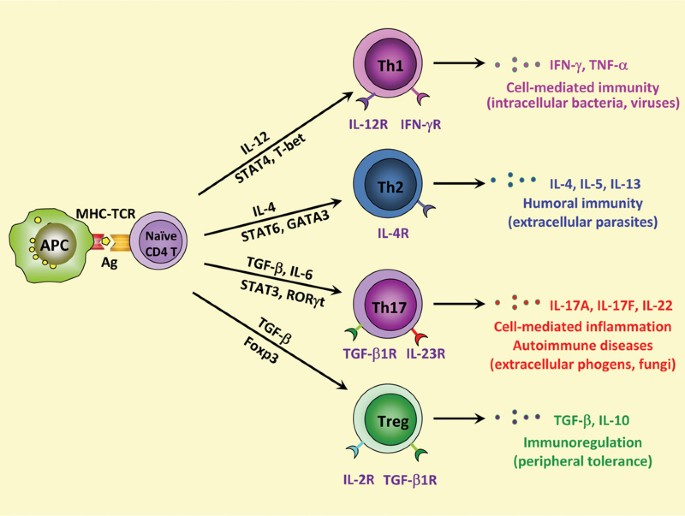
So people who generally have more of a Th1 response, this is my teeter-totter, but I like to think of the immune system as a teeter-totter, very oversimplified, but simplification is how we understand things.
Piper DobnerGUEST
I TH1 is one side of the immune system.
Piper DobnerGUEST
TH2 is the other side.

Klaus LeyGUEST
Two things.
Klaus LeyGUEST
One is CD8 T cells make a lot of interferon gamma, actually more even than Th1 CD4 cells.
Klaus LeyGUEST
So the interferon gamma was the first cytokine, one of the first cytokines that was known to drive atherosclerosis back in In the 90s, people did the double knockout with APOE and LDL receptor, and they found that interferon gamma was important.
Klaus LeyGUEST
So interferon gamma is a bad actor in atherosclerosis.

Christina G. GonzalesHOST
It often presents as skip lesions or patchy inflammation and it's transmural inflammation, which causes deep ulcerations, fistulas, and even strictures.
Christina G. GonzalesHOST
It's associated with Th1-mediated immune responses.
Christina G. GonzalesHOST
So how do these patients typically present? Well, they often have a spectrum of GI symptoms, including chronic diarrhea, which may be bloody, but less so than ulcerative colitis.
Christina G. GonzalesHOST
Abdominal pain, especially in the right lower quadrant if the ileum is involved.

John CampbellHOST
what what you're saying here it actually does make a little bit of sense so we have these lymphocytes that you know about the t helper lymphocytes Not to be confused with the T cytotoxic lymphocytes that actually kill cells, but the T helper lymphocytes.
John CampbellHOST
And some people are saying that they produce two groups of cytokines, these cell hormones, the TH1, the T helper 1 and the T helper 2.
John CampbellHOST
And without going into too much detail, it's the T helper two group of lymphocytes or the T helper two type of T helper cells that produce the immunoglobulin E or stimulate the production of the immunoglobulin E rather.
John CampbellHOST
And that's the one that's evolved in allergy and severe allergic reactions.

Bryan ArdisHOST
So a proactive preventative for Guillain-Barré syndrome would be vitamin D.
Bryan ArdisHOST
By inhibiting TH1/TH17 responses while increasing Treg activity, vitamin D helps reduce inflammation and restore immune balance.
Bryan ArdisHOST
You need the immune system to heal the nerves of Guillain-Barré syndrome.
Bryan ArdisHOST
An optimal vitamin D level of 40 to 60 nanograms can generally be achieved by a vitamin D dose of 6,000 IUs a day.

Rafael GonzalezGUEST
So the ideal situation is you regulate the immune system, and there's a particular cell in the body that's supposed to do that.
Rafael GonzalezGUEST
It's a CD25 regulatory T cell, and it's supposed to maintain that balance between a mounted pro-inflammatory response and an anti-inflammatory healing response, a Th1 and a Th2 response.
Rafael GonzalezGUEST
Balance that correctly to do so.
Rafael GonzalezGUEST
On the opposite spectrum, which is sort of crazy, and this is why the body's so, and the immune system's so complex, take a look at a cancer patient.

Daniel J. GuerraHOST
And the failure to properly terminate that kind of inflammatory response, then can result not only in a great deal of tissue damage, and maybe even something going from morbidity to almost close to a more mortal response, such as sepsis.
Daniel J. GuerraHOST
What else can be left behind when that inflammation starts to be drawn back down? By example, for Treg cells, now functioning against Th1 cells.
Daniel J. GuerraHOST
Well, you might then still result a perpetual inflammatory response.
Daniel J. GuerraHOST
And that perpetual inflammatory response, say in the kidney or the pancreas or anywhere else in the organ systems, the lung, the heart, the brain, the bladder, that can result then in an oncogenic transforming response.

speaker_1HOST
It shifts its posture.
speaker_1HOST
The body suppresses the cell-mediated immune response, the Th1 pathway, and heavily shifts toward the humoral immune response, what we call a Th2 immune predominance.
speaker_0HOST
The Th2 shift.
speaker_0HOST
How does that connect back to Kuhne syndrome?
Myriah HincheyGUEST
You know, those two things are going to drive autoimmunity.
Myriah HincheyGUEST
Then we have the imbalance between Th1 and Th2.
Myriah HincheyGUEST
If you're Th2 dominant, you're going to have more issues with... allergies, histamine, things like that.
Myriah HincheyGUEST
And then you're not going to have kind of like the competency of the immune system in the TH1 branch, which is really what we need to be able to to deal with the Lyme infection itself.

Thomas LodiHOST
There are, there are, there are two basic positions that the immune system can be on.
Thomas LodiHOST
They have, uh, poles, polarities, right? One is it can be what's oriented towards TH1, where the immune system is aggressive and, uh, uh, you know, finding out, searching out, and getting rid of enemies.
Thomas LodiHOST
And the other one is developing, developing tolerance and a downpl- and kind of balancing out the TH1, right? So you need to have a balance, but be more or- oriented toward the TH1.
Thomas LodiHOST
But when you're more oriented towards TH2 and less to TH1, is that's associated with what they call autoimmune conditions.
Thomas LodiHOST
So that means that there's an imbalance on this side.
Thomas LodiHOST
Okay? That's what it is.
17 more episodes mention Th1 cells.
Create an account to see the whole feed, search across every transcript, and follow the entities you care about.