TFEB
5
MENTIONS
3
EPISODES
3
PODCASTS
Search complete. 5 mentions across 3 episodes found for "TFEB".
Nov 4, 2026

John GildeaGUEST
Or there's another pathway.
John GildeaGUEST
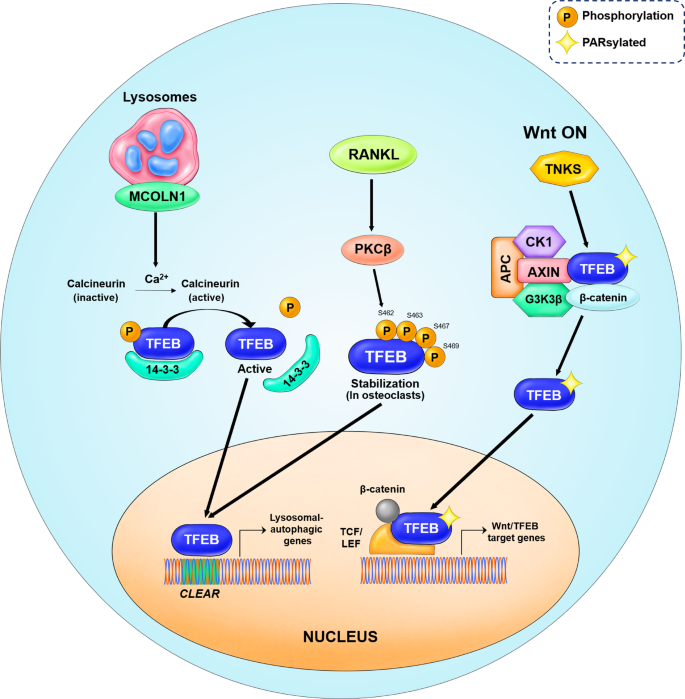
Similar to NRF2 is there's a master control gene that controls lysosome biogenesis, and that's called TFEB.
John GildeaGUEST
And so you can turn TFEB on, which it's like making an upgrade to your plumbing in your house, make the pipes bigger so that you can process more misfolded proteins or anything that you want to get rid of.
John GildeaGUEST
And then the sulforaphane is a switch that makes, if your lysosomes are overwhelmed, it'll dump it out into the circulation.
John GildeaGUEST
And that's the mechanism.

Daniel J. GuerraHOST
Protein complex, I also have mentioned just briefly, that's the FLCN FNIP2 complex.
Daniel J. GuerraHOST
Now, why that's important, I'm not going to give you the detail of that complex right now, only in that it inhibits the transcription factor, okay? And the transcription factor here is TFEB.
Daniel J. GuerraHOST
So the regulation of the transcription factor EB inhibits maintains lysosomal homeostasis.
Daniel J. GuerraHOST
And what does that support for the dendritic cell? Remember, lysosome is going to break down antigen, right? Yes, that supports optimum antigen processing and then hoisting on the surface of the dendritic cell with the matrix compatibility complex.

Constanza J CortesGUEST
They're called the 5xFAD model because they have five different genetic modifications that mimic a lot of the same mutations that we see in Alzheimer's patients.
Constanza J CortesGUEST
And so we studied those animals as well, and we wondered, can this TFEB overexpression protect their brain as well? And the answer was yes.
Constanza J CortesGUEST
And we did this actually in two different Alzheimer's disease models, because as you mentioned, in the brains of Alzheimer's patients, we have this amyloid beta plaques, but they also have something called tangles of tau protein.
Constanza J CortesGUEST
And so we tested both and TFEB expression in muscle protects against both, which is really interesting because it protects against both, but it protects them in different ways.
Constanza J CortesGUEST
And so now we're really interested to see to your point earlier of whether we can intervene once disease has already set in and the brain is already starting to accumulate these things.
Constanza J CortesGUEST
Different patients of Alzheimer's disease and different stages of Alzheimer's disease means you will have more plaques or more tangles.