Teutons
TribeWikipedia
685
MENTIONS
153
EPISODES
130
PODCASTS
Search complete. 685 mentions across 153 episodes found for "Teutons".
Sep 23, 2026

Richard VaughanHOST
Uh, of course, Sertorius.
Richard VaughanHOST
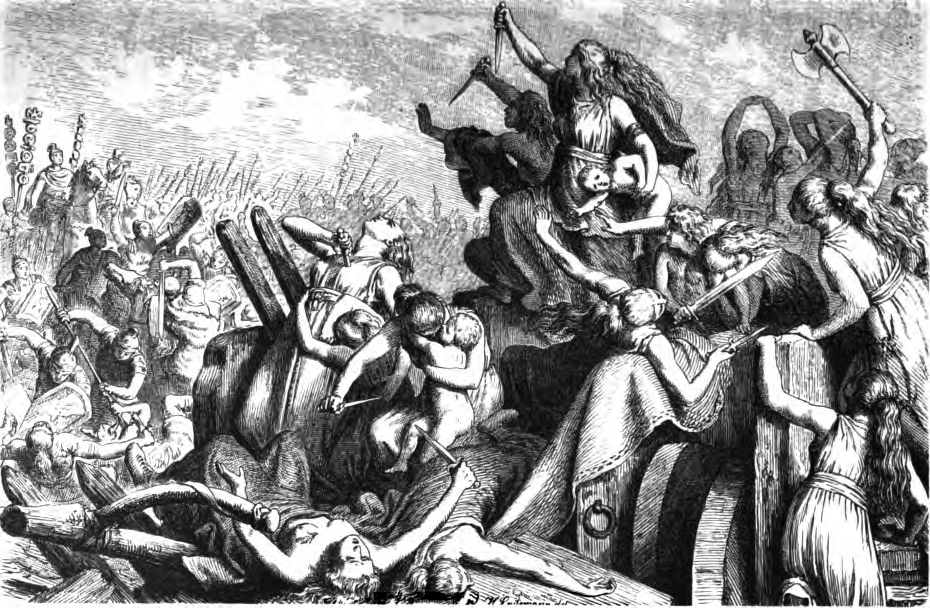
And he was, um, he was one of the lieutenants of Marius the Great in the battles against Jugurtha in North Africa and against the Cimbrians and the Teutons from Germany and from Denmark, who had come down to Southern France and into Northern Italy.
Richard VaughanHOST
And so he was a very important person, and he, he was sent to Spain as the governor of Spain, and during the civil war in Italy between many of the different tribes against the Romans, Sertorius took advantage of the...
Richard VaughanHOST
Or tried.

speaker_2NARRATOR
As far as I can understand the theory, the Irish are Celts and the English are Teutons.
speaker_2NARRATOR
Of course, the Irish are not Celts any more than the English are Teutons.
speaker_2NARRATOR
I have not followed the ethnological discussion with much energy, but the last scientific conclusion which I read inclined on the whole to the summary that the English were mainly Celtic and the Irish mainly Teutonic.
speaker_2NARRATOR
But no man alive with even the glimmering of a real scientific sense would ever dream of applying the terms Celtic or Teutonic to either of them in any positive or useful sense.
speaker_2NARRATOR
That sort of thing must be left to people who talk about the Anglo-Saxon race and extend the expression to America.
speaker_2NARRATOR
How much of the blood of the Angles and Saxons, whoever they were, there remains in our mixed British, Roman, German, Dane, Norman, and Picard stock is a matter only interesting to wild antiquaries.
7 MINS LATER
speaker_2NARRATOR
There is nothing Celtic about having legends.
speaker_2NARRATOR
It is merely human.

Pamela NagamiNARRATOR
Chapter 5.
Pamela NagamiNARRATOR
The Cimbri and Teutones.
Pamela NagamiNARRATOR
The Jugurthine War ended in 105 B.C.
Pamela NagamiNARRATOR
In one way it had been of real service to Rome.
15 MINS LATER
Pamela NagamiNARRATOR
But fortune helped the Romans more than all these precautions.
Pamela NagamiNARRATOR
The Cimbri, after willfully destroying every vestige of the spoils they had taken, in fulfillment probably of some vow, wandered westward on a plundering raid toward the Pyrenees, the road thither having been lately provided as it were for them by Domitius.
Pamela NagamiNARRATOR
In the Celtiberi they met with foes who sold too dearly the little they had to lose, and again they surged back into South Gaul where they were joined by the Teutones, and once more threatened Italy.
Pamela NagamiNARRATOR
But meantime the generals of the Republic had not been idle.

Jay BurdenHOST
To make matters worse, if that's even possible, this movement also produced Carlyle, a Faustian who established the great man of history, concept that Roosevelt was enamored with.
Jay BurdenHOST
Teddy's buddies started out with the less radical germ theorists, and as he pointed out, eventually became buddies with Madison Grant, supported the more radical racial offshoot of Teutonic paganism.
Jay BurdenHOST
Now that's word salad nonsense, but that term, paganist, is kind of interesting.
Jay BurdenHOST
He says, again later, Hitler used the same type of Volkish rhetoric that Teddy Roosevelt used because he was unfortunately steeped in the same paganist Teutonic germ theory that produced Hitler.
Jay BurdenHOST
That's weird.
Jay BurdenHOST
This is just some schizo on the internet.

Agnes Robert BaerNARRATOR
And yet now and then would come a high-pitched northern gable.
Agnes Robert BaerNARRATOR
Latin and Teuton met and mingled in the place.
Agnes Robert BaerNARRATOR
And, as Mr. Gibbon has taught us, the offspring of this admixture is something fantastic and unpredictable.
Agnes Robert BaerNARRATOR
I forgot my grievous thirst and my tired feet in admiration of a certain vague expectation of wonders.

JakeHOST
And Autodefay is actually a compilation album.
JakeHOST
And it's stacked full of some incredibly, again, Teutonic sounding.
JakeHOST
You mentioned Teutonic quite rightly in the German band Exmaldeutschland.
JakeHOST
But this was an Australian band.
JakeHOST
But at times, they sound so Teutonic, it is unreal.
JakeHOST
I'm quite certain that Revel is shouting and screaming in German a lot of the time, and it's very militaristic, and it's very confrontational, and it is hugely distorted electronics.
JakeHOST
Some of it with just a simple Casio drum machine providing the percussion, whilst all around it is just waves of white noise and feedback and shouting and stomping and raging.

Jeremy Ryan SlateHOST
The conquest did it.
Jeremy Ryan SlateHOST
The wars against the Cimbri and the Teutons up north sent people to the south in chains.
Jeremy Ryan SlateHOST
The Sulla's campaigns in Greece and Asia sent more, and the pirate fleets working every coast in the Mediterranean were selling whatever they could grab.
Jeremy Ryan SlateHOST
Every victory ended more or less in the same way, with the legions coming home and the slave traders following along behind them.

DodieNARRATOR
One widely prevalent theory ascribes to iron a meteoric origin, but the different nations of antiquity were wont to attribute this discovery to or invention to some favorite deity or mythological personage.
DodieNARRATOR
Osiris was thus honored by the Egyptians, Vulcan by the Romans, and Wodan or Odin by the Teutons.
DodieNARRATOR
In early times, the employment of iron in the arts was much restricted by reason of its dull exterior and brittleness.
DodieNARRATOR
There existed, moreover, among the Romans a certain religious prejudice against the metal, whose use in many ceremonies was wholly proscribed.
48 MINS LATER
Doc Deal MartinNARRATOR
But the efficacy of the horseshoe as a protector of people and buildings depends not solely upon its arched shape, nor on its bifurcated form, nor yet upon its fancied resemblance to a snake.
Doc Deal MartinNARRATOR
Its relation to the horse also gives it a talismanic value, for in legendary lore this animal was often credited with supernatural qualities.
Doc Deal MartinNARRATOR
An English myth ascribes to the horse the character of a luck-bringer, and horse-worship was in vogue among the early Celts, Teutons, and Slavs.
Doc Deal MartinNARRATOR
In Hindustan, also, the horse is regarded as a lucky animal, and when an equestrian rides into a sugar-cane field in the sowing season, the event is considered auspicious.

Becky CookNARRATOR
Besides that the Germans should insensibly form the habit of crossing the Rhine and enter Gaul in the large numbers was, he saw, fraught with danger to the Roman people.
Becky CookNARRATOR
He believed, too, that being fierce barbarians, they would not stop short when they had taken possession of the whole of Gaul, but would pass on into the province, as the Cimbri and Teutoni had done before them, and thence push on into Italy, especially as the Sequani were only separated from our province by the Rhine.
Becky CookNARRATOR
And he thought it essential to obviate this danger at the earliest possible moment.
Becky CookNARRATOR
Moreover, Ariovistus himself had assumed an inflated and arrogant demeanor, which made him quite insufferable.
7 MINS LATER
Becky CookNARRATOR
When he was consul, Ariovistus had eagerly solicited the friendship of the Roman people.
Becky CookNARRATOR
Why, then, should anyone suppose that he would abandon his loyal attitude in this harebrained way? For his own part, he was convinced that when he came to know his demands and realize the fairness of his terms, he would not reject his friendship or that of the Roman people.
Becky CookNARRATOR
But supposing he were carried away by mad passion and went to war, what on earth was there to fear? Or why should they distrust their own courage and his generalship? The measure of their enemy had been taken at a time when their fathers could remember when the Cimbri and Teutoni were defeated by Gaius Marius, and the army confessedly earned no less credit than their commander.
Becky CookNARRATOR
And again in recent years in Italy during the slave war, although slaves were, in some measure, helped by the experience and discipline which they had learned from us.

Ruth GoldingNARRATOR
It cannot be said of any of these great names that their individual courses in life would have been what they were had there been lacking a superb willpower resistless as the tide to bear them upward and onward.
Ruth GoldingNARRATOR
Let fortune empty her whole quiver on me I have a soul that like an ample shield Can take in all, and verge enough for more Fate was not mine, nor am I Fate's Souls know no conquerors Dryden End of chapter five Chapter six of an iron will by Orison Swett Marden assisted by Abner Bailey This LibriVox recording is in the public domain Staying power Never give up There are chances and changes Helping the hopeful a hundred to one And through the chaos high wisdom arranges Ever success if you'll only hold on Never give up For the wisest is boldest Knowing that providence mingles the cup And of all maxims the best as the oldest Is the stern watchword of never give up Be firm One constant element of luck Is genuine solid old Teutonic pluck Holmes Success in most things depends on knowing How long it takes to succeed Montesquieu The power to hold on is characteristic of all men Who have accomplished anything great They may lack in some other particular Have many weaknesses or eccentricities But the quality of persistence Is never absent from a successful man No matter what opposition he meets Or what discouragement overtakes him Drudgery cannot disgust him Obstacles cannot discourage him Labor cannot weary him Misfortune, sorrow, and reverses Cannot harm him It is not so much brilliancy of intellect Or fertility of resource As persistency of effort Constancy of purpose That makes a great man Those who succeed in life Are the men and women who keep everlastingly at it Who do not believe themselves geniuses But who know that if they ever accomplish anything They must do it by determined and persistent industry Audubon, after years of forest life Had two hundred of his priceless drawings Destroyed by mice A poignant flame, he relates Pierced my brain like an arrow of fire And for several weeks I was prostrated with fever At length physical and moral strength awoke within me Again I took my gun, my game bag My portfolio and my pencils And plunged once more into the depths of the forests All are familiar with the misfortune of Carlyle While writing his history of the French Revolution After the first volume was ready for the press He loaned the manuscript to a neighbor Who left it lying on the floor And the servant girl took it to kindle the fire It was a bitter disappointment But Carlyle was not the man to give up After many months of poring over hundreds of volumes of authorities And scores of manuscripts He reproduced that which had burned in a few minutes Proceed and light will dawn The slightest acquaintance with literary history Would bring to light a multitude of heroes of poverty or misfortune Of men and women perplexed and disheartened Who have yet aroused themselves to new effort at every new obstacle It is related by Arago that he found under the cover of a textbook he was binding A short note from d'Alembert to a student Go on, sir, go on The difficulties you meet with will resolve themselves as you advance Proceed and light will dawn And shine with increasing clearness on your path That maxim, said Arago, was my greatest master in mathematics Had Balzac been easily discouraged He would have hesitated at the words of warning given by his father Do you know that in literature a man must be either a king or a beggar? Very well, was the reply I will be a king His parents left him to his fate in a garret For ten years he fought terrible battles with hardship and poverty But won a great victory at last He won it after producing forty novels that did not win Zola's early manhood witnessed a bitter struggle against poverty and deprivation Until twenty he was a spoiled child But on his father's death he and his mother began the battle of life in Paris Of his dark time Zola himself says Often I went hungry for so long that it seemed as if I must die I scarcely tasted meat from one month's end to another And for two days I lived on three apples Fire, even on the coldest nights, was an undreamed-of luxury And I was the happiest man in Paris when I could get a candle By the light of which I might study at night End quote Samuel Johnson's bare feet at Oxford showed through the holes in his shoes Yet he threw out at his window the new pair that someone left at his door He lived for a time in London on nine cents a day.
Ruth GoldingNARRATOR
For thirteen years he had a hard struggle with want.
Ruth GoldingNARRATOR
John Locke once lived on bread and water in a Dutch garret, and Heine has slept many a night on a barn floor with only a book for his pillow.
143 more episodes mention Teutons.
Create an account to see the whole feed, search across every transcript, and follow the entities you care about.