TensorFlow
SoftwareWikipedia
59
MENTIONS
37
EPISODES
34
PODCASTS
Search complete. 59 mentions across 37 episodes found for "TensorFlow".
Sep 13, 2026

Crystal CarterGUEST
And One of the first tools that I tried on it was essentially like mapping out like an entity mapping thing.
Crystal CarterGUEST
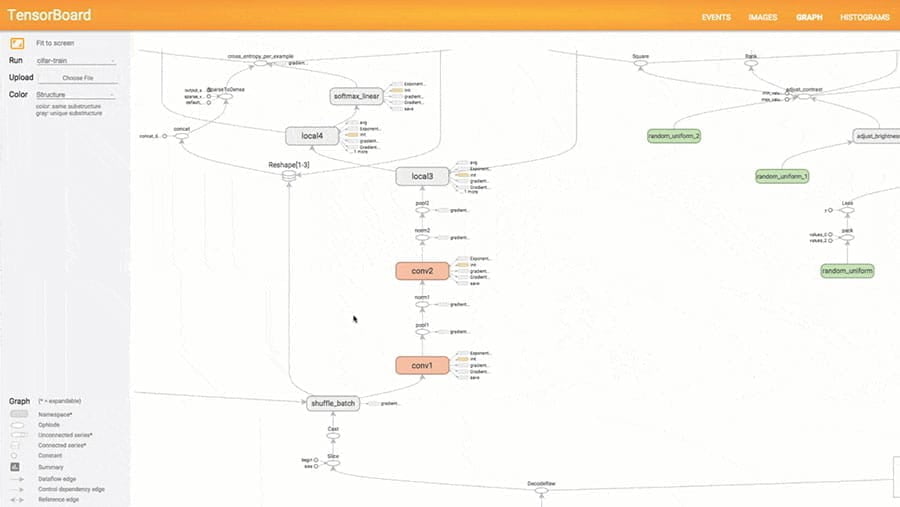
There's a lot of like TensorFlow has a tool that you can use to sort of check things out a little bit.
Crystal CarterGUEST
But it's very techie, like it's very ugly.
Crystal CarterGUEST
Like UX designers have not been there.
Crystal CarterGUEST
Um, but you need to make sure that your entity is clear and that your entity makes sense.
Crystal CarterGUEST
So have, have a look at kinds of entity associations that you have that are, they're related to your brand.
Crystal CarterGUEST
TensorFlow again, as I said, has, has that.
Crystal CarterGUEST
Um, you can also ask the LLM so you can say like game 10 entities associated with this brand.

Adam ReynoldsGUEST
I mean, way back when I had a...
Adam ReynoldsGUEST
I was using PyTorch and TensorFlow.
Adam ReynoldsGUEST
I don't know if anybody here knows that kind of technology.
Adam ReynoldsGUEST
Using PyTorch and TensorFlow, I taught my computer how to play Mario Kart.
Adam ReynoldsGUEST
I trained it on being able to run the Mario Royal Raceway, which is basically an oval track.
Adam ReynoldsGUEST
But that took...

Philip ChristosGUEST
So we see that they run a huge amount of experiments and they're kind of reusing some of the parts of the code and such code could be productized.
Philip ChristosGUEST
I know like TensorFlow became a standalone kind of product, so like
Alexey GrigorevHOST
let's
Philip ChristosGUEST
say open sourced technology.

ArthurGUEST
You know, historically, so Cohere is sort of an interesting company in that one of the co-founders was one of the people who created Attention Is All You Need.
ArthurGUEST
And, you know, there was Faster Transformer as a library that they had that was, you know, a little bit better than just, you know, pip import transformers, right? And then later, TensorFlow TLM, and then later VLLM.
ArthurGUEST
And I've been looking at the page attention implementation as somebody who came from sort of the background of virtualization.
ArthurGUEST
So I've been looking at GPU virtualization and thinking...
ArthurGUEST
They behave slightly differently.
ArthurGUEST
And, you know, from our perspective, the applications there, the attention algorithms themselves, as far as we're concerned, we have like one top or several top level applications.
ArthurGUEST
I, you know, you have SG Lang, TensorFlow, TLLM, LMCache, VLLM.
ArthurGUEST
And from the point of view of what user model is being loaded, that's really what we're optimizing for.

GmoneyHOST
I've been like-
Hunter OrrellHOST
But I think that's the, the trend you'll see, and this is just from like my, my early years in AI when we were doing, you know, like, uh, TensorFlow, like CNN models.
Hunter OrrellHOST
Um, you will see the low-end cost continue to like go down more and more.
Hunter OrrellHOST
But to the person who's like, "Hey, I have the most complex task, the heaviest lift, I don't care what it costs, I just need it done the best, and I'm comp--" Like that's where the edge is.

David AronchickGUEST
And they started releasing these as public papers.
David AronchickGUEST
So go back and look at TFX from Google about, uh, using TensorFlow, a way to string together all the steps of a machine learning pipeline.
David AronchickGUEST
You wanna shape your data, you wanna control it, you want to, um, normalize it, you wanna split it into training and inferent or training and test hold back.
David AronchickGUEST
You wanna tune your hyper parameters, et cetera, et cetera.
David AronchickGUEST
But I still felt there was a self-hosted thing.
David AronchickGUEST
I talked to a bunch of customers, and they're like, "Yeah, we actually have some self-hosted problems.
David AronchickGUEST
We would love this." And so I ended up finding, uh, Jeremy Louis, who's now at OpenAI, who had created a what's called a CRD, that's a custom resource definition for Kubernetes, that allowed you to spin up a small TensorFlow component.
David AronchickGUEST
And I was like, "Oh, what would this look like if we expanded this a little bit?" Where it wasn't just that one component, I think it was just training.

Sean FalconerHOST
He's probably one of the most famous and world-renowned engineers in the world.
Sean FalconerHOST
You could probably make a fair argument that Google might not exist, [chuckles] at least in the form that it is today, if Jeff Dean hadn't been there with all the contributions he made to, you know, MapReduce, Bigtable, Spanner, TensorFlow, Google Brain.
Sean FalconerHOST
Like, he's just this godlike figure.
Sean FalconerHOST
The fun Jeff Dean facts and, that are like these like Chet Norris the- memes and stuff like that, that I remember it was like, uh, only Jeff Ne- Dean knows the final number of pi and-

Chris CoyierHOST
i the point is the part that we're always i'm bad at anyway is why how did you make it why was it unsafe before and is safe now and i'm sure that that's the answer that you just need to read this thing but now it's the end of the show and i'm tired yeah i'm not gonna read yeah
Dave RupertHOST
i'm not gonna read this whole thing but What I wonder, because there's models out there, not large language models, right? Like TensorFlow models, like image recognition.
Dave RupertHOST
3D models.
Dave RupertHOST
Hot dog, not hot dog.
Thomas MachlerGUEST
But...
Thomas MachlerGUEST
We work a lot with GDAL and Python and TensorFlow and all these kind of things.
Thomas MachlerGUEST
We write libraries that have to work in all sorts of different nodes and different environments and so on.
Thomas MachlerGUEST
Have you ever tried to test your project against multiple GDI versions and then maybe put in some TensorFlow and some GPU support and not have gotten frustrated? If you actually managed to do this smoothly, just let me know.
Thomas MachlerGUEST
You don't need this talk.
Thomas MachlerGUEST
Who
16 MINS LATER
Thomas MachlerGUEST
And we had additional system dependencies, particularly around GPU use.
Thomas MachlerGUEST
So getting this all to work both in my local environment and in my Docker image was a pain.

Robert PittsGUEST
Data producers are increasingly moving their ETL pipelines and repositories to the cloud where new cloud native data formats and structures and data lakes and cubes and all these different forms offer really efficient data storage and retrieval options.
Robert PittsGUEST
And open source and AI and data science platforms like Spark and TensorFlow and Kafka and many, many others are available to support almost infinite scaling today.
Robert PittsGUEST
And also where deploying APIs and web-based data delivery services and spinning up websites can be done in minutes and seconds.
Robert PittsGUEST
All things which traditionally have been challenges for the open geospatial community when leveraging legacy stacks and systems architecture patterns.
27 more episodes mention TensorFlow.
Create an account to see the whole feed, search across every transcript, and follow the entities you care about.