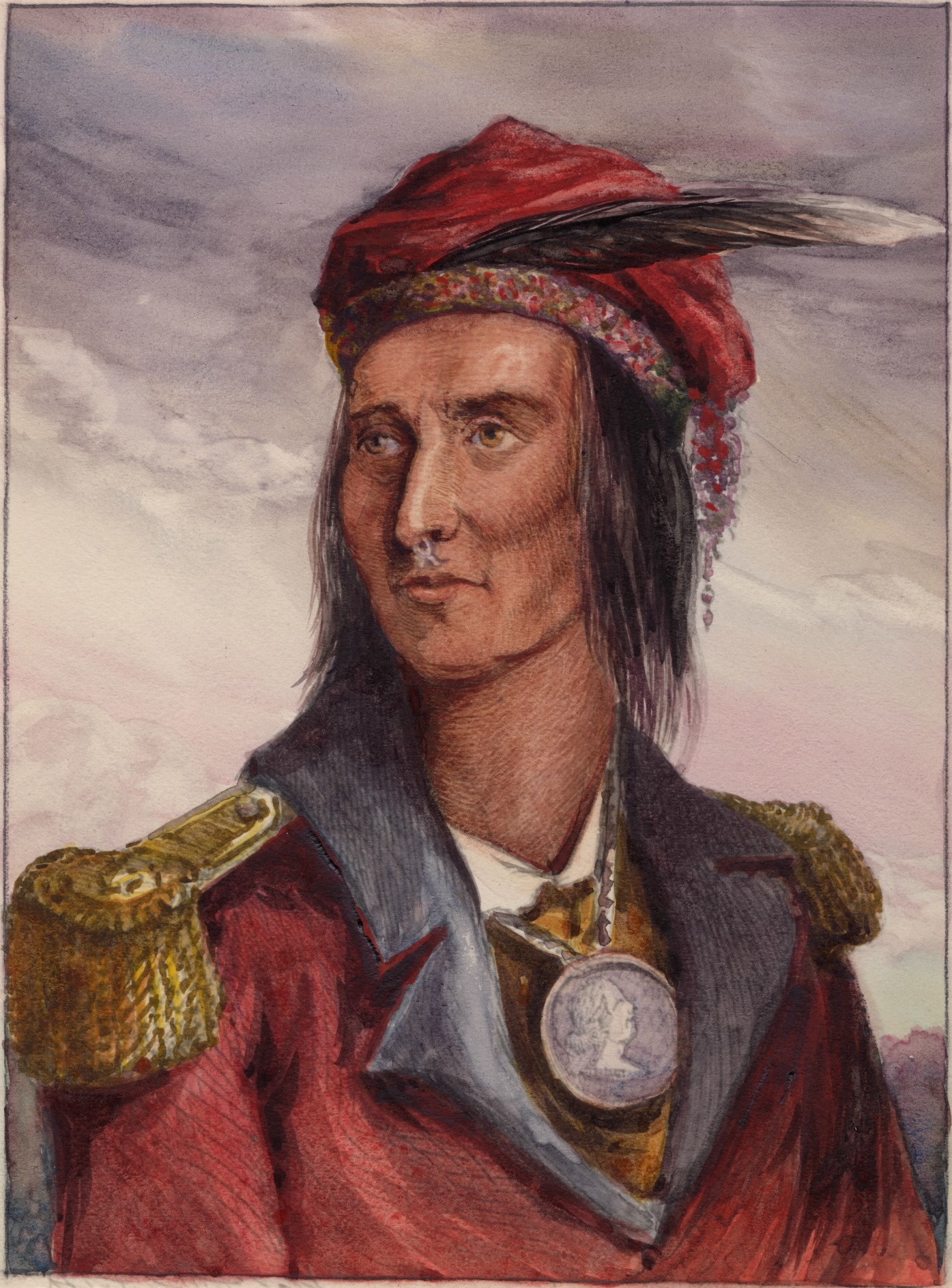
Tecumseh
Chief and warriorWikipedia
63
MENTIONS
20
EPISODES
19
PODCASTS
Search complete. 63 mentions across 20 episodes found for "Tecumseh".
Nov 22, 2026

Bill FinchHOST
They lived in a village, a big village called Wetumpka, sometimes called the Hickory Round.
Bill FinchHOST
And about 1810 or 1811, Tecumseh came down.
Bill FinchHOST
Tecumseh, some of you may know the story of Tecumseh, who tried to unite the nations.
Bill FinchHOST
His family was from Tuscaloosa.
Bill FinchHOST
They had been living in Tuscaloosa.
Bill FinchHOST
They probably had Alabama, maybe Coasati blood as well.
Bill FinchHOST
And they were trying to reunite all the tribes across North America.
Bill FinchHOST
And Tecumseh was defeated, but two people, two very important people, Weatherford and Josiah Francis, said, we're going to recreate what it is to be Indian, what it is to be Koasati, what it is to be Alabama.

Verónica DíazCORRESPONDENT
[aplausos]
Alejandro DolinaHOST
Hablaremos esta noche sobre Andrew Jackson y el éxodo de los indios norteamericanos.
Alejandro DolinaHOST
La vida de Andrew Jackson, a los efectos de contar una historia, puede separarse en dos partes, o quizá en cuatro o dieciséis.
GillespieHOST
Sí.
Alejandro DolinaHOST
En, en este caso, el caprichoso cronista dice: la primera, de la lucha contra los ingleses y contra los indios, y luego la etapa política en la que se encumbró como presidente de los Estados Unidos en 1829.
Alejandro DolinaHOST
A ver, esperá.
Alejandro DolinaHOST
Washington, Adams, Jefferson, Madison, Monroe...
Alejandro DolinaHOST
Eh, no, viene el otro Adams, el hijo de, del primer Adams, y después viene Jackson, quiero decir que es el séptimo.

KelsPANELIST
Let's start with Kels.
KelsPANELIST
Tecumseh.
KelsPANELIST
Why?
NeilHOST
Tecumseh.
NeilHOST
Endeavor.
KelsPANELIST
Tecumseh.
NeilHOST
It is Tecumseh.
NeilHOST
You look perfect so far.

Alexander MikaberidzeGUEST
element of it, and that is what might have happened if Spain or France, and especially I'm focusing on France, could have rallied the native nations more effectively to contain the American expansion.
Alexander MikaberidzeGUEST
And I think a possible scenario of it would be something like Tecumseh during the war of 1812, rallying the native nations to confront the Americans.
Alexander MikaberidzeGUEST
with the support of the British.
Alexander MikaberidzeGUEST
Well, what might have happened if France actually established its presence in south of Louisiana, and as Napoleon intended, at least until 1803, to use the native nations as a way of establishing a broader French presence in North America?

George BagbyGUEST
He prevails against a fleet of superior numbers and strength at Put-in-Bay off of Ohio, and he wins.
George BagbyGUEST
Uh, he famously sends the message to William Henry Harrison, "We have met the enemy, and they are ours." He actually captures the British fleet on Lake Erie, and this facilitates, uh, a limited invasion of Ontario and the death of Tecumseh.
George BagbyGUEST
But the militia is not the backbone of our national security here, uh, contrary to the, the idealism of the Republicans.
George BagbyGUEST
The Federalists say we should have made some investment in national defense.
12 MINS LATER
George BagbyGUEST
Um, that is a very interesting biography.
George BagbyGUEST
It mu- has much to do with Jackson in Alabama.
George BagbyGUEST
Um, I also have another, uh, great title that I, I was referencing material from this evening, Tecumseh and the Quest...
George BagbyGUEST
No, no, let's see.

Roxanne Dunbar-OrtizGUEST
now, it seems, of that prophecy, you might say, or that intention.
Roxanne Dunbar-OrtizGUEST
but they did repeat themselves the same general that, um, the major war after the, um, uh, war of independence was the war against the, um, the Shawnee, uh, Tecumseh is, you know, the representative of that war in the North, in the Northwest territory being Ohio, uh, the Ohio region.
Roxanne Dunbar-OrtizGUEST
And, um, So this was, you know, making
Roxanne Dunbar-OrtizGUEST
battle ready.
Roxanne Dunbar-OrtizGUEST
And then Andrew Jackson in the South against the Creeks, you know, the Creeks, and then all of a sudden.
Roxanne Dunbar-OrtizGUEST
Then he became president and then deported all of the Native people from the Southeast to clear the way for the Cotton Kingdom.
Roxanne Dunbar-OrtizGUEST
But then the wars against the Seminole nation in the Everglades, they had taken after the Shawnee wars and all, which they had, Tecumseh had gone and created this great confederation of all of the native nations.
Roxanne Dunbar-OrtizGUEST
Once that was defeated in the north, they retreated.

Bruce CarlsonHOST
While others were fighting, he was in the background.
Bruce CarlsonHOST
Someone else killed Tecumseh at the Battle of Tippecanoe, but he's calling himself Old Tippecanoe because, sure, he was in the back leading the army.
Bruce CarlsonHOST
Things like this were very common.
Bruce CarlsonHOST
And everybody's cheering, and they've really got Harrison now.

Andy HuntGUEST
So dating back to like 1840, 1840, 1860, 1880, 1900, every president every 20 years died while in office.
Andy HuntGUEST
And supposedly the reason for that or one of the explanations is this thing called the curse of Tecumseh.
Andy HuntGUEST
which there was this Indian chief named Tecumseh.
Andy HuntGUEST
The U.S. Army basically slaughtered his entire tribe and took over the land.
Andy HuntGUEST
And supposedly, at least, he said that there will be a curse placed on the United States where any president elected in a year ending in zero will die in office.
Mystic MarkHOST
So I'm sure there's more than one book with that title.
Mystic MarkHOST
But yeah, that is interesting.
Mystic MarkHOST
The Battle of Tippecanoe was where the Tecumseh curse was placed.

Dave FarinaHOST
Harrison gained national fame for leading US forces against American Indians at the Battle of Tippecanoe in 1811, where he earned the nickname Tippecanoe.
Dave FarinaHOST
As a general in the War of 1812, his most notable action was the Battle of the Thames, resulting in the death of Indian chief Tecumseh, which caused his Indian coalition to collapse.
Dave FarinaHOST
After the war, he was elected to the House of Representatives, and in 1824 the state legislature elected him to the Senate.
Dave FarinaHOST
He was appointed minister plenipotentiary to Colombia in May 1828, where he urged President Simón Bolívar to adopt American-style democracy.
10 more episodes mention Tecumseh.
Create an account to see the whole feed, search across every transcript, and follow the entities you care about.