Technical debt

Technical debt

Search complete. 80 mentions across 9 episodes found for "Technical debt".

Sep 10, 2026

Bill PrattMODERATOR
14:48
Well, Dana, can we go back to the lab? Many mission systems supporting national laboratory research have been in place for decades, and they remain tightly integrated with ongoing programs.
Bill PrattMODERATOR
15:00
What practical strategies are working for extracting technical debt from that scenario while maintaining continuity for active research and operational missions?
Dana GrishamGUEST
15:11
Yeah, I think for us, you know, tight integration with mission and ongoing programs is important.
Dana GrishamGUEST
15:17
just hands down part of our core values.
Dana GrishamGUEST
15:21
And in my mind, we cannot and really probably should not take on extracting technical debt from our operational missions as our top priority.
Dana GrishamGUEST
15:32
The focus for us has to be on building the future capacity and all of that mentioned value as part of that capacity.
Dana GrishamGUEST
15:39
We'll leverage the core capabilities that currently make our institution so unique.
Dana GrishamGUEST
16:32
So this is the reason for like a national investment.
Francis CardenGUEST
18:27
that humans have to understand to make sure it's safe and secure, test, maintain, and remediate.
Francis CardenGUEST
18:32
All we've done is we're using AI to create tomorrow's technical debt faster.
Francis CardenGUEST
18:38
I advocate there shouldn't be any technical debt in the future if you use models on what you build software.
Francis CardenGUEST
18:44
That's
Rob KoplowitzHOST
18:45
my view.
Alan RencherHOST
18:19
I had a phone call just earlier today with a, a group here in the Western US that Is it about 30-ish sites and they're in process to get to between s- you know, 70 or 80, and they're actually requiring standardization for, uh, as, as a condition of the, the acquisition.
Alan RencherHOST
18:37
And the properties they're talking about acquiring are a little bit distressed and, and interestingly in the past, as you know, you know, changing PMS and changing is, you know, that part of your platform to fix that tech debt you're talking about is change management and it's, there's a lot of pushback and it's tough and people don't like it.
Alan RencherHOST
18:57
In this case, the indu- the customer I was speaking to basically said they realize this has to happen.
Alan RencherHOST
19:02
They, they were saying, "Sign us up, we're ready to do it." Like they- they're seeing the exact same problem that you just described.
Alan RencherHOST
22:33
They have their data in order.
Alan RencherHOST
22:34
And almost all of them have consolidated on a tech stack.
Alan RencherHOST
22:38
They don't have that tech debt that you just, you just talked about.
Alan RencherHOST
22:41
And so there's, there's several areas where we could talk about that.
Nick TrumanHOST
10:10
Enjoy.
Alan DowellGUEST
10:11
we were carrying tech debt, a crazy amount of tech that we couldn't get out of it.
Alan DowellGUEST
10:15
Everyone- I love that you
Nick TrumanHOST
10:16
call it that as well.
Nick TrumanHOST
10:16
Tech debt is such a good way of describing it, yeah.
Alan DowellGUEST
10:18
Everyone for the last like 10 years up to that point had heard, that's a great idea, but we can't do it.
Alan DowellGUEST
10:25
That's a great idea, we can't do it.
Philipp HügleHOST
0:29
Das sagt Thomas Elsner, Partner bei McKinsey und Experte für große IT-Transformation.
Philipp HügleHOST
0:34
Thomas beschäftigt sich seit Jahren mit, mit einem Thema, das viele CEOs seit nachts wach hält: IT-Kosten oder neudeutsch Tech Debt.
Philipp HügleHOST
0:41
Und ich bin Philipp Hügle, Host dieses Podcasts.
Philipp HügleHOST
0:43
20 % der Unternehmen haben in den letzten sechs Monaten ihr KI-Budget überschritten.
Thomas ElsnerGUEST
2:35
Das heißt, du musst bezahlen, je nachdem, wie viel du nutzt.
Thomas ElsnerGUEST
2:38
Ähm, und das verschiebt dann natürlich die, die, den Kostenpunkt auch noch mal, auch noch mal dramatisch.
Philipp HügleHOST
2:44
Kann man denn sagen, dass, also ich mein, dein Thema der letzten Jahre oder eines deiner großen Themen der letzten Jahre, ähm, du hast viele Unternehmen dabei begleitet, Tech Debt, sagen wir mal, aufzulösen, zumindest zu verkleinern.
Philipp HügleHOST
2:55
Also sprich, IT-Kosten, die irgendwie aus Legacy IT, ähm, herrühren.
Jason LishGUEST
12:41
And then, you know, Justin, as you know, there's startups and others that are really bringing hope to that space as well.
Justin SomainiHOST
12:49
You know, it's interesting to bring up the, let's call it the legacy or the tech debt problem, for lack of a better word.
Justin SomainiHOST
12:56
How do we, you know, fix the mainframe, the deck of axes of the world? Those are the safest.
Justin SomainiHOST
13:02
I mean, they are.
Justin SomainiHOST
13:13
Yeah, to get one under for research is quite expensive.
Justin SomainiHOST
13:18
You know, but you had your whole, you know, identity authentication authorization layer in one environment, making it massively easy to secure or easier.
Justin SomainiHOST
13:29
But, you know, I'm sure there's a chock full of issues, you know, but this tech debt problem.
Justin SomainiHOST
13:35
And Ian, I mean, Cisco's been around a bit longer than Salesforce, but I assume that tech debt challenges still alive and well in your environment.
Brad Hefta-GaubHOST
42:02
Yeah.
Scott PoradHOST
42:03
Well, it scratches a different question, which is somewhere back in, I don't know, whenever TaskRabbit started 15, 18 years ago, someone created some tech debt.
Scott PoradHOST
42:12
They said, you know what, let's just put this in a YAML file.
Scott PoradHOST
42:15
And here we are 15 years later paying back that loan.
Brad Hefta-GaubHOST
42:42
Okay.
Brad Hefta-GaubHOST
42:44
I think it's super funny.
Brad Hefta-GaubHOST
42:45
I see this with my AI agents all the time, where they will trade off tech debt intentionally.
Brad Hefta-GaubHOST
42:54
They'll say in their discussion, I got these agents and they're doing code reviews of each other's code.
Johna Till JohnsonHOST
0:14
On today's show, we are going to talk about the challenges of making strategies as the environment gets infinitely more complex, particularly with the addition of AI.
Johna Till JohnsonHOST
0:25
And in particular, we'll be talking about strategies that acknowledge the presence and continued growth of technical debt.
Johna Till JohnsonHOST
0:34
And, John, before we jump into this, let's talk for a second about technical debt.
Johna Till JohnsonHOST
0:39
What is it? How what's its relationship to complexity, et cetera?
John BurkeHOST
0:44
Sure, sure.
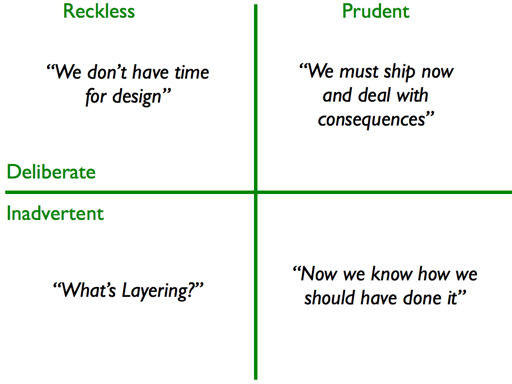
John BurkeHOST
0:45
And I think most people have this intuitive grasp of technical debt as that long list of things I never get to.
John BurkeHOST
0:53
And that's a very simplistic way of thinking about it.
John BurkeHOST
0:56
But it's more than that conceptually.
Paolo SironiHOST
21:39
So before we go to the break, my little take, my little two cents.
Paolo SironiHOST
21:43
The real problem that we are facing is the fact that technical debt that every institution wants to resolve is not about a certain infrastructure or a certain way of coding, which of course can be modernized.
Paolo SironiHOST
21:59
But it's about the fact that the monolithic code contains a lot of business logic that lost causality because people went from 10 lines, 400 lines, 1,000, 10,000, 10 billion lines, rest of code.
Paolo SironiHOST
22:12
So the people that did the coding are leaving or they're not even capable of understanding it anymore.
Paolo SironiHOST
22:25
And so now with agentic AI and with AI, you can extract that business logic, abstract it right in a way that it can own it.
Paolo SironiHOST
22:31
And then we can reposition it somewhere else where more automation agentic AI can power it up.
Paolo SironiHOST
22:36
Of course, as I think Paul mentioned before, making sure that you don't create a new technical debt because you need to have the competencies to manage those environments.
Paolo SironiHOST
22:45
But the point is that why did they lose causality? Because the business, they don't have any causality any longer.

We value your privacy

We use cookies to understand how you use our platform and to improve your experience. Click “Accept All” to consent, or “Decline non-essential” to opt out of non-essential cookies. Read our Privacy Policy.