Tax Reform Act of 1986
7
MENTIONS
7
EPISODES
7
PODCASTS
Search complete. 7 mentions across 7 episodes found for "Tax Reform Act of 1986".
Sep 15, 2026

Andrew KeenHOST
He's written a, a number of books on capitalism and the market.
Andrew KeenHOST
As a progressive, although I'm not sure he's anti-capitalist as such, focuses in his review on the Tax Reform Act of 1986.
Andrew KeenHOST
How central is this, uh, Eric, in the emergence of your everywhere millionaires? And, and does it suggest that the Reform Act of, of 1986 was a success or a failure? Tell us who passed this act and what was the thinking behind it.
Eric ZwickGUEST
The 1986 tax reform, I like to think of the, of the tax code as a house that depreciates over time and needs repairs.

Owen ZidarGUEST
So in 1986 – Well, earlier in the 80s, they also were bringing rates down.
Owen ZidarGUEST
But in 1986, there was the Tax Reform Act of 1986.
Owen ZidarGUEST
And that, for the first time, brought individual rates down enough to where it was lower than the traditional corporate tax rate.
Owen ZidarGUEST
So all of a sudden, you have people who want to own businesses or start new businesses realizing that it's much more attractive to do this pass-through form rather than a traditional corporation because...

MaxHOST
Cut taxes on the rich and on corporations, and they'll invest that money right back into the economy, creating jobs and wages that will trickle down to everybody else.
MaxHOST
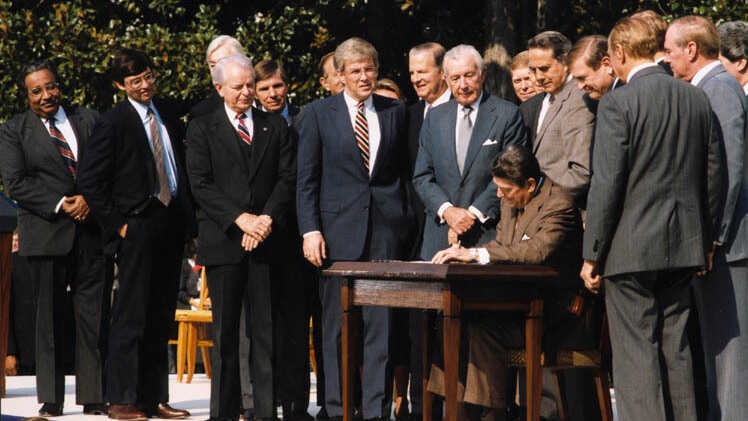
Five years later, Reagan did it again and doubled down by signing the Tax Reform Act of 1986, which then cut the top rate from 50% to 28%, which is the lowest it had been since before the Great Depression.
MaxHOST
And as we know now, nothing trickled down.
MaxHOST
it just poured up in 1980 the top four percent of taxpayers earned just as much as the bottom 39 percent combined by 2019 the top four percent earned as much as the bottom 57 percent the top 10 percent of americans now hold three times the wealth of everyone else in the country combined and crucially the growth that did happen accrued to capital not labor It accrued to stock market and asset ownership, not to paychecks.

Karlton DennisGUEST
self-employed or W-2, you can use the short-term rental strategy.
Karlton DennisGUEST
You know, it's funny because in 1986, when the Tax Reform Act came out and we had all this passive activity loss rules get introduced for the first time, I was studying the tax code, you know, probably in 2016, 2017.
Karlton DennisGUEST
And I was starting to think, you know, how did the IRS view Airbnb and VRBO when passive activity loss rules were rolled out in 1986, not in 1987? Years ago, years ago, when Airbnb and VRBO wasn't introduced until about 2011, 2013.
Karlton DennisGUEST
So right around this time period, I went back into the tax code to read the passive activity loss rules.

Bob PackwoodSOUNDBITE_SPEAKER
Oh, is it going to go down in history this way? Yes.
Bob PackwoodSOUNDBITE_SPEAKER
Would I like to be remembered for the author of the Tax Reform Act? You bet.
Bob PackwoodSOUNDBITE_SPEAKER
Would I like to be remembered for saving Hell's Canyon, that great gorge between Oregon and Idaho? You bet.
Bob PackwoodSOUNDBITE_SPEAKER
But I understand...

speaker_3GUEST
And that's not just a hypothetical.
speaker_3GUEST
In the decades leading up to the Tax Reform Act of 1986, the proliferation of tax shelters was rampant.
speaker_2HOST
I've read about this, like doctors and lawyers buying into weird partnerships.
speaker_3GUEST
Exactly.

speaker_1HOST
What is the distortion in the historical data?
speaker_2HOST
A prime example is the Tax Reform Act of 1986.
speaker_2HOST
Before this act, the top marginal tax rate for individuals was extremely high, much higher than the corporate tax rate.
speaker_1HOST
So what do people do?