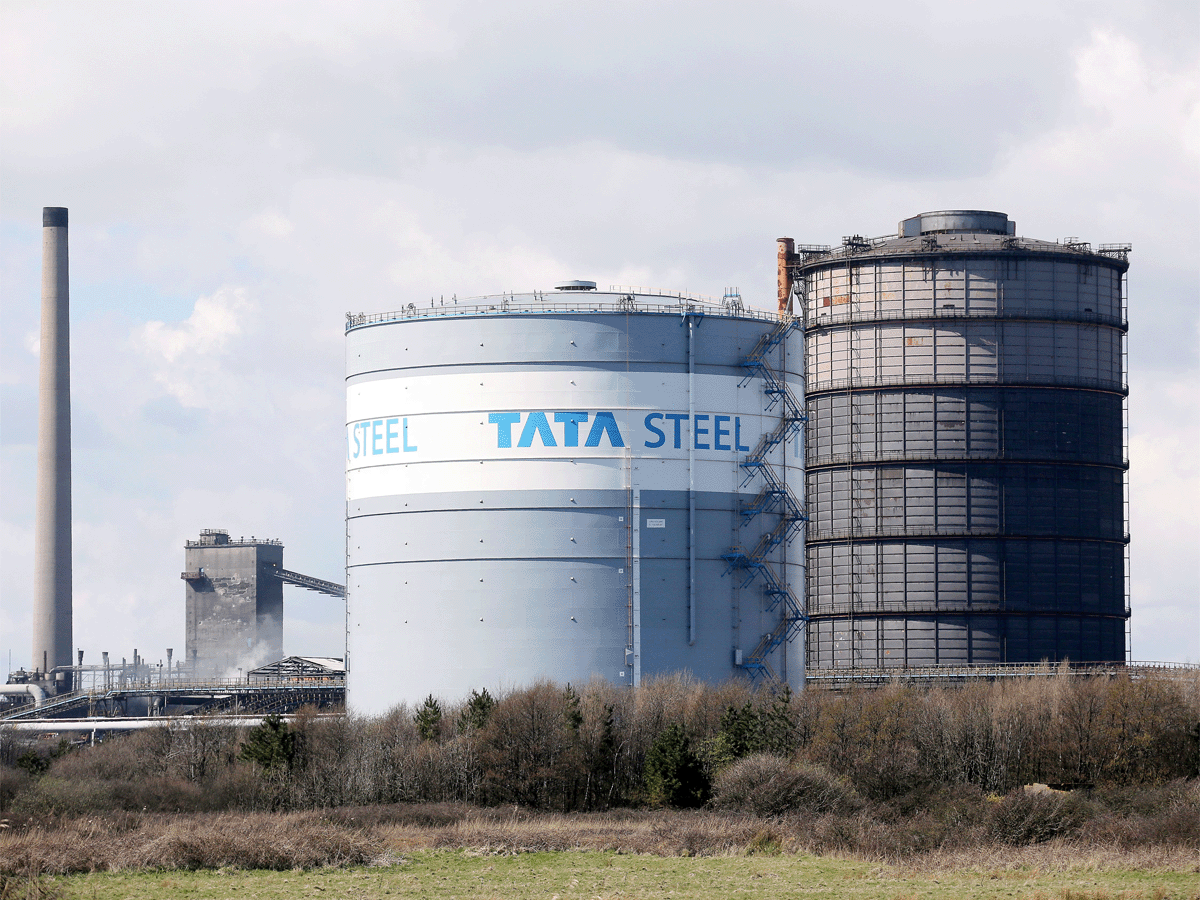
Tata Steel
Steel production companyWikipedia
44
MENTIONS
22
EPISODES
15
PODCASTS
Search complete. 44 mentions across 22 episodes found for "Tata Steel".
Oct 11, 2026
Aswath DamodaranHOST
They're a reflection of these companies' history.
Aswath DamodaranHOST
50 years ago, Tata Motors needed to build a factory and Tata Steel had excess cash.
Aswath DamodaranHOST
You know what the family did.
Aswath DamodaranHOST
They owned both companies.
Aswath DamodaranHOST
They weren't doing this.
Aswath DamodaranHOST
It was an internal capital market.
Aswath DamodaranHOST
But the accounting for it basically meant that Tata Steel now owned a piece of Tata Motors.
Aswath DamodaranHOST
And the older you are as a company, the more you're going to accumulate these crossholdings.
Aswath DamodaranHOST
You think, so what? When I come up with a value per share for Tata Chemicals, I feel a lot more shaky about that value than I do for Tata Consulting Services because so much of the value comes from this brown bag where I can't look inside the bag.
Aswath DamodaranHOST
Now, why do you think Tata Consulting Services is less exposed to that than Tata Motors, Tata Steel, or Tata Chemicals? Probably
speaker_1UNKNOWN
need some history.
speaker_1UNKNOWN
What do you think it is? Did any of these companies, how did these companies get these crossholdings
Aswath DamodaranHOST
So let's say Tata Motors wanted to build a new factory.
Aswath DamodaranHOST
didn't have enough money.
Aswath DamodaranHOST
Tata Steel did well that year.
Aswath DamodaranHOST
Remember, the family owned both companies.

AksharaHOST
CSEP makes a direct comparison of the major cost heads between who they call Japan's largest steel producer and India's most profitable steel firm in FY 25.
AksharaHOST
Both were unnamed, but they're most likely Nippon Steel and Tata Steel respectively.
AksharaHOST
The per ton cost for the Indian firm was found to be lower by approximately 20 to 40%, and this is largely because Indian labor costs are a fraction of Japanese ones.
AksharaHOST
But additionally, the costs of logistics and coking coal have also narrowed over time with Japan.
AksharaHOST
India's steel sector has made real productivity gains since liberalization in the 1990s.
AksharaHOST
So when tariffs on steel were slashed after 1991, the prevailing wisdom was that cheaper foreign steel would overwhelm domestic producers.
AksharaHOST
But firms like Tata Steel responded with cost cutting and modernization measures.
AksharaHOST
By 2001, Tata Steel was ranked the world's number one steel company by World Steel Dynamics.

Aswath DamodaranHOST
Remember, this is part of a family group of companies.
Aswath DamodaranHOST
So I looked at Tata Steel, over-leveled.
Aswath DamodaranHOST
Tata Chemicals, over-leveled.
Aswath DamodaranHOST
And then I looked at Tata Consulting Services, which is their crown jewel.
Aswath DamodaranHOST
And I'm going to make, and I can't prove this, but I'm going to make a statement that I think you need to think about with family groups.
Aswath DamodaranHOST
Which is, in my view, here's what I think is happening.
Aswath DamodaranHOST
Tata Motors, Tata Steel, Tata Chemicals are borrowing, in a sense, against Tata Consulting Services' debt capacity.
Aswath DamodaranHOST
You think, that makes no sense.

Laurent SegalenHOST
Are you going to expand them? Are you going to contract them? What's your view on that?
Marc RühsGUEST
So one good example there is, for example, Tata Steel in the Netherlands, a big steel plant in Europe, very important for the European steel production.
Marc RühsGUEST
But they have a high energy consumption.
Marc RühsGUEST
And of course, when you set up these big industrial complexes, you want to make sure that the energy is available all the time.
Aswath DamodaranHOST
But because of these companies' history, they've accumulated crossholdings in each other.
Aswath DamodaranHOST
So if you look at Tata Motors, you're going to see holdings from Tata Steel and Tata Chemicals and Tata Motors.
Aswath DamodaranHOST
You're saying, so what? The family group can enforce its control, not just through its holdings in Tata Sons, but through the intra-group holdings.
Aswath DamodaranHOST
The second is if you look at the boards of directors of these companies, you will notice there are independent directors that each company has, but there are also family group directors.
17 MINS LATER
Aswath DamodaranHOST
Second, I think the public companies need to be made independent standalone companies that they are on paper right now, but are not in practice.
Aswath DamodaranHOST
That will require that each of these companies sell its cross holdings and other Tata companies.
Aswath DamodaranHOST
Now, so that requires that Tata Motors get rid of its Tata Steel, Tata Chemical and whatever other Tata power holdings that it has and go back to being just Tata Motors.
Aswath DamodaranHOST
And secondly, I think that the board of directors for each company has to have a single mission, which is to protect shareholders in that company.

Paul PetersHOST
Water use is low at an estimate of 0.1% of the national total.
Paul PetersHOST
And that's probably because Tata Steel is using 50% of all the water, I think.
Gordon DarrochHOST
Oh, yes.
Gordon DarrochHOST
Yeah.

Rohan DharmakumarHOST
Jamseti died in 1904.
Rohan DharmakumarHOST
But he also pioneered the Tata steel plant at Jamshedpur, which obviously now we know is named after him, Jamshedpur, and began three years after his death.
Rohan DharmakumarHOST
Here's an interesting bit about Jamshedji.
Rohan DharmakumarHOST
He had traveled to England in 1880.
1 HR 34 MINS LATER
Sitaraman GanesanHOST
But Ratan Tata was not in the best of positions to do so.
Sitaraman GanesanHOST
For one, there were veterans in the group who were pulling their respective companies in different directions.
Sitaraman GanesanHOST
There was Russi Modi of Tata Steel, Darbari Seth of Tata Chemicals, and Ajit Kerkar of Indian Hotels, who were used to running things the way they saw fit.
Sitaraman GanesanHOST
And they were not willing to listen to Ratan Tata.

Huw ThomasCORRESPONDENT
Worth remembering, this is the, the furnace that's being built in Port Talbot, um, to replace the, uh, the traditional blast furnaces which were decommissioned a couple of years ago.
Huw ThomasCORRESPONDENT
Um, when the deal happened between government, um, you know, plowing hundreds of millions of, of pounds into the project alongside Tata Steel, it was said that this electric furnace, which will melt scrap steel, could be up and running by the end of 2027.
Huw ThomasCORRESPONDENT
A lot of people at the time thought that was very optimistic, but that was the, the, the date set by Tata, and, and it was the date that was repeated as being the, uh, the ambition.
Huw ThomasCORRESPONDENT
Um, that did, uh, sort of seep into, um, you know, spring 2028 at some point in discussions last year.
Huw ThomasCORRESPONDENT
Um, but the, the point that Tata Steel is now making is that the delay could be any time up until March 2029, which is, you know, some 18 months after the, the original deadline.
Huw ThomasCORRESPONDENT
And they say that is due to the inability to get a grid connection up and running until then.
Huw ThomasCORRESPONDENT
It is worth flagging that, um, that a-at the time of Tata Steel securing this deal with the government and talking about an electric arc furnace, there were people saying to me, "Well, you know, b- we can't get a grid connection in Bridgend for this thing.
Huw ThomasCORRESPONDENT
How come Tata Steel are so confident they can get this by 2027?" But seemingly assurances were made that this could happen.

KarenNARRATOR
We also need some clarity from the government about why it has an interdict against the firm, and what this means for the status of taxpayer funds already handed over.
KarenNARRATOR
The Lochaber agreement has faced sustained criticism since it was struck in 2016, as part of a back-to-back deal that saw the Scottish Government briefly take ownership of the Daliel and Clydebridge steel plants, buying them from Tata Steel for £1, before immediately selling them on to Mr Gupta's Liberty House for the same price.
KarenNARRATOR
It was negotiated in a matter of days during the pre-election period, with limited parliamentary scrutiny at the time.
KarenNARRATOR
The Scottish Government granted GFG's purchase of the Lochaber aluminium smelter and its associated hydropower stations from Rio Tinto, while GFG committed to buying electricity from the hydro scheme for 25 years.
12 more episodes mention Tata Steel.
Create an account to see the whole feed, search across every transcript, and follow the entities you care about.