Tarim Basin
Endorheic basinWikipedia
30
MENTIONS
13
EPISODES
7
PODCASTS
Search complete. 30 mentions across 13 episodes found for "Tarim Basin".
Oct 21, 2026
Laszlo MontgomeryHOST
Recognizing the drain on the treasury to fund these far-flung protectorates, she began winding them down.
Laszlo MontgomeryHOST
The four garrisons along the Tarim Basin were the first to go.
Laszlo MontgomeryHOST
Relations with the Tibetan Empire at that time were far from cordial.
Laszlo MontgomeryHOST
They'd been going at each other for a decade already, and with the Tang government on its back foot, an expansionist-minded Tibetan army saw an opening for themselves.

Marcus FuriousGUEST
And again, the last Persian Shah is killed at a very similar place to where Darius III was killed all those centuries ago by Bessus.
Marcus FuriousGUEST
And his son eventually takes refuge in China, funnily enough, through the Tarim Basin, he evacuates to China.
Marcus FuriousGUEST
And the Persians are technically allied to China, but China's never in a position to be able to send an army to help the Persians.
Marcus FuriousGUEST
And so at this point, Persia more or less becomes a part of the Islamic world.

Chris StewartHOST
Then we'll watch the Qing do the harder thing, turn a conquest into a country.
Chris StewartHOST
Let's head southwest, to the Tarim Basin.
Chris StewartHOST
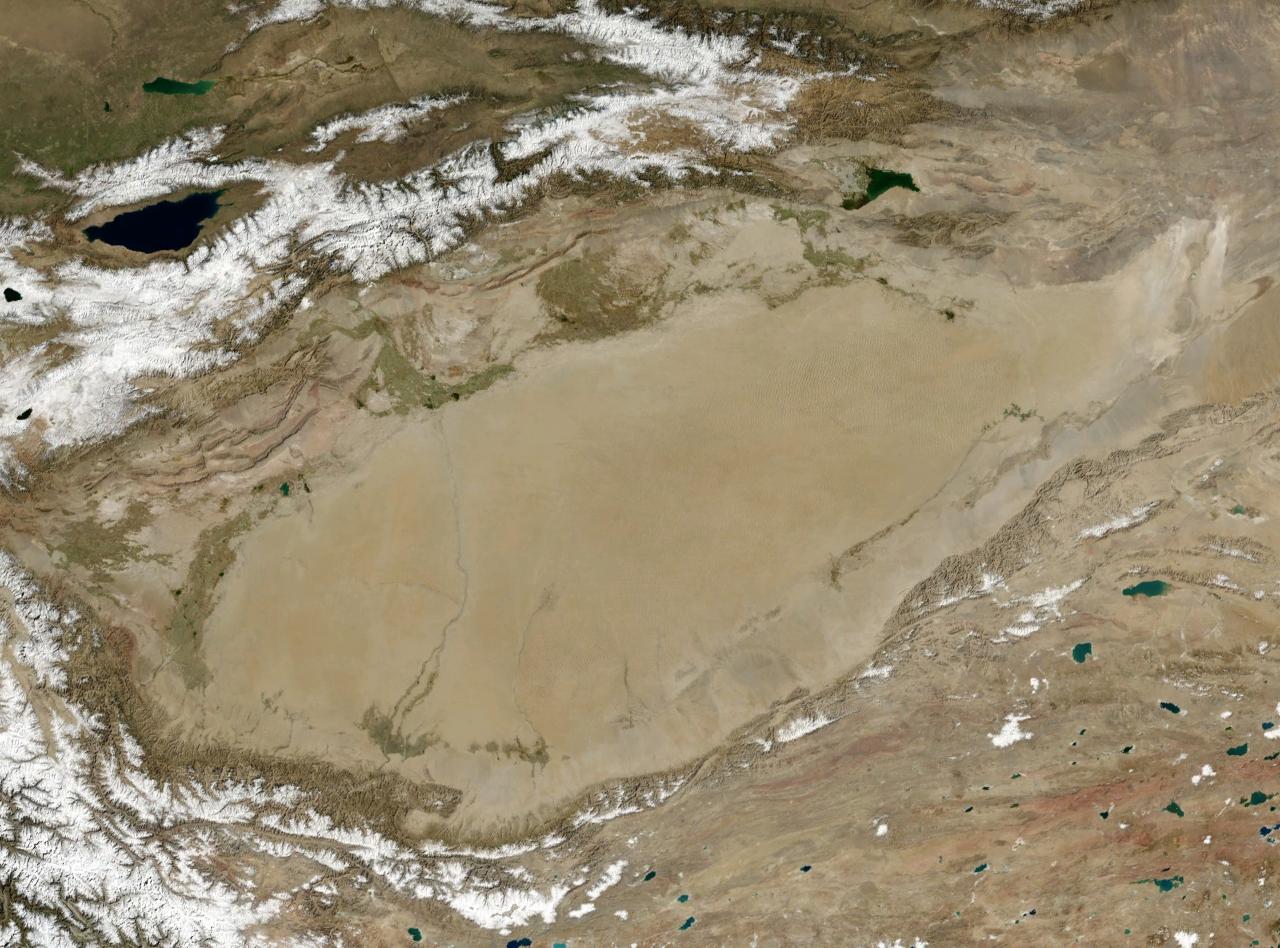
If the Djungar North was grassland and horsemen, the Tarim was virtually its opposite.
Chris StewartHOST
A ring of ancient oasis cities strung around the rim of a killing desert, the Taklamakan.
Chris StewartHOST
The elder, Burhan al-Din, and the younger, Qoja Jahan.
Chris StewartHOST
When the Qing smashed the Dzungars in 1755, they found these brothers in Dzungar custody and did what conquerors do to a useful local asset.
Chris StewartHOST
They released them and installed the elder to govern the Tarim Basin on the Qing's behalf.
Chris StewartHOST
Rule the South for us as our vassal was the arrangement.
Chris StewartHOST
So too is the second part of the formal name not exactly accurate.
Chris StewartHOST
Though the Uyghur peoples have indeed long held sway over the two regions of Xinjiang, Tarim in the south and Jungaria in the north, they are by no means there alone.
Chris StewartHOST
Other than them, and the significantly more recent influx of Han Chinese colonization in modern times, Xinjiang is likewise home to Tajiks, Hui, Kazakhs, Kyrgyz, Tibetans, Russians, Saibs, and, wait for it, the Mongols.
Chris StewartHOST
And it will be against these particular Western Mongols, also known as the Oirat, aka the Dzungars, that the majority of Qing forces will be directed in the century to come.
Chris StewartHOST
The term autonomous is likewise a cynically erroneous turn of phrase.
Chris StewartHOST
Even region is not strictly the case, as we've already seen it's at least two regions, Tarim and Dzungaria, three regions if you also want to separate out the Taklamakan Desert as a third separate region unto itself.
Chris StewartHOST
More correctly, the region consists of hundreds to thousands of microbiomes largely or completely disconnected from one another, except through whatever intercourse the shifting seasons might bring, be that in warfare or tradecraft.
Chris StewartHOST
Let's start by once again painting a picture of the region we're talking about, the Central Eurasian Steppes.
Chris StewartGUEST
He was an affront to the very world order that Kangxi upheld.
Chris StewartGUEST
And so today we will look at the decade when these two figures finally collided, a war that ranged from the Great Bend of the Yellow River all the way out to the sands of the Tarim Basin.
Chris StewartGUEST
Kangxi would later describe this struggle that would fulfill his very life.
Chris StewartGUEST
It is also a story that ends in the utter destruction of the Djungar nation and people, a clash of civilizations that would stretch on ultimately for more than a century and a tragedy across three generations.
Chris StewartHOST
For the Qing court, Inner Asia was a strategic buffer, not a revenue source or zone of active governance.
Chris StewartHOST
By the early 1800s, British India, Nepal, Khokhand, Maktoum-Zada networks in the Tarim Basin, and Russia all pressed against the Qing Empire's frontiers.
Chris StewartHOST
But from Beijing's vantage point, these were still just distant murmurs, barely audible through the haze of its own increasingly frenetic domestic concerns.
Chris StewartHOST
And so, Tibet found itself in a familiar, yet precarious position.
Chris StewartHOST
nor was it only the nobility peeling away.
Chris StewartHOST
Down in the Tarim Basin, the string of Muslim oasis cities the Jungars had held as subject provinces for decades, the region later called Altishar, or the Six Cities, the collapse of the Khanate's center was felt as an opening around its edges.
Chris StewartHOST
In 1754, as the Khanate tore at itself, Kashgar rose against its Jungar masters, and the grip the Jungars had kept on the oases for two generations began to slip.
Chris StewartHOST
Two men out of the region's most powerful religious lineage, the ones history will remember as the Koja Brothers, held for years as hostages up in Ili, are going to walk out of this chaos and into a story of their own a few years down the line.

Laszlo MontgomeryHOST
They ended up in this part of modern-day China around where Lake Qinghai is located.
Laszlo MontgomeryHOST
And they got themselves settled in those lands, and so strategic was their location, they were able to control the critical mountain passes and pasture lands and access through the Hexi Corridor and the Tarim Basin.
Laszlo MontgomeryHOST
They had also inserted themselves in between Tang China and Tibet.
Laszlo MontgomeryHOST
And like the northern Wei had gone and done, the Tuyuhun as well adopted many of the trappings of Chinese rule to govern and design their state.
7 MINS LATER
Laszlo MontgomeryHOST
Starting in six forty, the Tang armies began their takeover of Xinjiang.
Laszlo MontgomeryHOST
It didn't happen all at once, and once they had it, they didn't hold on to it for too long.
Laszlo MontgomeryHOST
Gaochang, now renamed Xizhou, became an important base of operations to carry out military campaigns south of the Tianshan mountain range in the all-important and strategic Tarim Basin, and Gaochang was taken in six forty.
Laszlo MontgomeryHOST
After Gaochang was taken in six forty, the armies of Ashina She'ar started to go after those parts of Xinjiang that hadn't submitted to Tang China.
Laszlo MontgomeryHOST
Before we move on to Li Yuan, Li Shimin, and the Tang Dynasty that they co-founded, let's look at the Sui and Western part of their empire.
Laszlo MontgomeryHOST
Like the Han Empire, the geography of the Sui also had that narrow panhandle shape extending west through the Hexi Corridor all the way into the eastern portion of the Tarim Basin.
Laszlo MontgomeryHOST
I didn't mention this last time, but Sui Wen Di and Yang Di both invested in re-fortifying the Great Wall, even though its effectiveness wasn't any better than the Maginot Line of some 1,400 years later.
Laszlo MontgomeryHOST
Both emperors committed a lot of funding and rounded up enough laborers using all the means at their disposal.

speaker_9NARRATOR
Others have looked toward the Altai.
speaker_9NARRATOR
Some have proposed that Shambhala was a memory of a particular Central Asian Buddhist polity, maybe a kingdom in the Tarim Basin, or a now-vanished state north of Kashmir that later became idealised.
speaker_9NARRATOR
On the other side are more cosmological mappings.
speaker_9NARRATOR
These treat Shambhala less as a specific valley and more as a node in a larger sacred landscape.
15 MINS LATER
speaker_9NARRATOR
By the time that caravan had crossed one high pass, stopped in a monastery guest house, and shared a meal with another group coming the opposite way, it would also be carrying rumours.
speaker_9NARRATOR
A famine in a distant province, a miracle-working teacher at a new temple, a war brewing somewhere beyond the next range.
speaker_9NARRATOR
By the time those stories reached a shrine in the Tarim Basin or a town on the Amu Darya, they had grown details.
speaker_9NARRATOR
Names attached to nameless kings, landscapes fleshed out, motives and morals added, often unconsciously, to fit the expectations of the listeners.
3 more episodes mention Tarim Basin.
Create an account to see the whole feed, search across every transcript, and follow the entities you care about.