Tariff-rate quota
29
MENTIONS
19
EPISODES
16
PODCASTS
Search complete. 29 mentions across 19 episodes found for "Tariff-rate quota".
Sep 13, 2026

Michael DykesGUEST
So we negotiated, Lighthizer and STR negotiated the USMCA, but we've never really received the market access that was supposed to happen under the USMCA.
Michael DykesGUEST
They have done things with the tariff rate quotas, the TRQ administration, that's basically prohibited us from getting in consumer goods to the Canadian consumer.
Michael DykesGUEST
Most of our exports to Canada are export, they process it further in Canada and then re-export it, a lot of times back to the US.
Michael DykesGUEST
So that's why Canada is our number two market, not because we're sending finished goods there and putting them on shelves for consumers to purchase, The other issue we had there is since they balance your milk supply for fluid milk and cream, they have significant amount of solid nonfat protein coming out the back of that system.
Michael DykesGUEST
So we have two issues.
Michael DykesGUEST
If we step back from that and think about it in broad strokes, Jeff, we have two issues.
Michael DykesGUEST
We have a TRQ administration issue that prohibits us from the market access to consumer goods that we want to get into Canada, that we're supposed to get into Canada.
Michael DykesGUEST
And we have an issue with their protein pricing cross-subsidization inside Canada, the way they price their proteins.

Joe OltmannHOST
All right.
Joe OltmannHOST
So you know what TRQs are, right? no so trqs are the things that we have they're quantitative quotas that allow for like sugar to come over only in certain amounts that there's a quota for importation right
Vince LanciGUEST
right
Joe OltmannHOST
and those trqs are controlled by ofac and and they have different standards they have for different countries so sugar comes out of like four main places ones like canada sugar out of sedan a basically a cutout like you're in normandy It's a cutout, right? So it's sovereign to everything else around it, including sanctions.

Shad SullivanSOUNDBITE_SPEAKER
And I was like, all right, everybody, shut up about the wolves.
Shad SullivanSOUNDBITE_SPEAKER
I want to talk about these TRQs and this beef coming in.
Theodore RossHOST
But I didn't get to it.
Theodore RossHOST
And that's okay.
Theodore RossHOST
Yeah, I know that podcast.
Theodore RossHOST
Yeah, it's Shad Sullivan.
Theodore RossHOST
He is one of these very angry small C, or in this case, maybe big C conservatives who went to the White House last Friday to talk to President Trump about these TRQs.
Theodore RossHOST
That means tariff rate quote.

Jacob VillagomezGUEST
So we are asking for relief from USTR, the United States Trade Representative.
Jacob VillagomezGUEST
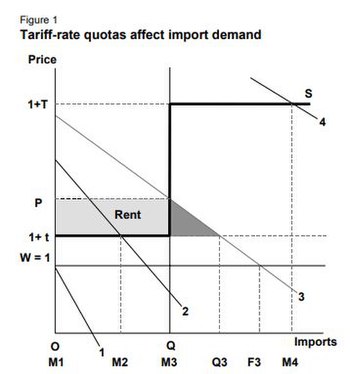
We're asking them to enforce the situation with a TRQ, which is a tariff ratio quota system.
Jacob VillagomezGUEST
This would really be helpful for growers because this mechanism would would dictate how much volume you can bring in.
Jacob VillagomezGUEST
And should you exceed that volume, this would be the applied tariff rate for anything that goes, anything that surpasses the quota that's been stated in this rule.
Jacob VillagomezGUEST
So we are hoping for some sort of relief here with respect to Argentina and hope that it's a TRQ system.
Nick PapagniHOST
Makes great sense right there.
Nick PapagniHOST
This is how you can be competitive in the rest of the world.

ArtHOST
Canada does not pay U.S. farmers directly for milk in the way they buy or sell for goods.
ArtHOST
Instead, U.S. dairy exports to Canada are governed by tariff rate quotas, or TRQs, under the U.S.-Mexico-Canada agreement, the USMCA, which sets limits on how much milk can be imported duty-free each year.
ArtHOST
All right, so how does the system work? They have a quota, like for milk, okay? They have a quota.
ArtHOST
U.S. milk can enter Canada at low to zero tariffs.

Al MusselGUEST
Um, you know, ba-based on the work that I do, I, I think this would be costly for the Canadian, uh, dairy industry, you know, from, from a couple of different perspectives.
Al MusselGUEST
You know, fi-first of all, the, the TRQs for dairy products that are in demand in Canada, which are cheese, butter, cream, et cetera, they're already filled.
Al MusselGUEST
So when they're already filled, well, you know, who, who, you know, why, why care about the TRQ administration? I think the reason to care is that the, the US interest is to export to Canada as high a valued product as possible, and I think they thought that if they could get more influence over that by allocation to retailers, that that would, that would benefit, uh, them.
Al MusselGUEST
Well, if you, if you have, um, more of the, again, the, the volume can't change, it's filled, but if it's oriented more towards premium products, presumably that, that presents a prospect that some of the Canadian premium dairy products will be chased out of that space, which is a loss to Canadian, um, uh, dairy processors.
Tyler McCannHOST
But it was because they weren't able to resolve these issues through the dispute settlement mechanism that they were looking for these other changes at, at the end of the day, right?
Al MusselGUEST
Well, one, one of the concerns that, uh, that, that I think comes up here is w- specifically with the Section Three Thirty-Eight tariffs.
Al MusselGUEST
You know, the, the, the president said, "Well, you know, look, you're gonna, you know, basically you're gonna allocate the TRQs to our satisfaction or else." You know, but, but, but wait a minute.
Al MusselGUEST
You know, the dispute resolution mechanism within the CUSMA agreement, which was, you know, as I think everybody knows, that was negotiated under the first Trump administration, at the time was the, the best trade, uh, trade deal ever negotiated.

Sean HaneyGUEST
I think, you know, throughout the history of this back and forth trade negotiation and what's going to happen with the future of the USMCA, I think agriculture is really trying to stay out of the prop wash of some of the other industries that are really the targets.
Sean HaneyGUEST
Of course, there is challenges and the US dairy industry, for example, does have, you know, they have longtime grievances in terms of how Canada is does administer those TRQs that were negotiated under the original USMCA agreement.
Sean HaneyGUEST
But in the context, that is nowhere near some of the pain.
Sean HaneyGUEST
And I guess the reality of the talks when it comes to steel and aluminum autos and lumber, which have taken up a lot of the oxygen in the room.

Brian EngelmanHOST
It's always a tell when AI is gonna start answering you a question that you didn't ask.
Brian EngelmanHOST
Grok AI is telling us, well, the main suppliers that typically fill these TRQs and could move more or much, move that much lean trim This is spelled out really weird.
Brian EngelmanHOST
Lean trim quickly.
Brian EngelmanHOST
Brazil, Australia, New Zealand, or Uruguay.

Shawna MorrisGUEST
We also have a key priority that's not the focus of current discussions, but also relates to USMCA follow through, and that's Canada's increasing use of loopholes to keep ratcheting out ever-increasing amounts of low-priced Canadian dairy protein products into the US and other markets.
Shawna MorrisGUEST
For right now, though, the current talks have been very much focused on those TRQ issues, given the authority the administration called upon in order to levy the tariffs that we have now in place.
Jesse AllenHOST
And as I understand it, this has been an issue really since the onset of USMCA and maybe even more so back to the original NAFTA agreement and things of that nature.
Jesse AllenHOST
This is not something that just happened overnight when it comes to dairy relations between the two countries, right, Shawna?
Shawna MorrisGUEST
That's their own internal domestic policy decisions.
Shawna MorrisGUEST
What we're focused on is that clearly you can see from the fill rate drops here.
Shawna MorrisGUEST
So for instance, since the agreement was implemented, if we take a look at yogurt through the end of last year, we've only seen 20% of that cumulative TRQ filled in terms of the quantities.
Shawna MorrisGUEST
Ice cream's been less than half over that period.
9 more episodes mention Tariff-rate quota.
Create an account to see the whole feed, search across every transcript, and follow the entities you care about.