TAR DNA-binding protein 43
ProteinWikipedia
30
MENTIONS
10
EPISODES
10
PODCASTS
Search complete. 30 mentions across 10 episodes found for "TAR DNA-binding protein 43".
Oct 28, 2026

Steve GardnerHOST
wanted to come back to that because the time at which, at the moment, you get to intervene is a very late stage in the disease process.
Steve GardnerHOST
And it may well be that some of the trigger events have happened and gone by that stage if, for example, TDP-43 mislocalization was one of the initiating factors.
Steve GardnerHOST
We'd all love to have a drug that impacted on TDP-43 misfolding and its subsequent biology.
Steve GardnerHOST
But the chance of diagnosing somebody at that point in the disease is actually relatively low at the moment.
Steve GardnerHOST
And so even a successful drug there may not have the full effect that you would hope for.
Brian DickieGUEST
First of all, there is some exciting work being done looking at peripheral tissue biomarkers, not necessarily blood, but skin, gut biopsies, tear fluids even, that may actually be able to identify TDB43 pathology.
Brian DickieGUEST
at an incredibly early stage.
Brian DickieGUEST
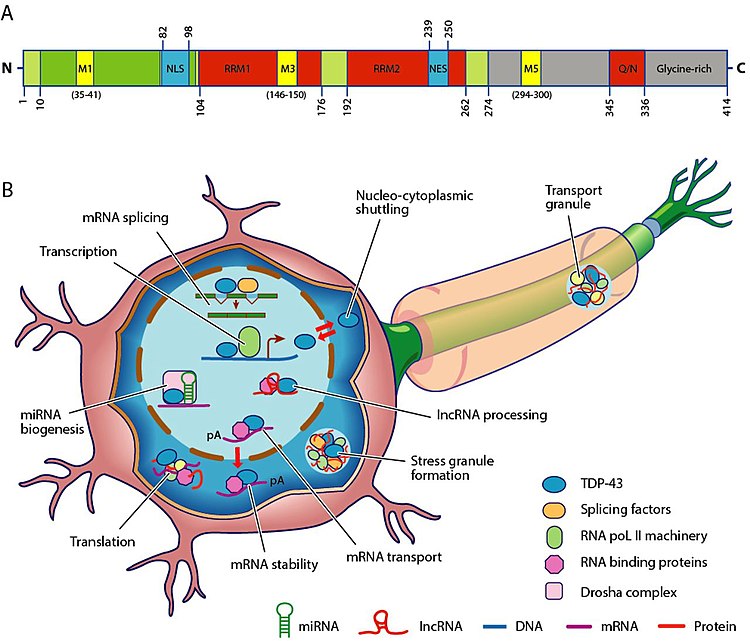
And second thing is that I used to think TDP-43 was actually too tough a target because that protein does so many things within cells.

Emily RogalskiGUEST
is that you get the abnormal function of different proteins.
Emily RogalskiGUEST
And so they have a variety of names from TDP43 to FTLD tau, things that we probably don't need to go into great detail about, but they share this common name of neurodegenerative disease because they all represent these misfolded proteins that then cause lots of grief in the brain.
Emily RogalskiGUEST
can cause brain cell loss and cause disruption in our daily life.
Emily RogalskiGUEST
And because they keep going or are progressive, they're different than a vitamin deficiency where we say, oh, we see a problem.
Emily RogalskiGUEST
So it used to be 20 years ago when I was first doing this work, we hadn't even named all of the bad proteins that we knew something was causing the disease, but it hadn't been even completely discovered.
Emily RogalskiGUEST
And so there's been great discovery that's happened in the last 20 years so that we understand more about the bad proteins that are taking up residence.
Emily RogalskiGUEST
And it used to be the only way that we knew for sure it was the amyloid protein versus the FTLD tau versus TDP43 was that we had to wait until someone passed away and we looked under the microscope to be sure.
Emily RogalskiGUEST
Now we're entering an era of a very different landscape.

LitaHOST
Today we're talking about a form of dementia that many people have never heard of, even though it may account for some memory loss in very old adults and can look a great deal like Alzheimer's disease.
Jean MarieHOST
It is typically called limbic predominant age-related TDP-43 encephalopathy.
Jean MarieHOST
That is a mouthful to say, so for the rest of this episode, we'll just call it by its abbreviation, L-A-T-E, or LATE.
LitaHOST
Our title for the episode today is Late, the dementia that can look like Alzheimer's.

Mark HymanHOST
Yes.
Paul ThompsonGUEST
And there's another one that's very, very, very recently discovered, TDP-43.
Paul ThompsonGUEST
So there's something called LATE.
Paul ThompsonGUEST
It's a type of dementia that has a different pattern in the brain.

Shane LiddelowGUEST
It could be amyloid or tau in Alzheimer's disease.
Shane LiddelowGUEST
It could be TDP-43 in motor neuron disease or amyotrophic lateral sclerosis, ALS.
Shane LiddelowGUEST
So the initiators can be very different but there is not a possibility, I strongly feel, I just do the math in my head on this, there is not a possibility that each one of those cells responds differently to every single stimuli because there's an infinite number of stimuli in the universe and there is not an infinite number of combinations of genes to give us an infinite number of responses in glia and microglia and astrocytes.
Shane LiddelowGUEST
So there's a smaller number of responses that they have I would say arguably more in microglia than there are in astrocytes.
20 MINS LATER
Shane LiddelowGUEST
And then also, you know, we're talking about Parkinson's a lot here.
Shane LiddelowGUEST
It could be pathogenic proteins as well.
Shane LiddelowGUEST
So alpha-synuclein, of course, is a big one in Alzheimer's disease or it could be amyloid or tau in Alzheimer's disease or it could be TDP-43, another protein that's important in pathogenesis of ALS or motor neuron disease.
Shane LiddelowGUEST
So there are many different things that we think could make them susceptible.

Daniel J. GuerraHOST
But in recent years, other mutations associated with that initial have been described.
Daniel J. GuerraHOST
One of them is that protein we discussed just last lecture, which is a co-transcription factor.
Daniel J. GuerraHOST
It's the TARDPD, DBP, excuse me.
Daniel J. GuerraHOST
And then there are a couple of other genes.
Daniel J. GuerraHOST
There's the FUS, the PPN one-- PFN one, and the C9ORF seventy-two.

Jinsy AndrewsGUEST
So I won't, I won't say anything more than that because you gotta attend the meeting to hear about the details, but that will be shared during that-- during the annual meeting as well.
Nicholas J. MaragakisGUEST
You mentioned a little bit about what does the future look like, and I, I would say that The, first of all, excitingly, I think we have really good targets, so we- and we're really understanding much more about pathways, particularly t- those related to sporadic ALS and TDP-43 mediated pathways, as well as those other genes we mentioned, FUS and SOD1, that really allow us now more so than ever to really understand relevant pathways and target those relevant pathways.
Nicholas J. MaragakisGUEST
And I think we're seeing that as, as several groups of pharma start to have additive information regarding those.
Nicholas J. MaragakisGUEST
And I think we'll also be leveraging much more so than ever, and I know sitting on the scientific advisory board, uh, as, as both Dr. Andrews and I do, we've really seen this emphasis on biomarkers, and can we leverage biomarkers to speed trials to really understand targets and target engagement? Uh, so I, I really think that's, that's really, I would view, at least the next few years, getting bett- better biomarkers and, and really, um, leveraging opportunities to influence those pathways.
Nicholas J. MaragakisGUEST
Yeah.
Jinsy AndrewsGUEST
So some of the new science now is trying to target antisense oligonucleotides and viral vectors towards these kind of modifier genes in sporadic ALS, um, or even targeting SOD1.
Jinsy AndrewsGUEST
So we have several early phase clinical trials targeting UNC13A, STATHMIN2, SOD1, um, and TDP-43, and so there are, um, phase one studies underway, and so this is kind of the new, the new wave of the future, and that will be an exciting time for sporadic, um, ALS, especially for those dealing with that type of, um, ALS 'cause it's, it's-- they see so much of the success that's happening for the smaller proportions of people who carry the SOD1 and now FUS-associated ALS.
Marco MeglioHOST
[upbeat music] We're going to take a quick break from our conversation with Dr. Maragakis and Dr. Andrews to keep you up to date on the latest developments in neurology.

Eric WideraGUEST
You know, you can tell me what late stands for in your audience, Nate.
Nathaniel ChinHOST
Limbic predominant age-related TDP43 encephalopathy.
Eric WideraGUEST
Just rolls off the tongue, doesn't it?
Nathaniel ChinHOST
Yeah.

Colin QuinnGUEST
So the problem is, is that SOD1 represents 2% of ALS, right? So not good enough.
Colin QuinnGUEST
That's, [laughs] that's not most people I see in clinic, right? So can we apply the logic of what causes ALS in sporadic disease? The common element that we have, um, is this protein called TDP-43, which was actually the aggregation of TDP-43, uh, is seen in 97% of people with ALS.
Colin QuinnGUEST
Um, and that was actually discovered at Penn, uh, quite a while ago.
Colin QuinnGUEST
Um, and at first it's just like, okay, there's some phosphorylated TDP-43 in these cells.
Colin QuinnGUEST
We have no idea does that matter.
Colin QuinnGUEST
Like what, what's the relevance of this? And in most, um, neurodegenerative conditions, there are aggregated proteins, meaning that there's clumps of some protein, amyloid, tau.
Colin QuinnGUEST
And what's interesting in ALS is that TDP-43 isn't just clumped up.
Colin QuinnGUEST
It's also because it's clumped up in the cytoplasm, in the body of the cell and not in the, in the nucleus, the brain of the cell.

Jonathan CherryGUEST
So tau is the main one, but some cases can have other proteins.
Jonathan CherryGUEST
One is called TDP-43.
Jonathan CherryGUEST
There are some frontal temporal dementias that, and motor neuron diseases that, that are, that can have this protein too, but for some reason, some cases can have some TDP, uh, aggregation.
Jonathan CherryGUEST
It's another protein that can get dysregulated and stick, become sticky.