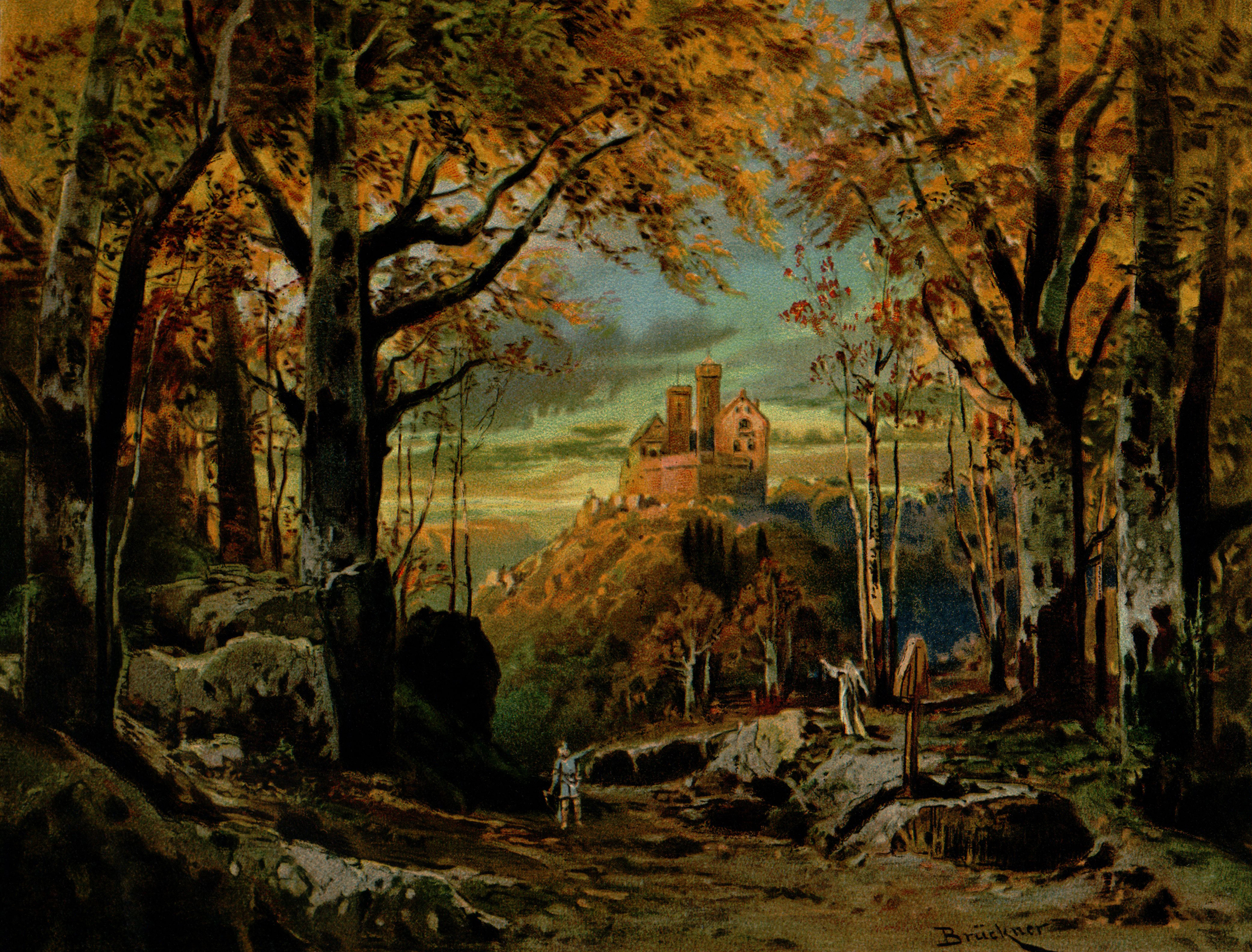
Tannhäuser
Opera by Richard WagnerWikipedia
20
MENTIONS
13
EPISODES
12
PODCASTS
Search complete. 20 mentions across 13 episodes found for "Tannhäuser".
Sep 26, 2026

John BurlinsonNARRATOR
A man and a woman, joined by God but separated by unkind condition, play their parts, and our hearts are made by the Master to vibrate in sympathy with the central idea.
John BurlinsonNARRATOR
Only a broken-hearted man could have conjured forth from his soul such couples as these: Senta and the Dutchman, Elizabeth and Tannhauser, Elsa and Lohengrin, Tristan and Isolde, Sigmund and Sieglinde, Walter and Eva, Siegfried and Brunnhilde.
John BurlinsonNARRATOR
Wagner's unhappy marriage forms the key note of his art.
John BurlinsonNARRATOR
Every opera he wrote depicts a soul in bonds.
22 MINS LATER
John BurlinsonNARRATOR
Only such men as proved themselves past masters in density and adepts in abuse are given a place in this academy of immortals.
John BurlinsonNARRATOR
No writer, musician, or artist who ever lived brought down on his head an equal amount of contumely and disparagement as did Richard Wagner.
John BurlinsonNARRATOR
Turner, Millet, and Rodin have been let off lightly compared with the fate that was Wagner's, and even the shrill outcry that was raised in Boston at the sight of Macmonnie's Bacchante was a passing zephyr to the storm that broke over the head of Wagner in Paris when, after one hundred sixteen rehearsals, Tannhauser was produced.
John BurlinsonNARRATOR
The derisive laughter, catcalls, shouts, hisses, and uproar that greeted the play were only the shadow of the criticisms that filled the daily press, done by writers who mistook their own anserine limitations for inanity on the part of the composer.

ExpatriateNARRATOR
And he would be a bold bourgeois who would pretend to a higher mind than Dante.
ExpatriateNARRATOR
Tannhäuser may die in the conviction that one moment of the emotion he felt with St. Elizabeth was fuller and happier than all the hours of passion he spent with Venus, but that does not alter the fact that love began for him with Venus and that its earlier tentatives towards the final goal were attended with relapses.
ExpatriateNARRATOR
Now Tannhäuser's passion for Venus is a development of the humdrum fondness of the bourgeois Jack for his Jill, a development at once higher and more dangerous, just as idealism is at once higher and more dangerous than philistinism.
ExpatriateNARRATOR
The fondness is the germ of the passion.
ExpatriateNARRATOR
The passion is the germ of the more perfect love.

David WalesNARRATOR
And so the two seemed everlastingly at cross purposes.
David WalesNARRATOR
Wagner gave Schumann a score of his Tannhäuser as soon as it appeared in a lithographed form.
David WalesNARRATOR
Writing to Mendelssohn, Robert repudiated the music as weak, forced, amateurish, deficient in melody, and wanting in form.
David WalesNARRATOR
Not long afterwards, he went to hear the work and took back much of what he had said, declaring that the impression created by a stage performance was very different and that, though the score did not radiate the pure sunlight of genius, the opera nevertheless exercised on the hearer a mysterious magic which held one captive.
David WalesNARRATOR
From the viewpoint of his own art, Robert was to a certain degree logical in his claims, but his prophetic vision and artist's conscience refused to let him reject the work outright.
David WalesNARRATOR
Nor should we judge him too severely for his conclusions.
David WalesNARRATOR
After Tannhäuser, he never heard a note of Wagner's music.
David WalesNARRATOR
However he might have reacted to Tristan, it is hardly possible that Schumann could have brought himself to dismiss Wagner as a bad musician if he had been spared to hear Die Meistersinger.

speaker_2UNKNOWN
CHOIR SINGS CHOIR SINGS CHOIR SINGS
Pat CorkeryHOST
The Pilgrim's Chorus from Tannhauser was performed there by the Robert Shaw Chorale.
Pat CorkeryHOST
Aussie baritone Peter Dawson has for us On the Road to Mandalay.
Pat CorkeryHOST
On the Road to Mandalay

speaker_2NARRATOR
It is everlastingly to be regretted that temperamental differences kept him and Schumann from amalgamating for their liberal, artistic slants and their incorruptible idealism should have made them fellow fighters in the cause of musical progress.
speaker_2NARRATOR
unfortunately the pair seemed almost to bristle at each other's approach had wagner matured in his art as early as schumann in his or could they have known one another in the fine frenzy of schumann's early davidsbundler years the story might have been of an inspiring artistic relationship wagner had been a contributor to schumann's zeitschrift and had entertained a flattering idea of some of robert's earlier music rightly enough he noted in it much ferment but also much originality he continued to like paradise and the paris and the piano quintet and afterwards during his swiss exile he went so far as to entreat clara to play at one of her zurich concerts the symphonic studies but thrown frequently together in dresden the two repelled rather than attracted each other wagner who talked incessantly complained that one could get nowhere with a person who refused to open his mouth schumann that one could not possibly exchange ideas with a man who never allowed one the opportunity to say a word moreover wagner's far-darting and flamboyant ideas were unintelligible to poor schumann and even frightened him and so the two seemed everlastingly at cross purposes wagner gave schumann a score of his tannhäuser as soon as it appeared in a lithographed form Writing to Mendelssohn, Robert repudiated the music as weak, forced, amateurish, deficient in melody, and wanting in form.
speaker_2NARRATOR
not long afterwards he went to hear the work and took back much of what he had said declaring that the impression created by a stage performance was very different and that though the score did not radiate the pure sunlight of genius the opera nevertheless exercised on the hearer a mysterious magic which held one captive he had been deeply moved by much of it and he praised the technical effects and above all the instrumentation a thing for which schumann himself had always been reproved yet in another missive he declared that wagner could not write four consecutive bars of correct music that he was all in all a bad musician from the viewpoint of his own art robert was to a certain degree logical in his claims but his prophetic vision and artist's conscience refused to let him reject the work outright nor should we judge him too severely for his conclusions After Tannhäuser, he never heard a note of Wagner's music.
speaker_2NARRATOR
However, he might have reacted to Tristan.
speaker_2NARRATOR
It is hardly possible that Schumann could have brought himself to dismiss Wagner as a bad musician if he had been spared to hear Die Meistersinger.
David WalesNARRATOR
Guntram, a member of a religious order in the time of the Minnesingers, esteems the ruling duke but kills himself after renouncing the duchess, the object of his affection.
David WalesNARRATOR
Despite the dramatic resemblances to Tannhäuser and Lohengrin, Alexander Ritter found in the opera a departure from Wagnerian influences.
David WalesNARRATOR
Slowly, as Strauss labored over the three acts of Guntram, he spent no such time on the tone poems which now began to follow in rapid succession.
David WalesNARRATOR
After the ill-fated opera and a quantity of fine new Lieder, superbly diversified in expressive scope and lyric moods, there followed the tone poem which, apart from Don Juan, continues even in the present age to address itself most warmly to the public heart, Till Eulenspiegel's Merry Pranks.

Nate BrownHOST
Obviously, grand opera is very large and long.
Nate BrownHOST
And then next chapter is Opera and Ideas, for which he gets into the ideas of Wagner because the example is Tannhäuser.
Nate BrownHOST
And so he talks about Wagner's ideas of what an artwork should be, the total artwork, gesamtkunstwerk, right? And the alternate here is Fidelio by Beethoven, and Beethoven expressing some of his kind of universalist and revolutionary ideas there.
Nate BrownHOST
The chapter after that is Epic Opera, and the example is Die Walküre by Wagner, which we did not listen to yet in the project because I plan on listening to the entire Ring cycle all together, either in consecutive weeks or maybe all of them in one week or something like that.

speaker_0NARRATOR
There was a rare standing ovation, which turned into rhythmic clapping in unison, slightly unnerving, even if it was, as Anna said, a Central European tradition.
speaker_0NARRATOR
We drove to the Munich airport the next day, listening to Tannhäuser.
speaker_0NARRATOR
Wagner had been right, declared Max, about the subtitles.
speaker_0NARRATOR
We didn't deserve them.

Simon EversNARRATOR
"I've never seen any opera.
Simon EversNARRATOR
I know the marches from Tannhäuser and Lohengrin and O Star of Eve." "But it is impossible that you don't know Tristan," he exclaimed.
Simon EversNARRATOR
"The second act of Tristan is the greatest piece of love music.
Simon EversNARRATOR
No, it isn't." He laughed.

ExpatriateNARRATOR
And he would be a bold bourgeois who would pretend to a higher mind than Dante.
ExpatriateNARRATOR
Tannhäuser may die in the conviction that one moment of the emotion he felt with St. Elizabeth was fuller and happier than all the hours of passion he spent with Venus, but that does not alter the fact that love began for him with Venus, and that its earlier tentatives towards the final goal were attended with relapses.
ExpatriateNARRATOR
Now Tannhäuser's passion for Venus is a development of the humdrum fondness of the bourgeois Jacques for his Jill, a development at once higher and more dangerous, just as idealism is at once higher and more dangerous than philistinism.
ExpatriateNARRATOR
The fondness is the germ of the passion.
ExpatriateNARRATOR
The passion is the germ of the more perfect love.
3 more episodes mention Tannhäuser.
Create an account to see the whole feed, search across every transcript, and follow the entities you care about.