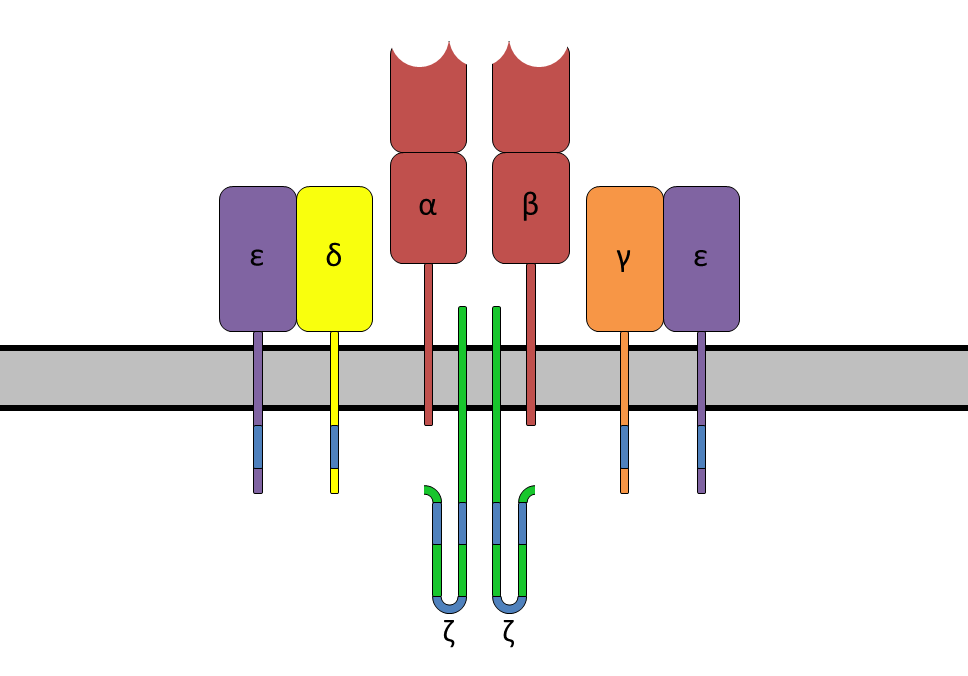
T-cell receptor
17
MENTIONS
10
EPISODES
9
PODCASTS
Search complete. 17 mentions across 10 episodes found for "T-cell receptor".
Oct 2, 2026

Lorenza RimassaSOUNDBITE_SPEAKER
Then we have cell therapies Cell therapies can be autologous cell therapies or allogenic.
Lorenza RimassaSOUNDBITE_SPEAKER
And for autologous, we have CAR-T cells or TCR-T cells.
Lorenza RimassaSOUNDBITE_SPEAKER
CAR-T are T cells derived from patients and engineered to express surface proteins that target antigens on the surface of cancer cells.
Lorenza RimassaSOUNDBITE_SPEAKER
TCR, T cells, again are patient-derived T cells engineered to recognize a tumor-specific protein fragment with the MHC combination within cancer cells.

Jeff MartinHOST
They're like innate receptor only.
Jeff MartinHOST
NKT cells have a sort of TCR, like a T cell receptor.
Jeff MartinHOST
and they can adopt a certain form of T-cell-like memory against antigens and stuff.
Jeff MartinHOST
They are significantly more rare, though.
Jeff MartinHOST
You can kind of see it.
Jeff MartinHOST
It's super tiny right here.
Jeff MartinHOST
You can see their TCR right there.
Jeff MartinHOST
It binds to a very special kind of antigen-presenting molecule called CD1.

Seema AcevesGUEST
David Hill at CHOP has shown that there are milk-specific T-cells.
Seema AcevesGUEST
They respond to milk in culture, and they have a certain TCR and a different profile than the other pathogenic effector T-cells.
Seema AcevesGUEST
So if that type of test actually is commercialized and validated and then the trial is done that, yes, you have these T cells and I take milk out of your diet and you get better, that's huge, right? Then you can have a really good conversation with your parents, your families, your patient and say, you look like this might actually work for you.
Seema AcevesGUEST
Let's try it.

Brenda RaudHOST
But this idea that you need to have, you need to have it both ways.
Brenda RaudHOST
You need to have a cell that survives really long because you need that TCR to survive for a long time so you can potentially detect all of these potential pathogenic proteins or like you are able to respond to all of these pathogens.
Brenda RaudHOST
But on the other hand, you need to be ready to respond to it very quickly.
Brenda RaudHOST
So it's very interesting.

BasharHOST
So, question one in a sentence, is this lymphoma a B or a T cell lymphoma? So, you can prove it by immunophenotype with clonality shown by light chain restriction here.
BasharHOST
in B cells and TCR rearrangement or aberrant marker loss in T cells.
BasharHOST
Most of what you'll see is B.
BasharHOST
When it's T, we tend to get a bit more worried.

Cyril KontoGUEST
So that's our value proposition.
Cyril KontoGUEST
Our value proposition is also to work on both surface and intracellular cancer biology with antibody-based T-cell engager or a TCR-based T-cell engager.
Ryan FlynnHOST
Got it.
Ryan FlynnHOST
And you mentioned earlier making sure that the T cell's health is good enough to actually kill the tumor.

Daniel J. GuerraHOST
Two things already have been now revealed.
Daniel J. GuerraHOST
So neutrophil myelinase isoform 2, which remember was involved in the whole Nrf2 keep activity, that's why I'm bringing it in now, its expression is is indeed essential for T-cell receptor signal amplification and the sustained level of the amplification, when specifically antigen presentation is relatively low.
Daniel J. GuerraHOST
And what it induces, the NSM-2, on the TCR with low antigen presentation, is a particular enzyme called PKC zeta.
Daniel J. GuerraHOST
That's a protein kinase C isoform zeta.
Daniel J. GuerraHOST
And what PKC zeta does is generate microtubule polarization.
18 MINS LATER
Daniel J. GuerraHOST
Because now you've got diacylglycerol.
Daniel J. GuerraHOST
Diacylglycerol, remember, via allosteric activation, activates the protein kinase C-zeta.
Daniel J. GuerraHOST
And what does that PKC-zeta enzyme do? TCR-mediated T-cell activation.

Daniel LevineHOST
What's DBTV and what is improving T-cell receptor stability matter for manufacturer and scale?
Jack SilbersteinGUEST
you know, this first T-cell engager that's been approved for solid tumors, it was actually a T-cell engager that was targeted against peptide MHC complexes.
Jack SilbersteinGUEST
And it uses what's called a T-cell receptor or a TCR.
Jack SilbersteinGUEST
T-cell receptors are the protein in your body that naturally recognizes peptide MHC complexes.
Jack SilbersteinGUEST
They're known to people like them because they have this great specificity.
Jack SilbersteinGUEST
They've been engineered to be specific to peptide MHC versus something like an antibody that other people are working on where the specificity is a little bit more unknown.
Jack SilbersteinGUEST
And so what this first molecule was that was developed and it was approved in 2022, it's a molecule called Kimtrek or Tabentafusp approved for uveal melanoma.
Jack SilbersteinGUEST
It has this great specificity, but there are challenges from a manufacturing standpoint when it comes with using something like a TCR or a T cell receptor.
Martin PrlicGUEST
And we really don't see much of a clonal overlap between those expanded Tregs versus the non-expanded Tregs.
Martin PrlicGUEST
So, yeah, to get to TCR signals, it's still tricky, right? I mean, even in mouse, it's not trivial.
Martin PrlicGUEST
What helps is that the activation time point is always really well defined, right? We know when the T cells get activated, so then we know what markers to look for.
Martin PrlicGUEST
And there are some reporter mice, too, with Nr77 is the one protein that really specifically indicates that a T cell got a T cell receptor signal and not a cytokine signal.
7 MINS LATER
Martin PrlicGUEST
I mean, we're also thinking if there's acute inflammation, CD8 T cells can get activated by inflammatory cytokines if the right cytokines are around us.
Martin PrlicGUEST
It's termed either inflammation-driven activation or bystander activation.
Martin PrlicGUEST
And T cells can even... kill stress cells independently of the um of a strong tcr signal um if they express nkgd so basically almost start acting like in case cells so they get activated through these um pro-inflammatory cytokines they start to express granzyme to express nkgd and then stress cells will express the ligands for nkgd so then um these bistro activated t cells um uh could potentially kill stressed or infected cells in a TCR-independent manner.
Martin PrlicGUEST
So we were thinking maybe this is what will happen, and we're kind of hoping this will happen, because that's what my lab has also been interested for a long time, is sort of bystander activation in tissues.

Vincent RacanielloHOST
Right.
Vincent RacanielloHOST
And you talk about whether that's cytokine-driven or TCR engagement.
Vincent RacanielloHOST
Do you think you can resolve that in the phase two?
Mumtaz BalkhiGUEST
Yes, absolutely.