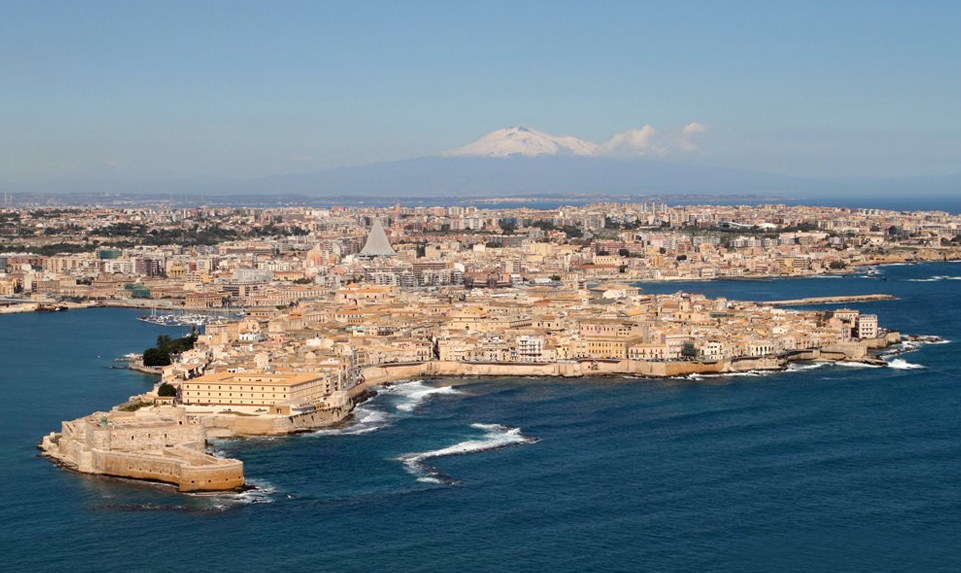
Syracuse
City in ItalyWikipedia
898
MENTIONS
148
EPISODES
127
PODCASTS
Search complete. 898 mentions across 148 episodes found for "Syracuse".
Sep 18, 2026

speaker_29NARRATOR
But more important still, he was the first to see that the command of the sea is necessary to the possession of land.
speaker_29NARRATOR
So vessels plied up and down the Mediterranean Sea, backwards and forwards, bringing merchandise to Alexandria, trading with Athens, with Carthage, with Syracuse, with Rome, with the East, until the city grew and grew.
speaker_29NARRATOR
A wonderful lighthouse of white marble was built on the island of Pharos, four hundred feet high, which was reckoned among the seven wonders of the world.
speaker_29NARRATOR
Fires were lit on its summit to guide the vessels safely into port.

RuthieHOST
Mm-hmm.
SarahHOST
It's about, it's about these two males who are from Syracuse, which apparently is a city or town or island, I don't know, in, from ancient Greece.
BreenaHOST
Okay.
SarahHOST
And they have just recently defeated Athens at war.
BreenaHOST
Mm-hmm.
SarahHOST
So these two fellows are Syracusan.
SarahHOST
Athen- their people just defeated Athens, and now they've, they have all these prisoners of war on their little island in their little village-
BreenaHOST
Mm-hmm

Kane MercerNARRATOR
When I waded in the river and opened it up, the water rushed forth and not a few Sunday clothes were spoiled.
Kane MercerNARRATOR
Archimedes running naked through the streets of Syracuse and shouting Eureka at the top of his voice did not make a greater impression than myself.
Kane MercerNARRATOR
I was carried on the shoulders and was the hero of the day.
Kane MercerNARRATOR
Upon settling in the city I began a four years' course in the so-called normal school preparatory to my studies at the college or real gymnasium.

Larry WilsonNARRATOR
In the memoirs of the Etruscan Academy of Cortona is a drawing of a picture found in Herculaneum, representing a marriage at which a sorceress is practising divination with five stones.
Larry WilsonNARRATOR
The Syracusans, when about to enter the matrimonial state, used to go in procession to the temple of Diana, the goddess of chastity, preceded by chanters, musicians, and persons carrying flowers and vessels of incense, and accompanied by tame tigers, leopards, and the like animals.
Larry WilsonNARRATOR
The Acritus, in his second idyll, alludes to this custom.
Larry WilsonNARRATOR
End of chapter 2.

speaker_5NARRATOR
In the memoirs of the Etruscan Academy of Cortona is a drawing of a picture found in Herculaneum, representing a marriage at which a sorceress is practising divination with five stones.
speaker_5NARRATOR
The Syracusans, on about to enter the matrimonial state, used to go in procession to the temple of Diana, the goddess of chastity, preceded by chanters, musicians, and persons carrying flowers and vessels of incense, and accompanied by tame tigers, leopards, and the like animals.
speaker_5NARRATOR
The Acritus, in his second idyll, alludes to this custom.
speaker_5NARRATOR
End of chapter 2.

speaker_5NARRATOR
Still it bears some resemblance to them, and I wish it to suffice me for all of the little kind.
speaker_5NARRATOR
It is Hiero the Syracusan.
speaker_5NARRATOR
The man rose from a private station to be the prince of Syracuse, nor did he either owe anything to fortune but opportunity, for the Syracusans, being oppressed, chose him for their captain.
speaker_5NARRATOR
Afterwards he was rewarded by being made their prince.
speaker_5NARRATOR
He was of so great ability even as a private citizen that one who writes of him says he wanted nothing but a kingdom to be a king.
21 MINS LATER
speaker_12NARRATOR
These methods are when, either by some wicked or nefarious ways, one ascends to the principality, or when by the favour of his fellow citizens a private person becomes the prince of his country.
speaker_12NARRATOR
And speaking of the first method, it will be illustrated by two examples, one ancient, the other modern, and without entering further into the subject, I consider these two examples will suffice those who may be compelled to follow them.
speaker_12NARRATOR
Agathocles, the Sicilian, became king of Syracuse, not only from a private but from a low and abject position.

LambdaNARRATOR
On one occasion, when he noticed Plato at a very costly entertainment tasting some olives, he said, Oh, you wise man, why, after having sailed to Sicily for the sake of such a feast, do you not enjoy what you have before you? And Plato replied, By the gods, Diogenes, while I was there I ate olives, and all such good things a great deal.
LambdaNARRATOR
Diogenes rejoined, What then did you want to sail to Syracuse for? Did not Attica at that time produce any olives? But Favorinus, in his Universal History, tells the story of Aristippus.
LambdaNARRATOR
At another time he was eating dried figs when Plato met him, and he said to him, You may have a share of these.
LambdaNARRATOR
And as he took some and ate them, he said, I said that you might have a share of them, not that you might eat them all.

LambdaNARRATOR
On one occasion, when he noticed Plato at a very costly entertainment tasting some olives, he said, Oh, you wise man, why, after having sailed to Sicily for the sake of such a feast, do you not enjoy what you have before you? And Plato replied, By the gods, Diogenes, while I was there I ate olives, and all such good things a great deal.
LambdaNARRATOR
Diogenes rejoined, What then did you want to sail to Syracuse for? Did not Attica at that time produce any olives? But Favorinus, in his Universal History, tells the story of Aristippus.
LambdaNARRATOR
At another time he was eating dried figs when Plato met him, and he said to him, You may have a share of these.
LambdaNARRATOR
And as he took some and ate them, he said, I said that you might have a share of them, not that you might eat them all.

Rocky RuggieroHOST
Buongiorno a tutti.
Rocky RuggieroHOST
Today's podcast keeps us on that magical island of Sicily, and specifically in the city of Siracusa, which I introduced to you in my previous podcast, located on the southeastern corner of the island and one of the great ancient superpowers of the Mediterranean world.
Rocky RuggieroHOST
You may remember me telling you that Siracusa was was, in those centuries before the birth of Christ, even more important than many of the Greek, and by which I mean the Greek cities on the Peloponnesian Peninsula, that Syracuse was more powerful than many of those cities.
Rocky RuggieroHOST
Perhaps even more powerful than Athens itself.
Rocky RuggieroHOST
And we talked about the history of Syracuse, and we talked specifically about a part of the city known as the Ortigia.
Rocky RuggieroHOST
An Ortigia is this little island right off of the coast of Syracuse, which was the citadel.
Rocky RuggieroHOST
It was the sort of last line of defense, if you will.
Rocky RuggieroHOST
Today, instead, we are looking at one of the most... abundant archaeological sites in all of Sicily, and that is the Neapolis Archaeological Park in Siracusa.

John BurlinsonNARRATOR
Such were his hopes that he regarded Sicily as a mere beginning, and not, like the rest, as an end of the expedition.
John BurlinsonNARRATOR
So while Nicias was trying to divert the people from the capture of Syracuse as an undertaking too difficult for them, Alcibiades was dreaming of Carthage and Libya, and after winning these, of at once encompassing Italy and Peloponnesus.
John BurlinsonNARRATOR
He almost regarded Sicily as the ways and means provided for his greater war.
John BurlinsonNARRATOR
The young men were at once carried away on the wings of such hopes, and their elders kept recounting in their ears many wonderful things about the projected expedition.
John BurlinsonNARRATOR
This fell at that time, and little images like dead folk carried forth to burial were in many places exposed to view by the women, who mimicked burial rites, beat their breasts, and sang dirges.
John BurlinsonNARRATOR
Moreover, the mutilation of the Hermae, most of which in a single night had their faces and forms disfigured, confounded the hearts of many, even among those who usually set small store by such things.
John BurlinsonNARRATOR
It was said it is true that Corinthians had done the deed, Syracuse being a colony of theirs, in the hope that such portents would check or stop the war.
John BurlinsonNARRATOR
The multitude, however, were not moved by this reasoning, nor by that of those who thought the affair no terrible sign at all, but rather one of the common effects of strong wine, when dissolute youth in mere sport are carried away into wanton acts.
138 more episodes mention Syracuse.
Create an account to see the whole feed, search across every transcript, and follow the entities you care about.