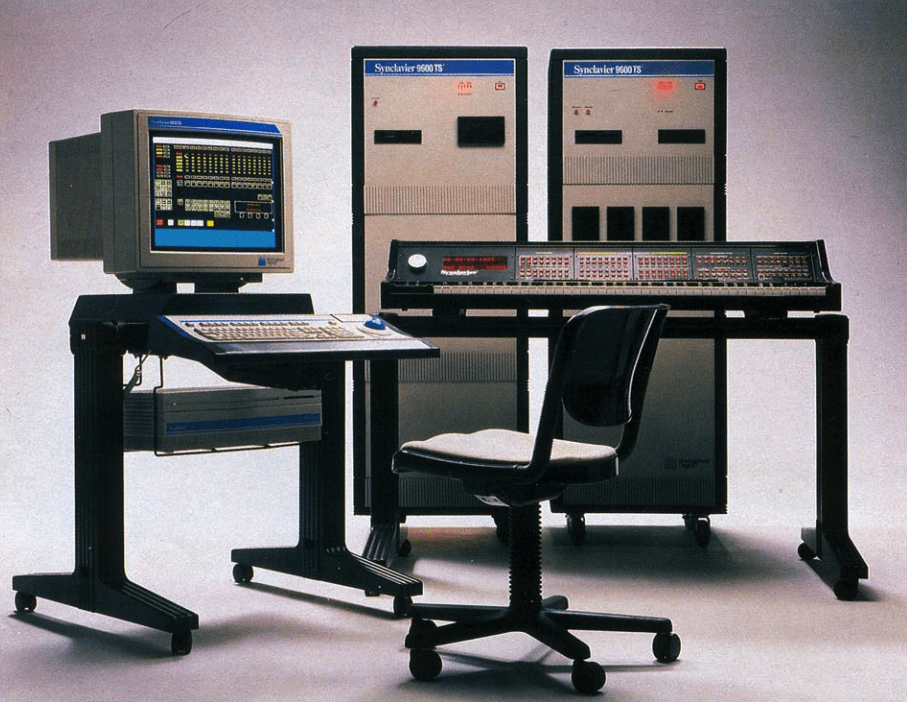
Synclavier
Product lineWikipedia
9
MENTIONS
6
EPISODES
6
PODCASTS
Search complete. 9 mentions across 6 episodes found for "Synclavier".
Sep 9, 2026

Brian KehewGUEST
...
Brian KehewGUEST
so it was, like, a weird thing, but I loved that, and I found this school, Cal State Dominguez, not only had that, but they had a Synclavier, which was definitely state-of-the-art in the future as far as I thought.
Brian KehewGUEST
So I went to that school, which is basically Compton in the middle to late '80s.
Brian KehewGUEST
That's where I lived.

Sean EnglandGUEST
People have created applications that try to replicate Foley.
Sean EnglandGUEST
There was a time where people were doing it with a keyboard, like a musical keyboard, like a Synclavier or something, trying to perform Foley in real time on... you know, keyboards or, you know, that type of thing.
Sean EnglandGUEST
And as a drummer, there's many correlations between being a musician and a drummer to Foley.
Sean EnglandGUEST
And one of the things as a drummer, you know, I came up in the 80s learning to play drums.

Sunny ShoemakerHOST
In addition to being a more standalone work than Big Science, Mr. Heartbreak has more traditional pop rock elements, such as Laurie Anderson using a more conventional singing style, as well as the aforementioned guitar work, largely performed by Adrian Blue, generally best known from his work in King Crimson, but I'm more familiar with his solo work.
Sunny ShoemakerHOST
Adding a consistent through line is the use of the synclavier on every track.
Sunny ShoemakerHOST
The Synclavier was an early synthesizer and digital sampling system.
Sunny ShoemakerHOST
I've briefly touched on the Moog or Moog Potato Potato through the Pisces, Aquarius, Capricorn, and Jones episode, but it will for sure return, most notably on the Abbey Road episodes.
Sunny ShoemakerHOST
And while I haven't talked much about the Mellotron...

Anthony MarinelliGUEST
So you could create a wavetable and then apply FM to it.
Anthony MarinelliGUEST
And that's kind of the basis of the Synclavier.
Anthony MarinelliGUEST
And then sampling happened later.
Anthony MarinelliGUEST
And then you were able to mix and match.
Anthony MarinelliGUEST
The Synclavier didn't have a filter, but it allowed you to very easily send out control voltage, which I did all the time.
Anthony MarinelliGUEST
And I used Roland filters.
Anthony MarinelliGUEST
I used the Roland 100M so I could do what the PPG was doing, which is a beautiful sound to be able to still filter, you know, wavetables.
17 MINS LATER
Anthony MarinelliGUEST
It was in 1983-ish.

Craig Parker AdamsGUEST
I used to stand right behind him.
Craig Parker AdamsGUEST
He'd be at the Synclavier or sit by him.
Craig Parker AdamsGUEST
He played things for me.
Craig Parker AdamsGUEST
I could ask him questions.

Stephen ShirkGUEST
And a friend had another o- opening at a jingle house, which doesn't sound nearly as cool as the Hit Factory, but, um, I got to do all kinds of stuff.
Stephen ShirkGUEST
Rather than just set up small, you know, little bits of gear here and there and be around big-name people, instead I was getting to engineer, I was getting to-- I learned to build Pro Tools systems for the studio 'cause believe it or not, when I moved into this jingle house, the main recording system that they had, the main multitrack, was a Synclavier, um, what do they call it? Post Pro, which is like a 16-channel 100 KHz sampling, you know, hard disk recorder that's like six feet tall and could heat your whole apartment.
Stephen ShirkGUEST
It ran so hot and it was, it was a dinosaur.
Stephen ShirkGUEST
But it, it worked, and we used it for many years.