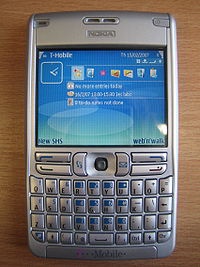
Symbian
Operating systemWikipedia
11
MENTIONS
8
EPISODES
7
PODCASTS
Search complete. 11 mentions across 8 episodes found for "Symbian".
Oct 17, 2026
Bob TinkerGUEST
He would ask, "What else is bothering you?" And it turned out that's how we discovered the urgent pain that we decided to really focus on that really helped us to unlock growth.
Bob TinkerGUEST
Because there was a couple customers that said, "You know what? Yeah, you guys are talking about Symbian and BlackBerry and Windows Phone, and that's all fine, yeah." He said, "You know what? What's really bugging me is iPhone." He said, "I have 10 of my execs are using iPhones, and they told me I have to figure out how to make them work or I'm fired." And we're like, "Hmm, that sounds like an urgent pain." [laughs] The second thing we did was build a prototype that we could show customers.
Bob TinkerGUEST
It was rough, it was buggy, but it sort of illustrated the idea of what you could do with a security and management platform to help onboard smartphones and wipe smartphones.
Bob TinkerGUEST
We talked to probably 40 or 50 teaching customers.

Carl PeiGUEST
It's been this way for a long time.
Carl PeiGUEST
The Palm OS days, the Symbian days, they were all like this.
Carl PeiGUEST
But if the future of computing is without apps, then the companies who have apps today They also have to change.
Carl PeiGUEST
Now they're very much ahead of us in terms of the company scale and the traction, but if everybody has to start from the beginning again, then we also have the opportunity to win this race.

Jeremy AllaireGUEST
And it attracted, you know, billions and billions of investment from everything from open source developers to the biggest companies in the world, like Microsoft and Compaq.
Jeremy AllaireGUEST
And so we had the PalmPilot, and we had the BlackBerry, and we had the Windows phone, and we had the Samsung phones, and we had Symbian and Nokia and NTT, and many, many, many others.
Jeremy AllaireGUEST
And we all thought at the time like, "Wow, mobile's big.
Jeremy AllaireGUEST
Look at all this stuff.

Richie MensahHOST
I always say this is one of my favorite bets I ever made in life.
Richie MensahHOST
You know, I'm, I'm a geek sometimes, and I remember when Nokia had to make the decision between the Windows, um, software or the Android software 'cause they were on Symbian.
Niyi AdesanyaGUEST
Mm-hmm.
Richie MensahHOST
And then they chose Windows, and I remember telling two friends of mine that, "Oh, Nokia just made a mistake."
Niyi AdesanyaGUEST
Wow.
Richie MensahHOST
'Cause that time Android was new, and I told them, "I've used the Android software, and I feel like Android is about to take over." That time iPhone hadn't even been popular yet, so it was Symbian, Android, and BlackBerry.
Richie MensahHOST
And I told them, "I, I feel like Android is about to become the next thing." And Nokia had the best hardware at that time.
Niyi AdesanyaGUEST
Mm.

Jan VermeulenGUEST
And, uh, before the market collapsed into, you know, essentially the two-horse race we have today, plus Linux, right? So we have, uh, Apple and, and Wintel, um, and, and Linux.
Jan VermeulenGUEST
And on the cellphone side, it's very similar, where, you know, you, you had BlackBerry and Windows Phone and, um, Symbian, and, like, you, you had so many, uh, different options and then, you know, over time it collapses to, to a, a-
Stephen GrootesHOST
Mm.
Jan VermeulenGUEST
Uh, to a two-party state, as it were, Android and iOS.
Jan VermeulenGUEST
Um, and so it's-- I think it's just a natural progression of a new technology, the so-called S-curve.
Stephen GrootesHOST
Sure.
Stephen GrootesHOST
Symbian, now there's a word I haven't heard anywhere in a very long time.
Stephen GrootesHOST
Jan Vermeulen, thanks very much indeed.

Jan VermeulenGUEST
And so, uh, we see that, um, in whenever there's a new technology is, uh, the, the, the space explodes, and we saw that with the, the early PCs, the, it's the same thing, and you had manufacturers for days and designs and, and cool operating system ideas and, uh, before the market collapsed into, you know, essentially the two-horse race we have today, plus Linux, right? So we have, uh, Apple and, and Wintel, um, and, and Linux.
Jan VermeulenGUEST
And on the cell phone side it's very similar, where, you know, you, you had BlackBerry and Windows Phone and, um, Symbian, and, like, you, you had so many, uh, different options and then, you know, over time it collapses to, to a, a, uh, to a two-party state, as it were, Android and iOS.
Jan VermeulenGUEST
And so, uh, with, you know, one or two, um, uh, outliers that are still trying to do something.
Jan VermeulenGUEST
Um, and so it's, I think it's just a natural progression of a new technology, the so-called S curve.
Stephen GrootesHOST
Sure.
Stephen GrootesHOST
Symbian, now there's a word I haven't heard anywhere in a very long time.
Stephen GrootesHOST
Jan Vermeulen, thanks very much indeed.
Stephen GrootesHOST
Editor at mybroadband.co.za.

Greg FawsonGUEST
I mean, you know, there's operating systems, mobile operating systems nowadays that most people are too young to have heard of.
Greg FawsonGUEST
Symbian, that was 45% of the market.
Greg FawsonGUEST
That was Sony Ericsson, Nokia, Motorola, who were massive players.
Greg FawsonGUEST
You had Windows CE at the time.

Oscar ClarkeHOST
So I have a fascination with the way that technology has evolved ever since that time.
Oscar ClarkeHOST
I have very fond memories working with the guys at Symbian, if anyone remembers Symbian.
Oscar ClarkeHOST
Oh, yes.
Oscar ClarkeHOST
yeah particularly we were launching carmageddon on a um motorola a1000 phone which nobody would know i think it was a massive brick nowadays yeah um but it was the first kind of smartphone predating the iphone uh by about four years maybe something like that anyway So we definitely think, I mean, I think we all feel like whatever the end result is, we're going to be getting more effective glasses that have better battery life.