Sykes–Picot Agreement
73
MENTIONS
48
EPISODES
37
PODCASTS
Search complete. 73 mentions across 48 episodes found for "Sykes–Picot Agreement".
Nov 24, 2026

StuartAUDIENCE
His assassination, of course, led to World War I, and it led to a number of other issues.
StuartAUDIENCE
In World War II, it led to the Sykes-Picot Agreement, which screwed up the entire Middle East, which we're dealing with today.
StuartAUDIENCE
I mean, it just goes on and on, the repercussions from that assassination.
Alison StewartHOST
Thank you so much for calling.

Miranda MelcherHOST
Let's move to the sort of realm after the conflict.
Miranda MelcherHOST
We've got all sorts of treaties going on, some more secretive than others, obviously famous ones like the Sykes-Picot Agreement or the Treaty of Sevres.
Miranda MelcherHOST
What factors sort of made it so that those couldn't necessarily be resisted? I mean, Ataturk, you talk about in the book, isn't going around saying, yes, this is a great idea, but he can't really do anything about it, right?
David S. TongeGUEST
Well, two things happen.

Miranda MelcherHOST
Let's move to the sort of realm after the conflict.
Miranda MelcherHOST
We've got all sorts of treaties going on, some more secretive than others, obviously famous ones like the Sykes-Picot Agreement or the Treaty of Sevres.
Miranda MelcherHOST
What factors sort of made it so that those couldn't necessarily be resisted? I mean, Ataturk, you talk about in the book, isn't going around saying, yes, this is a great idea, but he can't really do anything about it, right?
David S. TongeGUEST
Well, two things happen.

Sharmine NarwaniHOST
And yeah, I totally forgot what I was going to say.
Sharmine NarwaniHOST
Oh, no, about Thomas Barak, the U.S. envoy in this region, how he did this thing, was it earlier this year or last year, where he said, you know, he went off on Sykes-Picot and this disastrous plan, right? But he went off on Sykes-Picot because he's saying Sykes and Picot did not draw the borders the way they should be drawn, okay? Here's me.
Sharmine NarwaniHOST
and the Americans to redraw the region's borders.
Sharmine NarwaniHOST
But in fact, we have enough efficiency and focus in this region.

JustinHOST
Britain maintained that it was excluded.
JustinHOST
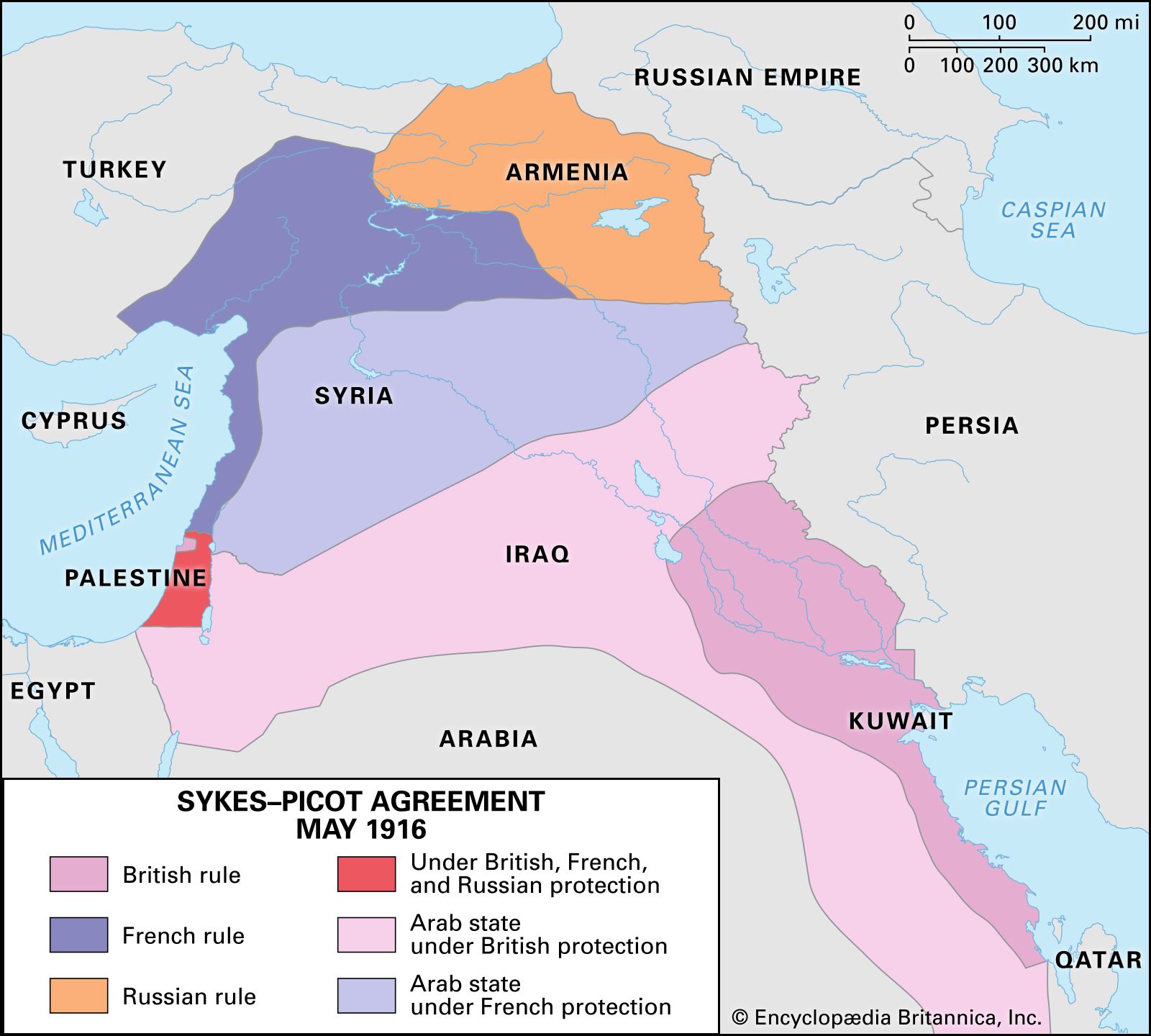
Second, in May of nineteen sixteen, Britain and France made the secret Sykes-Picot Agreement, dividing the Ottoman lands between themselves.
JustinHOST
The agreement called for international administration of the area marked brown on its map, which included Jerusalem and much of Palestine.
JustinHOST
Third, on November second, nineteen seventeen, Foreign Secretary Arthur Balfour wrote a letter to Jewish Lord Rothschild asking him to convey a declaration to the Zionist Federation.

Sharmine NarwaniGUEST
So a lot of these, you know, there'll be a lot of rethinking about this.
Sharmine NarwaniGUEST
And interestingly, Tom Barak, that awful American ambassador, has talked about, you know, Sykes-Picot was awful, you know, borders should be different here.
Sharmine NarwaniGUEST
But I want to tell Tom Barak is that you Americans are not going to be redrawing the borders.
Sharmine NarwaniGUEST
We in West Asia will be doing it for ourselves.

John GGUEST
Same thing, Iraq.
John GGUEST
If you look at the Sykes-Picot Agreement from 1917, that's what the British and the French did in the Middle East.
John GGUEST
They just carved it all up.
John GGUEST
created these groups that would be hostile towards each other.

Brandon WeichertHOST
This was why we went into Afghanistan.
Brandon WeichertHOST
Partly was to try to implement the breakdown of the Sykes-Picot order, which nobody likes, but they were going to replace it with something like this long term.
Brandon WeichertHOST
And what you're seeing right now, now in Iran, you're seeing a continuation of General Wesley Clark's statement of seven wars in seven years.
Brandon WeichertHOST
Now, obviously, the timeline was wrong.

Cynthia ChungGUEST
But in this case, the Berlin to Baghdad railway, if this had been built, it was delayed until 1940.
Cynthia ChungGUEST
But if it had been built when Otto von Bismarck had first suggested it, which was at the end of the 19th century, it would have preceded the Sykes-Picot disaster that ended up carving up the Middle East between Britain and France.
Cynthia ChungGUEST
But mainly, you know, Britain really did a number on the Middle East politics.
Cynthia ChungGUEST
And it was done very clearly with the idea, too, of separating countries in such a way the oil was like away from the areas where you you had like a certain amount of uh industrial development that was already occurring um so this was done with a very conscious policy to to um arrest development in the middle east if this rail had been built and hadn't been delayed we could have avoided a lot of this including you know the british mandate of palestine which later on created the situation of Israel and and the sort of politics that occurred from that were very much fueled by Britain and were not just simply organic things that occurred without the aid of British policy this is a picture of the transcontinental rail during Lincoln's presidency.
1 HR 9 MINS LATER
MattHOST
But if we would have allies, we must first of all gather to ourselves friends."
Cynthia ChungGUEST
So, yeah, he's specifically referring when he says our intervention in behalf of England's oil investments in Iran is the coup of Mossadegh that was orchestrated by British and American intelligence during Eisenhower's presidency.
Cynthia ChungGUEST
And again, he's making it very clear that this kind of British imperial politics in the Middle East, the Sykes-Picot stuff, the Palmerston Israeli views for how world empire should function, he's clearly saying that this needs to end and he's in complete opposition to it.
Cynthia ChungGUEST
And again, people should realize that the situation in the Middle East today is, again, very much a result of the imperial interventions into these countries.
38 more episodes mention Sykes–Picot Agreement.
Create an account to see the whole feed, search across every transcript, and follow the entities you care about.