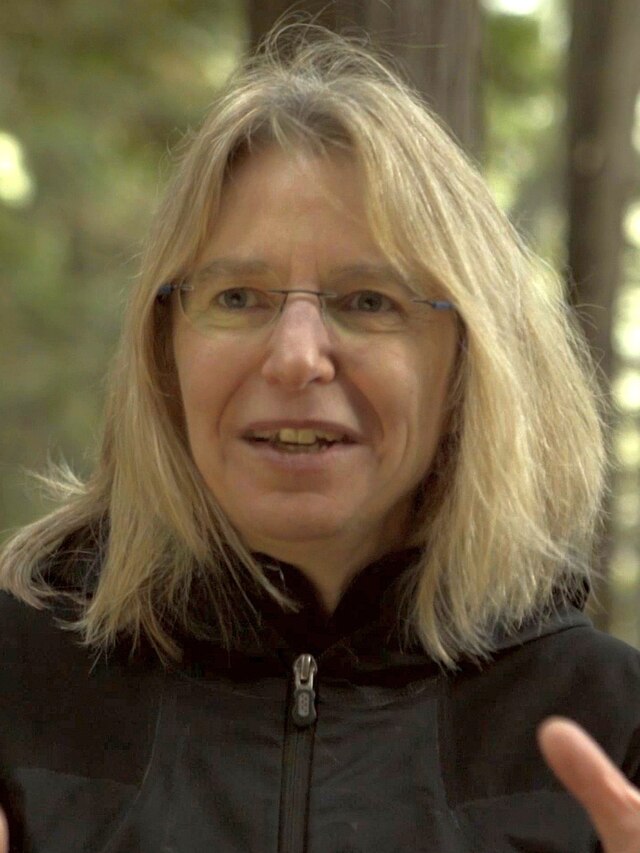
Suzanne Simard
Canadian scientistWikipedia
12
MENTIONS
8
EPISODES
8
PODCASTS
Search complete. 12 mentions across 8 episodes found for "Suzanne Simard".
Sep 17, 2026

Sophie Jane HardyHOST
It's ...
Sophie Jane HardyHOST
And I'm seeing us as, um, as mother trees, so this idea from Suzanne Simard that there are these big trees in the forest who through the mycelial network, fungal network are, um, nourishing and supporting each other, and they're sending nutrients out to where, where it's needed.
Sjanie Hugo WurlitzerGUEST
Mm-hmm
Sophie Jane HardyHOST
You know, so to feel if it does, like, kind of punch you in the heart like it did when, when you shared on the retreat this idea of these sites being desecrated, the work's already been done underground [laughs] you know, and this network is so strong already.

Rafe MartinHOST
But as a preface, I want to read you a few quotes from a novel by Richard Powers, The Overstory, which is very much about the consciousness of trees.
Rafe MartinHOST
So a few quotes, and a lot of this is based, the information he presents is based on the very real work, not fictional, the Canadian botanist Suzanne Simard.
Rafe MartinHOST
And you'll see a little later in the Tay Show, Jill Lepore in the New Yorker or the New York Times, I don't remember which, quoted her in an article about how trees have saved us at this point.
Rafe MartinHOST
Anyway, here are a couple of quotes.
21 MINS LATER
Rafe MartinHOST
That's pretty astonishing.
Rafe MartinHOST
The arrogance of what human cultures have done with that connection is very humbling.
Rafe MartinHOST
In the novel The Overstory, Richard Powers talks of experiments by the Canadian ecologist Suzanne Simard, who concludes that plants form communities and guilds, communicate with one another chemically, as well as across species.
Rafe MartinHOST
Her central point is that trees care for one another.

Jonathan RoseGUEST
So you get to hear ideas like that.
Jonathan RoseGUEST
A woman named Suzanne Simard, who is the leader who really figured out how trees talk to each other.
Jonathan RoseGUEST
And again, trees are both supporting themselves and they're creating-- They're definitely supporting the common good through their roots.
Jonathan RoseGUEST
They're distributing carbohydrates and nutrients to each other.

Kai DickensHOST
[gentle music] So what if Nina's tapping into something we simply don't yet know how to measure? The same way tree communication sat in the shadows for decades before science finally recognized it.
Paul StametsSOUNDBITE_SPEAKER
Suzanne Simard's work actually kind of pierced the envelope and brought us to a new level of understanding that deciduous and conifer trees can actually exchange nutrients.
Kai DickensHOST
Dr. Suzanne Simard is a forest ecologist whose research changed how the world understands tree communication.
Kai DickensHOST
Her groundbreaking book, Finding the Mother Tree, is incredible.
Kai DickensHOST
And here's Dr. Simard in 2016 talking about one of her experiments.
Kai DickensHOST
She's a member of the Tsimshian Nation, native peoples who are indigenous to the Pacific Northwest in British Columbia.
Teresa RyanSOUNDBITE_SPEAKER
My Tsimshian name is Simhayets.
Teresa RyanSOUNDBITE_SPEAKER
I did my second postdoc with Suzanne Simard.

speaker_4ADVERTISER
Watch the CEBL all season on CBC and CBC Gem.
Matt GallowayHOST
We've talked to Suzanne Simard, forest floor researcher.
Matt GallowayHOST
She means she looks at, at what's beneath the surface-
Nalini NadkarniGUEST
Yes

Tom WesselsGUEST
Well, we know that's not the case now.
Tom WesselsGUEST
Starting with Suzanne Simard's work back in the mid-90s, looking at mycorrhizal fungal communities and forests, these mycorrhizae associate with the roots of photosynthetic plants.
Tom WesselsGUEST
So what they do is that's where they get their energy resource.
Tom WesselsGUEST
They extract the plant sugars from the roots of that plant.

James SteidleGUEST
And then finally, one guy got exasperated with me, government scientist.
James SteidleGUEST
And he's like, you know who you need to talk to? You need to talk to Suzanne Simard.
James SteidleGUEST
Never heard.
James SteidleGUEST
This is 2010.
James SteidleGUEST
She wasn't really a household name at that point.
James SteidleGUEST
So I called up Suzanne Simard.
James SteidleGUEST
And here's the first person who is like, Yeah, it's crazy.
James SteidleGUEST
Aspen's an amazing tree.

Julie HirtHOST
You know, I'm, 'cause I'm curious about... 'Cause I, what you're saying, I also am like, oh, where can you find evidence, and I'm using air quotes, um, evidence of this, like in the natural world or in the 3D world.
Julie HirtHOST
And I'm a big fan of Suzanne Simard, who wrote Finding the Mother Tree, and then she has a new book out, When the Forest Breathes, which is wonderful and heartbreaking and everything.
Julie HirtHOST
In this march of the trees, because of climate change, the trees are marching to the north in an effort to survive as best they can because it's as a warming planet.
Julie HirtHOST
So I'm curious, I kinda think what you're saying with the, how the animals are creating the, the light code, the blueprints and whatnot for going forward is then, 'cause what comes in behind those trees marching to the north, so that feels like that might be part of that h- the healing repopulation work Gaia, how Gaia can heal and survive, which she will.