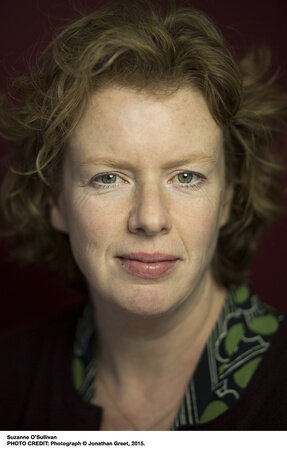
Suzanne O'Sullivan
Physician
15
APPEARANCES
15
PODCASTS
Nov 1, 2026


Louise PerryHOST
What are some of the other mechanisms we know about that can cause real physical symptoms?

Suzanne O'SullivanGUEST
So when I qualified as a doctor, you know, there was so little thought being put into this, but we're beginning to develop kind of theories and understanding of how you can get a real physical symptom in the absence of disease.
Suzanne O'SullivanGUEST
And in order to understand those mechanisms, one has to understand how the brain processes information.
Suzanne O'SullivanGUEST
So I think, you know, we kind of think very often, or we sort of, it feels instinctual to believe that we're experiencing the world exactly as it is, when the reality is that we are, as information enters, we are very rapidly manipulating it in our brains to interpret it according to our understanding of the world.
Suzanne O'SullivanGUEST
So we're not soaking up information like a sponge or like a video camera.
Suzanne O'SullivanGUEST
You know, sensory information is coming in from below, And I'm quickly manipulating in my head to say, what's that? So I often use the example of, say, look at something like a mobile phone.
20 MINS LATER


William CrawleyHOST
More widely, though, Suzanne, do we have an over-diagnosis problem when it comes to ADHD?
Suzanne O'SullivanGUEST
Yeah, I mean, I, I would certainly say we do have an over-diagnosis problem.
Suzanne O'SullivanGUEST
That's not to say that I would disagree On the, on the reality that underdiagnosis also exists.
Suzanne O'SullivanGUEST
Um, whether, to what degree it exists now is very hard to say, but I would say the majority problem is overdiagnosis.
Suzanne O'SullivanGUEST
And I, I wanna be super clear because I think people misunderstand this term.
Suzanne O'SullivanGUEST
They think it means that a diagnosis is fundamentally wrong or they think it means a person isn't suffering.
William CrawleyHOST
And then Suzanne, the question [laughs] some are asking, um, why do people so often want this diagnosis, this label? Some are pointing at social media, some are saying there may be peer pressure, some are saying, has this become fashionable because of interviews done by, by celebrities? What, what's the pull factor towards this diagnosis?

Suzanne O’SullivanGUEST
you have to realise that we didn't even have things like, so MRI scans only came into regular clinical use in the 1990s.
Suzanne O’SullivanGUEST
But, you know, even then in the 1990s, they were quite blunt instruments.
Suzanne O’SullivanGUEST
You know, the images, we look back at them now and say they were very fuzzy.
Suzanne O’SullivanGUEST
You know, it's really only in the last, say, 10 years or so that we've had, you know, these incredibly good images that have been widely available.
Suzanne O’SullivanGUEST
But that's how long we've had to find out what, before something like the MRI scan, we didn't even know what the inside of the healthy body looked like because you couldn't do CT scans in everyone because they came with big doses of radiation.
Suzanne O’SullivanGUEST
So this is, we are so early in this stage of scanning the inside of people and therefore, We are only now beginning to learn about all those internal differences.

Aylin ElçiCORRESPONDENT
How do you draw the line between prevention and over-diagnosis? How do you make sure that people still get the help they need or do the screenings they should do? Yeah.


Suzanne O'SullivanGUEST
So what I need people to understand, and the reason that I included Lyme disease in the book, is because I want-- I think there's a sort of a perception sometimes that you go to your doctor, you have a blood test, the blood test comes back, and it says positive, you have the thing.
Suzanne O'SullivanGUEST
You know, I, I spend the morning in the office looking through the blood tests of my patients and brain scan results and so forth, and you almost never get a full range of tests back that say these are all completely normal.
Suzanne O'SullivanGUEST
Because we all look very different on the outside, and we are equally different on the inside, and yet we kind of expect from these test results some sort of immediately easily interpretable positives and negatives and normals and not normals.
Suzanne O'SullivanGUEST
In the case of Lyme disease, and for every blood test actually, there's a, just a dozen caveats.
22 MINS LATER


Claire SandersonHOST
At, at what point in your career did you think this over-diagnosis is doing more harm than good?
Suzanne O'SullivanGUEST
Yeah, I think, you know, it's been a gradual thing that's happened over the last kind of 10 to 20 years.
Suzanne O'SullivanGUEST
Let me just kind of explain what I mean by over-diagnosis, because I always think that people hear that word and they think, "Oh, she's saying there's nothing wrong with you.
Suzanne O'SullivanGUEST
You're complaining about nothing." So over-diagnosis and misdiagnosis are completely different things.
Suzanne O'SullivanGUEST
Over-diagnosis, the diagnosis might well be entirely correct, but it's not necessarily benefiting you.
26 MINS LATER
Claire SandersonHOST
Are you saying that there are people getting diagnosed with autism who are not autistic, or that the parameters in which we assess aut- uh, conditions like autism and ADHD have shifted throughout the years?

Claire SandersonHOST
At what point in your career did you think this overdiagnosis is doing more harm than good?
Suzanne O'SullivanGUEST
Yeah, I think, you know, it's been a gradual thing that's happened over the last kind of 10 to 20 years.
Suzanne O'SullivanGUEST
Let me just kind of explain what I mean by overdiagnosis, because I always think that people hear that word and they think, oh, she's saying there's nothing wrong with you.
26 MINS LATER
Claire SandersonHOST
Are you saying that there are people getting diagnosed who are not autistic or that the parameters in which we assess conditions like autism and ADHD have shifted throughout the years?

Güneş TaylorHOST
But then on the flip side, there's a lot about, I mean, you know, we hear a lot about people talking about sort of feeling validated, right? And this idea of validation and being seen is something that, again, I would say on the opposite pole of the sort of Huntington's side of the spectrum was the chapters where you talked about Lyme's disease and long COVID, for example, right? So I'm curious as to how you think about the different types of things that can go wrong with people's bodies and the sort of how these labels sort of affect that, if that makes sense.
Suzanne O'SullivanGUEST
Yeah, no, let me, because it is a very sort of, you know, let's say that, you know, 20 years ago or before I started worrying and thinking deeply about this subject, I might have thought that an explanation is always a good thing and that there's no particular downside to it.
Suzanne O'SullivanGUEST
What I really want people to understand is that every time you get a medical label or a diagnosis, it potentially brings benefits and a potentially... can be harmful in other ways.
Suzanne O'SullivanGUEST
And I would say that generally, if you're at the severe end of a disease or disorder spectrum, so let's say you have a disability that's very, very disabling, so you can't function normally in the world, then a diagnosis which brings an explanation and support is generally very helpful because you need a lot and you have a lot to gain.
Suzanne O'SullivanGUEST
And the harm of having your difficulties labelled as disease or disorder is very small because you are already disabled by the disorder.
Suzanne O'SullivanGUEST
So when I'm talking about problems like overdiagnosis and harms of diagnosis, I'm always talking about that other end of the spectrum where the symptoms or difficulties are much fewer.
19 MINS LATER
Güneş TaylorHOST
So what do you recommend actually that people sort of how they conduct themselves given the state of the world now?

12:44

I suppose just to get the background to all of this, can you just start by reminding us why the surgery for incontinence was stopped back in 2018?
Suzanne O'SullivanGUEST
So for years, we had been using tapes or sort of strips of vaginal mesh for stress incontinence surgery since about the late 1990s.
Suzanne O'SullivanGUEST
And during the, I suppose, mid 2015, 2016, some controversies arose out of the use of vaginal mesh for prolapse, which is an entirely different operation.
Suzanne O'SullivanGUEST
Now, the concerns were about transvaginal mesh for prolapse and not for stress incontinence.
15:41
God, it's so frustrating, particularly for the women, and obviously must be very frustrating for you in your job, because I take it you're dealing with the women, you know they need this operation, and you're obviously dealing with women who are saying to you, Suzanne, I don't want to go overseas for the procedure.


Derek ThompsonHOST
So maybe tell us a bit about how the autism story and the ADHD story fit together in a way that might build up toward a larger thesis here.
Suzanne O'SullivanGUEST
So we all can, are aware that autism, there is a great many more people with autism in the world than there used to be, because most of us didn't know many people with autism, and now I think most of us know, um, many people with this diagnosis.
Suzanne O'SullivanGUEST
So the first possibility is that autism itself is becoming more common for whatever reason.
Suzanne O'SullivanGUEST
Um, I don't believe there's any good evidence to say that the, the actual set of symptoms that are autism...
Suzanne O'SullivanGUEST
We're talking about woolly things here, we've got to remember, because there's no objective evidence that ADHD or autism are discrete disorders.
10 MINS LATER
Derek ThompsonHOST
How would you fill out this story of the cost to our bodies of over-diagnosis and over-medication?

35:58

It's not a complete data set, and also, most importantly, how we diagnose autism has significantly changed over time." Has there been a kind of mission creep in autism diagnosis, the very way we define the spectrum, and is that a good or a bad thing?
Suzanne O'SullivanGUEST
Yeah, so I believe that the increase in the diagnostic rates of autism, so what Professor Pask has said very clearly, this is a, a snapshot of diagnostic rates.
Suzanne O'SullivanGUEST
What we're seeing here is a gradual increase in the number of people being diagnosed with autism based on multiple factors, the biggest of which is that we have softened and softened and expanded and expanded the diagnostic criteria for autism to make them more and more inclusive, and we've done that for very good reason because somebody felt that we were under-diagnosing, we could help more children if we made the diagnoses more inclusive.
Suzanne O'SullivanGUEST
So that's the primary reason why these diagnostic rates are rising, but then also for the reasons that, uh, Professor Frances has said, where people are more aware of the diagnoses, they're seeking it.
Suzanne O'SullivanGUEST
But to come to your second half of your question, is it a good thing?Well, I would have to really question whether or not it was a good thing.
Suzanne O'SullivanGUEST
The difficulty with diagnosing medical conditions in milder and milder forms is that when you're diagnosing someone with a very mild form of a condition, what they stand to benefit from treatment is quite small, the benefits are small from the treatment.

Suzanne O'SullivanGUEST
You know, they find things, we feel compelled to treat them, and a large number of the people who we treat with these super, super early cancer cells would never have needed to be treated if we hadn't found those cells.
Suzanne O'SullivanGUEST
You have to treat a certain number of people to save one person, and the number of people you have to treat can be very large.
Suzanne O'SullivanGUEST
For example, in prostate screening, um, with, with prostate-specific antigen, which is a blood test, you potentially have to screen 1,000 men to save one life.
6 MINS LATER

Mary WalterHOST
What- to what do we a- attribute this? Is this just the- the ability to diagnose it better?

Suzanne O'SullivanGUEST
Yeah, so what I always say to people is, "You know, d- you have to remember that a lot of the technology we have now to look inside the healthy body has only been available to us for a couple of decades." You know, the MRI scan came into regular use in the 1990s, but the really good MRI scanners have only been around for a couple of decades now.
Suzanne O'SullivanGUEST
So we did not know for a very, very long time what the inside of the healthy body looked like.
Suzanne O'SullivanGUEST
You know, we were not able to genetically test, you know, mass numbers of people until the last 10 years.
Suzanne O'SullivanGUEST
We've got all these new types of technology that allow us look inside the healthy body in a way that we never have before, and we're detecting things that were always there that we didn't know were there.
Suzanne O'SullivanGUEST
So for example, if you look at autism studies of people, you will often find that they have small abnormal cells that didn't progress.
Mike CarruthersHOST
exist.So I get what you're saying about cancer, but s- what about something like heart disease, where it's reversible in many cases, so it would seem the earlier you catch it, the less reversing you have to do, so why not catch it early?


Suzanne O'SullivanGUEST
Um, and I spoke to a lady called Valentina who when she was 28 and pregnant with her first child discovered that Huntington's disease was in the family, and therefore she had a 50/50 chance of ultimately developing Huntington's disease. Now, what that did to her was it devastated her health because it focused her, on her body in a very unnatural way. She was aware of the types of symptoms you can get from Huntington's disease, like changes in mood, um, loss of coordination, and because she was aware of these things, she began looking out for them in herself. If she noticed ordinary things that could happen to anybody like tripping over something or forgetting something, rather than dismissing them as you would when you're healthy, because she was at risk of disease, they really entered her, um, the kind of, um, her anxious attention, and so they became more obvious and she paid more attention to them and then they got worse. So that over the course of 20 years, she became gradually disabled by the fear of developing Huntington's disease, and I'm very happy to say for this incredible lady-
Suzanne O'SullivanGUEST
Exactly. It just means that basically not, not having the diagnosis, you may well be better off, and that's because when you tell someone they have a medical problem, you know, you take a, uh, 15 or 14-year-old child and you say, "Well, your social communication problems, or your difficulties, your interests indicate you have a neurodevelopmental brain problem," well, what happens to that child? They potentially focus on the things they can't do. They focus on the negative aspects of themselves. They, they have lower expectations for themselves. Teachers have lower expectations for them. Then the disorder becomes a self-fulfilling prophecy. You could have a child with difficulties, recognize them, and not give them the label which would more likely help them to focus on the things they can do. So it's not that ca- calling someone autistic at a mild level is wrong. The question is, is it beneficial?


Suzanne O'SullivanGUEST
This is a really good example because you would think that Lyme disease is a fairly straightforward diagnosis.
Suzanne O'SullivanGUEST
So obviously people will be aware that Lyme disease is caused by a bacteria and that you catch Lyme disease by a tick bite.
Suzanne O'SullivanGUEST
And one might assume, therefore, that if you have the bacteria, you must have Lyme disease.
Suzanne O'SullivanGUEST
But Lyme disease is a beautiful example of how subjective diagnosis is, both in the clinical symptoms and in the tests.
Suzanne O'SullivanGUEST
The bacteria that cause Lyme disease are very hard to detect in the blood because there's not loads of them.


Suzanne O'SullivanGUEST
Basically, the way these things come about is that we, as doctors and scientists, are encouraged to make sure we keep as many people healthy as possible, and therefore to find as many people who might be at risk of disease as possible and treat them.
Suzanne O'SullivanGUEST
So we are incentivized to find as many people who might get diabetes as we can, and an absolutely religious belief in the assumption that finding diagnosis early and treating it is the right thing to do.
Suzanne O'SullivanGUEST
So what we'll do is we'll say, "Okay, so to be pre-diabetic used to mean that you had to have a fasting blood sugar of six.
Suzanne O'SullivanGUEST
We might be missing some people." So we expert committee get together and we say, "Let's change that parameter and say you can have pre-diabetes at 5.6." Nothing has changed in science.
24 MINS LATER
