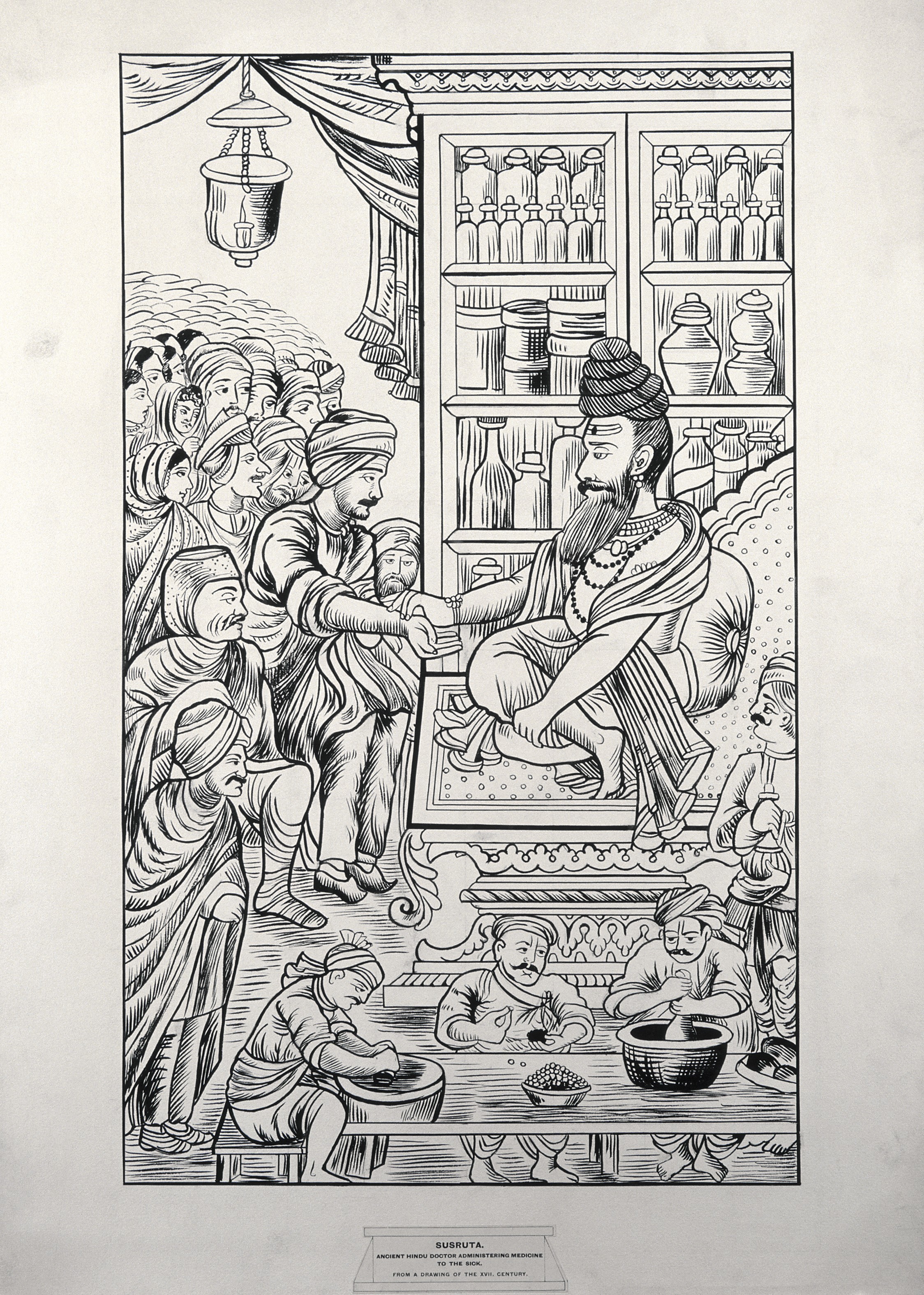
Sushruta
Indian physicianWikipedia
16
MENTIONS
6
EPISODES
6
PODCASTS
Search complete. 16 mentions across 6 episodes found for "Sushruta".
Nov 3, 2026

Vijay MoorthyGUEST
That's interesting.
Vijay MoorthyGUEST
See, Sushruta Samhita, you know, Sushruta is considered the forefather of modern surgery.
Vijay MoorthyGUEST
And Sushruta Samhita was written 3000 years ago.
Vijay MoorthyGUEST
I think it's about second century AD, around between second century.
Vijay MoorthyGUEST
And there, if you really look at Sushruta, That is what is called prasuti, which is about obstetrics.
Vijay MoorthyGUEST
Sushruta says that, you know, until when you can wait for natural birthing and if not, you need to use instruments.
Vijay MoorthyGUEST
And he had developed instruments for birthing.
Vijay MoorthyGUEST
So Ayurveda does not have that romantic feeling that A lot of new age people are saying that, OK, it is all about natural.

Pallavi SmartSOUNDBITE_SPEAKER
Also, as Balbhardi has stated that these changes are in line with the National Education Policy 2020 recommendations, which, as I already said, has greater emphasis on Indian knowledge system.
Ichha SharmaHOST
Pallavi also tells us that in history, Sushruta, described as the father of surgery, now gets a detailed account of his medical contributions, including techniques for reconstructing the nose.
Ichha SharmaHOST
Chanakya, who previously received only a brief mention, has an expanded section covering the Arthashastra, governance, taxation, defence and his role in Chandragupta Maurya's rise.
Ichha SharmaHOST
But it is these changes to the history textbook that raise a different set of questions.

NicholasHOST
So are you familiar with this? So it's one of the three great, it's one of the three great texts.
NicholasHOST
It's Sushruta.
NicholasHOST
So
BridgeHOST
anyway,
NicholasHOST
So I bought Charaka three years ago and then I had been dragging my feet about getting the Ashtanga Hridyam and this one because they had to come from India.
NicholasHOST
But get this.
NicholasHOST
Sushruta, son of Saeed Vishwamitra, is said to be the author of this treatise.
NicholasHOST
It embodies the teaching of his preceptor.

Sameer DossaniGUEST
There's many ways to frame it, but it's all kind of the same thing.
Sameer DossaniGUEST
And you look at, okay, where's the first diagnosis of diabetes, for example, in history? And you go back to this ancient Indian doctor called Sushruta.
Sameer DossaniGUEST
There's some debate about when exactly he lived, but somewhere between the 3rd century BCE and the 3rd century CE.
Sameer DossaniGUEST
So roughly 2,000 years ago.

Theo WrenfieldNARRATOR
Imagine, if you will, a world where healing and stargazing were not separate pursuits, but part of one great tapestry of understanding, woven by scholars who believed that the cosmos and the human form share deep and mysterious connections.
Theo WrenfieldNARRATOR
Long before the Gupta Golden Age began to shine, the foundations of Indian medicine had already been laid by a physician named Sushruta, whose work, though compiled perhaps centuries earlier, continued to guide healers throughout this flourishing era.
Theo WrenfieldNARRATOR
The Sushruta Samhita, a remarkable text attributed to him, reads today like a window into an astonishingly sophisticated medical tradition.
Theo WrenfieldNARRATOR
Within its pages, we find detailed descriptions of surgical procedures, the classification of different types of wounds, and careful instructions for preparing instruments with cleanliness in mind.
Theo WrenfieldNARRATOR
Long before the modern understanding of infection existed, Sushruta described techniques for reconstructive procedures, and physicians trained in his tradition learned to work with remarkable precision and care for their patients.
Theo WrenfieldNARRATOR
Picture a quiet training ground somewhere in ancient India, where students gathered around their teacher, perhaps near the banks of a slow-moving river, practicing their delicate skills not on living patients, but on fought fruits, on the stems of plants.
Theo WrenfieldNARRATOR
or even on the hides of animals, patiently developing the steady hands they would one day need.
27 MINS LATER
Theo WrenfieldNARRATOR
Likely, as with most historical transformations, it was not any single cause but several forces converging together, much as different streams merge to form a river's changing course.