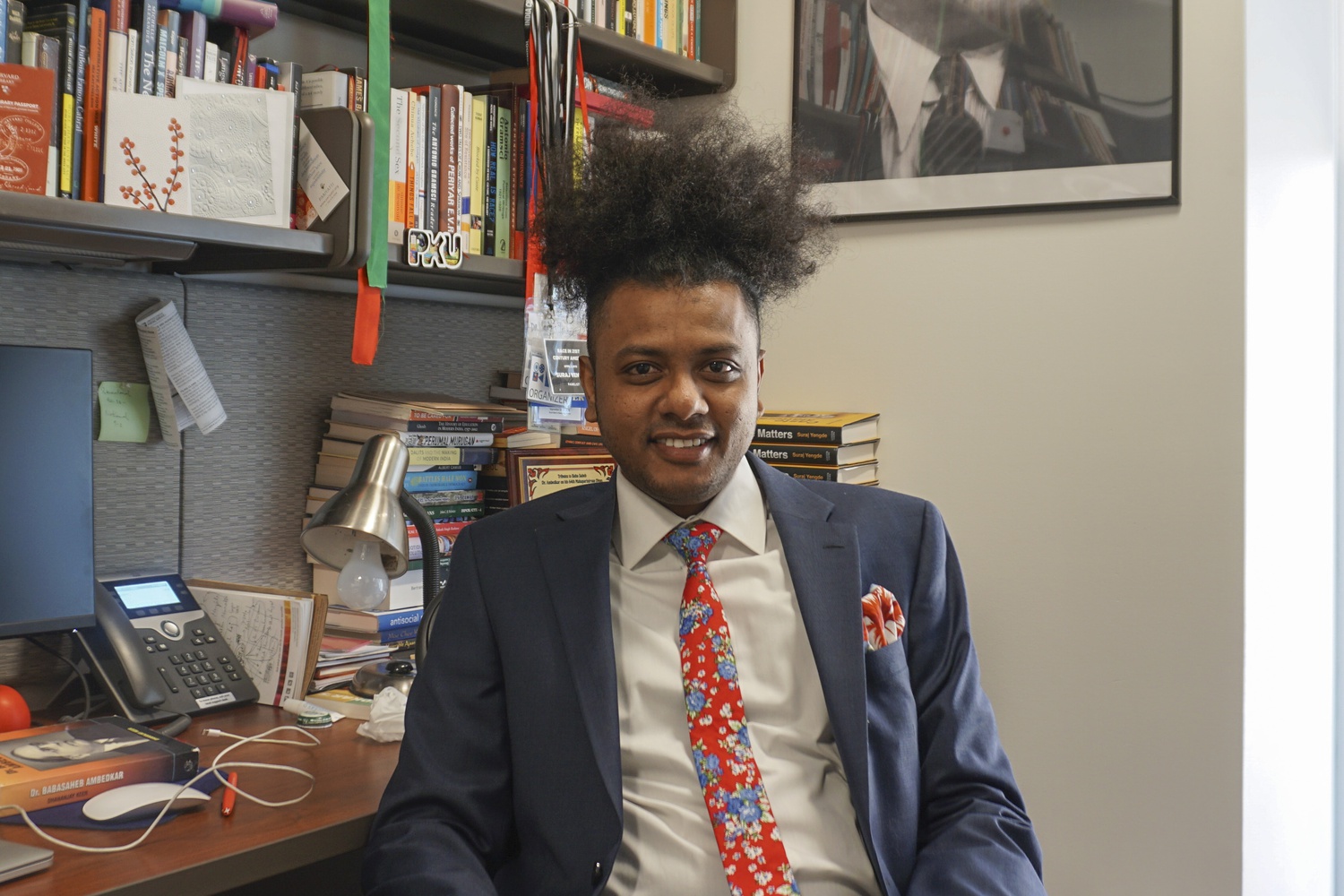
Suraj Yengde
Indian scholar and author
5
APPEARANCES
5
PODCASTS
Aug 26, 2026


Suraj YengdeGUEST
He became the first Dalit to matriculate from the Bombay province, and he didn't stop there because matriculation during that time was pr- probably the highest achievement one could do, and then, you know, you get a job, like a clerical or any kind of job, and you, uh, you know, get married and sustain your life.
Suraj YengdeGUEST
He was, again, the first Dalit to graduate with a BA or in any degree from that province.
Suraj YengdeGUEST
Uh, he could have easily stopped there, but his hunger for knowledge was so, uh, desperate, so he went.
Suraj YengdeGUEST
Um, he was of course offered a suggestion if he, if he wants to pursue education abroad, and he applied to Columbia, and he got through Columbia in 1913, class of 1916.
15 MINS LATER

Piali RoyCORRESPONDENT
Ambedkar's words are from a 1931 transcript from a meeting between him and Gandhi.

Suraj YengdeGUEST
It's, uh, you know, the Black movement, for example, by the 19th century itself, uh, was global in nature, as in the abolitionist here in this part of the world where I'm right now, uh, in the New England area, uh, was, was really advocating through this channels of commonwealth.
Suraj YengdeGUEST
Uh, and, and so as a result, uh, the liberation of Black people was very well reported and documented.
Suraj YengdeGUEST
And Ambedkar, being a product of what was happening during Harlem Renaissance, we see, uh, that, you know, there is so much parallels he sees, and he makes a, a, a remarkable argument to say that untouchables here were the surplus labor.
Suraj YengdeGUEST
Whereas here in Black, uh, condition of post-slave society, they were the, this kind of mass exodus of people from south to north, and that's what they created this kind of new civilization.
Suraj YengdeGUEST
His mentor, John Dewey, for example, was somebody who wrote about this, um, Chicago and other regions were creating of a new post-migrant society.

Marco WermanHOST
Hinduism has a strong connection with caste, so what role does caste play for Indo-Trinidadian life?

Suraj YengdeGUEST
parallels? The black movement, for example, by the 19th century itself was global in nature.
Suraj YengdeGUEST
as in the abolitionists here in this part of the world where I'm right now in the New England area, was really advocating through this channels of commonwealth.
Suraj YengdeGUEST
And so as a result, the liberation of black people was very well reported and documented.
Suraj YengdeGUEST
And Ambedkar, being a product of what was happening during Harlem Renaissance, We see that there is so much parallels he sees, and he makes a remarkable argument to say that untouchables here were the surplus labor, whereas here in black condition of post-slave society, they were this kind of mass exodus of people from south to north, and that's what they created, this kind of new civilization.
Marco WermanHOST
Hinduism has a strong connection with caste, so what role does caste play for Indo-Trinidadian life?

Suraj YengdeGUEST
See, I mean, this is again a theory that really needs to be refined and understood.
Suraj YengdeGUEST
Unfortunately, caste, the way it has been presented, is often within the canon of a religion.
Suraj YengdeGUEST
Like, how do you appreciate the caste existing among Muslims or Sikhs? So in this book in particular, the focus was on immigrants or heritage, people with the heritage of South Asian descent.
20 MINS LATER

Sandro GaleaHOST
Looking ahead, what are the most urgent research questions or political interventions needed to deepen our understanding of caste as a global structure?

11:00
Does that mean that caste is more kept in place through consent? That people are consenting to social ranking? Or is it kept in place through violence?
Suraj YengdeGUEST
I had written this article about Amitkar had talked about inter-caste marriages and the future of it.
Suraj YengdeGUEST
But also he said annihilation of caste that it would not be the only solution.
Suraj YengdeGUEST
And so oftentimes when people say how do we annihilate caste, people always go back to this one kind of...
Suraj YengdeGUEST
Because it's easily... a touchable idea about you know intercaste marriage i mean you know go figure and then you see the intercaste violence at the same side you know it's it's it's huge so for us to really assess how caste would really prolong its uh life larger than the shelf expiration date it is by the complicity of the institutions that are meant to challenge caste.
22 MINS LATER
34:35
the kind of analogizing with race or thinking about historical connections, not just analogizing, but thinking about historical connections between, you know, Dalit and African-American experiences is so important to you.