Support vector machine
13
MENTIONS
6
EPISODES
6
PODCASTS
Search complete. 13 mentions across 6 episodes found for "Support vector machine".
Nov 4, 2026

speaker_3HOST
That's fascinating.
speaker_3HOST
But if we pivot back to supervised learning for a second, there is another algorithm that is incredibly vital for security professionals, right? Support vector machines or SVM.
speaker_4HOST
SVM is a massive one.
speaker_3HOST
Let's talk about that.
15 MINS LATER
speaker_4HOST
If you were handed a perfectly labeled historical data set, which supervised algorithm discussed today would you deploy to draw a clear boundary between the threats and the safe traffic?
speaker_3HOST
Good question.
speaker_4HOST
Conversely, if you were flying totally blind on a new network and just needed to find hidden anomalies, which unsupervised algorithm would you rely on? Think deeply about the fundamental mechanical differences between how support vector machines separate known data and how K-means clustering searches for the unknown.
speaker_3HOST
And as you think through that, I want to leave you with a lingering security dilemma.

Tengyu MaHOST
Maybe you also have g.
Tengyu MaHOST
And if you do the new right work, I think we have claimed that neural network is the same as L1 SVM in a kernel space.
Tengyu MaHOST
So then the corresponding thing would be you minimize the L1 norm of A such that the sum of Ai, Vi, Xj is equal to Yj.
Tengyu MaHOST
So in some sense, when you do the neural networks, you have a lot of features, and you're choosing a subset of features, a sparse subset of features.
Tengyu MaHOST
And in contrast, regularizing network only need Neuronuts only need n is equal to all of the samples.
Tengyu MaHOST
Any questions about this? I think this part is a little bit kind of like hand-wavy, because I didn't want to go into all the details.
Tengyu MaHOST
And also, this depends a little bit on what we discussed in the past, right? So L1-SVM connections to the connection between L1-SVM and writeworks.
Tengyu MaHOST
Any questions? So I guess maybe just to wrap up this once again.

speaker_3HOST
Yes.
speaker_3HOST
They then take this vast phase space data and feed it into a machine learning tool called a support vector machine or an SVM.
speaker_2HOST
I want to guess how this SVM works.
speaker_3HOST
Sure.
speaker_3HOST
Try it.
speaker_3HOST
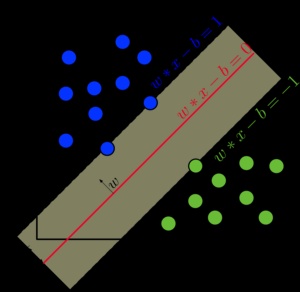
In a simple 2D graph, you draw a line.
speaker_2HOST
But
speaker_3HOST
in face space, which has many dimensions, the SVM calculates a complex multidimensional boundary called a hyperplane.

Neeraj VermaHOST
You know, it's, it's interesting, right? 'Cause general- generalized predictive models are...
Neeraj VermaHOST
So, uh, we've been writing predictive models forever, right? S- whether they're SVM, whether they're neural nets, their heavy use cases are always in analytics, right? When you've got a crap ton of data that you've got to go through and come up with something that's useful-
Eric SiegelGUEST
Yeah
Neeraj VermaHOST
...

John PlattGUEST
Well, you can view SMO as a almost like stochastic gradient descent where it was trying to be what's the minimal change, which way it goes uphill, given that you have this quadratic program.
John PlattGUEST
But of course, the quadratic program is very particular to the mathematical structure of SVMs.
John PlattGUEST
You can view fundamentally SVMs as loss function hacking because instead of okay so if you map for example consider a binary for the simplest case a sigmoid output unit so it's so it's using a cross entropy you know t times log p plus one minus t times log of log one minus p the usual And then you have a sigmoid unit, which is sort of the matched link function to that loss function.
John PlattGUEST
If you map that back to the logit, it looks like a kind of like a ramp.
John PlattGUEST
So asymptotically, it looks linear like this and it's flat.