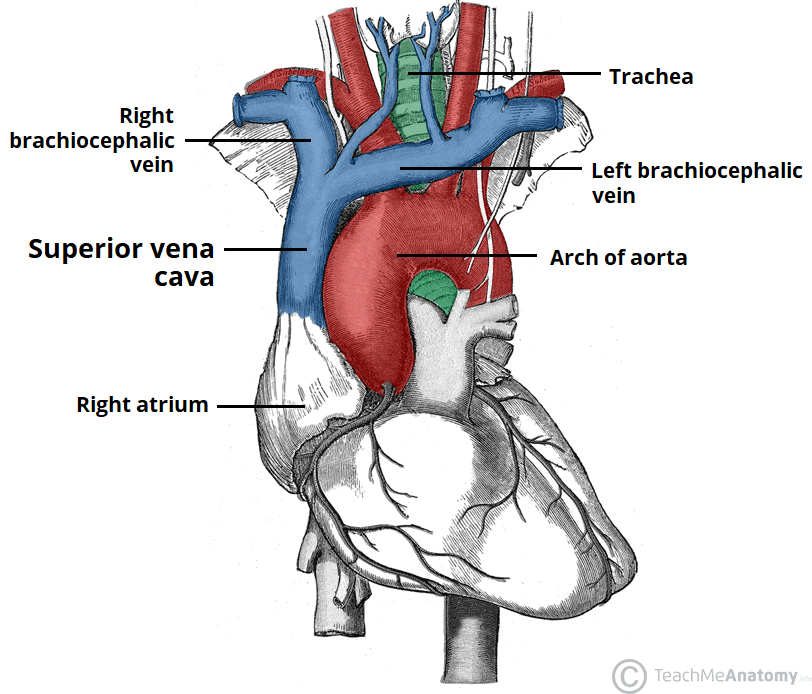
superior vena cava
VenaWikipedia
7
MENTIONS
5
EPISODES
5
PODCASTS
Search complete. 7 mentions across 5 episodes found for "superior vena cava".
Sep 14, 2026

Michael CantyGUEST
So for some reason, some people just don't absorb the fluid from that space, and we need to take it out again.
Michael CantyGUEST
And we can also put it into the superior vena cava, or the, the ...
Michael CantyGUEST
It's called an atrial shunt, but typically it sits just in the, the SVC.
Michael CantyGUEST
That was very commonly done a few decades ago, much less commonly done now.
Michael CantyGUEST
It works really well, but it's a tricky thing to do, a difficult thing to fix when it doesn't work, and it's associated with problems like, uh, venous thrombosis of the jugular vein, or even shunt nephritis where you get this immune complex accumulation onto the shunt catheter in the circulatory system.

Mike CharlesworthHOST
You can confirm the guide wire passing into the IVC or the aorta before you dilate.
Mike CharlesworthHOST
The IVC from a modified mid-esophageal bicaval view, the thoracic aorta in the descending aortic views and from the right internal jugular you can watch the wire pass through the SVC into the right atrium on the bicaval view.
Calum DownesHOST
So you can firm the wire before you put a large bore cannula over it.
Mike CharlesworthHOST
Which makes the dilatation a great deal safer.

NatalieHOST
Perfect.
NatalieHOST
Think about your blue blood returning through your IVC or SVC.
NatalieHOST
It's going into your right atrium.
NatalieHOST
And here it's going to have a choice whether you're a single ventricle that's RV is your pumping chamber to both systems, the pulmonary and systemic, or if it's your left side, that's the pumping chamber.
33 MINS LATER
Megan RollerGUEST
But then it continues to drop over the next couple of months, just at a slower rate.
Megan RollerGUEST
And so by the time you hit your gland, your PVR has dropped to where it's going to essentially be.
Megan RollerGUEST
And I don't know how much you want me to go into gland anatomy and physiology, but basically you are creating a connection between your SVC and your pulmonary artery.
Megan RollerGUEST
And so that is how you're going to be supplying your pulmonary blood flow.

Joel DunningHOST
At the start, you see a, a re-entry, uh, as all pediatric surgeons are so good at doing.
Joel DunningHOST
You then see the, uh, SVC to pulmonary artery anastomosis dissected out.
Joel DunningHOST
Uh, Sami Said's really strict about how you have to dissect everything out off-pump without heparin, which looked very brave to me.
Joel DunningHOST
Uh, and then he dissected out the IVC, uh, and then he stuck a, a conduit on the inferior wall of the pulmonary artery while, uh, obviously blood was still going to the right lung off-pump, which was really impressive, but then came the most impressive bit.

Abhilash KoratalaGUEST
And portal vein tends to be pulsatile at baseline, not like the actual crisp cardiac pulsatility, but more haziness because of arterial portal connections, uh, and you might not be able to use that.
Abhilash KoratalaGUEST
Um, so you're relying more on intrarenal, um, venous flow and, and, and other things you have to look at like which are not in the liver such as IJV in ultrasound or SVC if you're able to access that from subxiphoid or femoral.
Abhilash KoratalaGUEST
However, like these are all based on our experience rather than, uh, having, uh, formidable published data.
Madelyn RenzettiHOST
So in those cases, you're looking at, um, femoral vein, um, pulsatility?