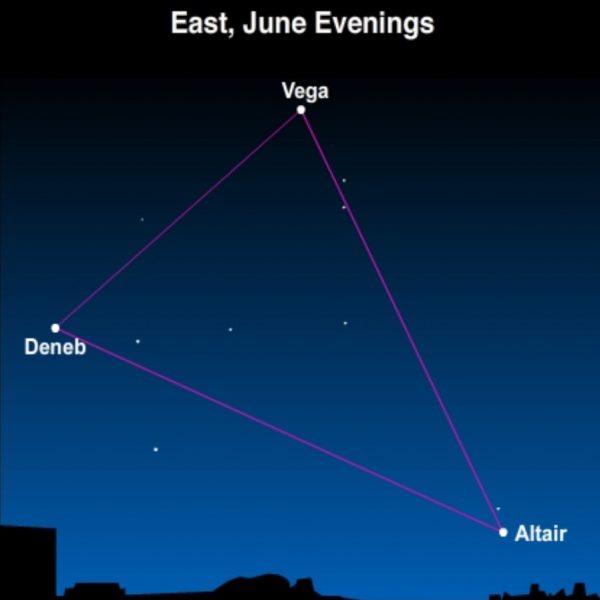
Summer Triangle
18
MENTIONS
9
EPISODES
6
PODCASTS
Search complete. 18 mentions across 9 episodes found for "Summer Triangle".
Nov 1, 2026

Kelly BeattyHOST
With the switch back to standard time, it'll start getting dark by 5 p.m., and there's plenty to see after nightfall.
Kelly BeattyHOST
Look high up in the west, directly above the sunset point, and you'll see our old friends the three bright stars of the Summer Triangle.
Kelly BeattyHOST
Vega, at lower right, is the brightest.
Kelly BeattyHOST
Deneb is above it, by the width of two or three fists held at arm's length, and Altair is farther off to Vega's left.
Kelly BeattyHOST
I suppose Summer Triangle is something of a misnomer, because you'll be able to see this striking trio well into December.
Kelly BeattyHOST
Now turn to your left and draw an imaginary line starting at Vega, downward through Altair, to near the southern horizon.
Kelly BeattyHOST
The only decently bright star in that part of the sky is Fomalhaut.

AnnaHOST
They checked the field of view in Starry Night Over the Rhone from 1888 against photographs taken on site.
AnnaHOST
They suggest the stars in Café Terrace at Night may be the Summer Triangle.
AnnaHOST
Kim's line is that the conversation with Van Gogh's Other Skies is still going.
AveryHOST
Now the other side, because there is one.

Mark BreenHOST
This week's highlights shine high overhead, and for the sake of your neck, you'll want to view the top of the skies from a more relaxed, perhaps reclining position, and dressed warmly for our cool evenings.
Mark BreenHOST
Just minutes before 8:00, our focal point, the star Deneb, sits exactly at the zenith, currently the highest star in the Summer Triangle, itself quite high in the southwest.
Mark BreenHOST
Almost directly below Deneb in the north, but quite high, look for a square of slightly brighter stars connected to a triangle of slightly brighter stars just below it.
Mark BreenHOST
It appears as an upside-down house or perhaps an ice cream cone, though this celestial figure represents King Cepheus, the square perhaps his head, and the triangle as his crown.
Mark BreenHOST
Although the stars aren't impressively bright, his pattern and location actually create a relatively good representation of this serpentine creature.
Mark BreenHOST
To the upper left of his head, very high and due west at 8 o'clock, the piercing, steely blue star Vega combines with Deneb overhead and the star Altair in the southwest to form the summer triangle.
Mark BreenHOST
Thursday, royalty reigns from on high on Night Sky.
Mark BreenHOST
Night Sky is a production of Vermont Public and the Fairbanks Museum and Planetarium.

Billy NewmanHOST
So Hercules is a cool one to, to get to go out and spot pretty easy with a lot of the, the North American summertime stuff that we got up here.
Billy NewmanHOST
So, uh, I think it's like, uh, you know, if you're looking at like the Summer Triangle of like Vega and Deneb and Altair, sort of that band of the Milky Way, it would be west of that.
Billy NewmanHOST
It would have risen before then, so it'd be kind of up, up above there as you're kind of moving up toward the, um, uh, Corona Borealis and, uh, and then over a little further west from there up between like Arcturus and Boötes and then the Corona Borealis and like Hercules and then like as you're kind of getting into Lyra and Vega and the Milky Way stuff over there.
Billy NewmanHOST
But yeah, Hercules, cool constellation to check out.

Ian LauerHOST
I'm Ian Lauer, and this is Star Stories.
Ian LauerHOST
[intro music] [page turning] Tonight, we're looking at the Summer Triangle, named because after sunset in summer in the Northern Hemisphere, if you look up above you, you'll see a group of three of some of the brightest stars in the night sky form a giant triangle.
Ian LauerHOST
And those stars are Deneb, Altair, and Vega.
Ian LauerHOST
Tonight's story about the Summer Triangle comes to us from ancient China.
Ian LauerHOST
And the earliest recordings we have of this story comes from about two thousand six hundred years ago.
Ian LauerHOST
But what's really fascinating about this story is that because the ancient Chinese wrote down a lot of what they did, we can see how this story changed over time into the narrative that most people know of today.
8 MINS LATER
Ian LauerHOST
And I actually told my wife this story before recording this episode, and she thought, "Yes, it's a beautiful story, but it's also really sad that she can only meet her lover once a year." So I'm curious what you think about this story.
Ian LauerHOST
Uh, I think it's sad as well.
Mark BreenHOST
As we head for the middle of October this week, let's turn our focus to the middle of the sky, so to say, the top of the sky.
Mark BreenHOST
And we'll start by taking that literally, the very top, the zenith of the heavens, where at 8.05 this evening, shifting back to 10 of 8 by the end of the week, a bright celestial beacon anchors one of the points of the summer triangle, the star Deneb.
Mark BreenHOST
I don't think Deneb has achieved the level of other noteworthy stars.
Mark BreenHOST
It's no North Star, Polaris, or Sirius, or Alpha Centauri, though it ranks as the 15th brightest star we can see, which makes it brighter than the North Star.
Mark BreenHOST
It's the least bright star of the Great Summer Triangle, but it certainly holds its own in that trio.
Mark BreenHOST
And with any comparison, it should be noted Deneb achieves such brilliance from an astounding 2,600 light-years away, tens, even hundreds of times farther than almost any other star.
Mark BreenHOST
From Deneb, we'll expand our view to the Dragon, the King and Queen, and others.

Paul HillHOST
...
Paul HillHOST
Summer Triangle still over there and-
Jenifer MillardHOST
Yeah
Paul HillHOST
... look down.
Stuart GaryHOST
Despite its size, Altair spins on its axis in just 10 hours compared to our Sun's 28 Earth day rotation.
Stuart GaryHOST
Now, these three stars, Altair, Deneb, and Vega, form a stellar grouping known as the Summer Triangle.
Stuart GaryHOST
Now, also in October, there are three meteor showers, the Draconids, the Taurids, and the Orionids.
Stuart GaryHOST
The Draconids take place on October the 8th.