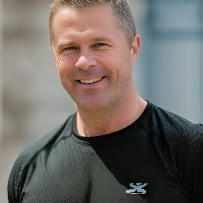
Stuart M Phillips
Researcher
9
APPEARANCES
9
PODCASTS
Aug 19, 2026


Stuart PhillipsGUEST
There's a whole industry selling entrepreneurs productivity hacks, cold plunges, nootropic stacks, supplement stacks, the perfect morning routine, a new note-taking system.
Stuart PhillipsGUEST
So as a founder, your scarce resource is attention, and you should spend it where the return is biggest.
Stuart PhillipsGUEST
So let me give you the four big levers, sleep, nutrition, movement, and muscle.
13 MINS LATER
John Lee DumasHOST
But the biggest thing that I hear is, "JLD, I have no time." So what's the minimum effective dose of health habits that actually can deliver the biggest return?


Stuart PhillipsGUEST
Everything we've done in weight loss has always been in conjunction with exercise, right? So, you know, just flat out admitting we've never just restricted energy and asked people to lose weight.
Stuart PhillipsGUEST
So we've always combined it with exercise and we found that in women, for example, they can actually do the, it's the holy grail of body, what's called recomposition, which is lose fat, but gain muscle on 1.3 grams of protein per kilogram body weight per day.
Stuart PhillipsGUEST
So it's not like it's impossible to do, it's difficult, But you do have to provide a resistive stimulus to the...
Stuart PhillipsGUEST
So you have to do some form of weightlifting or really I think I'll call it some type of hatha yoga, like a sort of an aggressive yoga posing, not just the static hold poses.

Tom RifaiGUEST
But he would say that exercise is king, nutrition is queen, and put them together and you have a kingdom.

35:38

So any other thoughts on like sleep, how to kind of mentally wrap your head around?

Stu PhillipsGUEST
I mean, I think I think that, you know, and there's a perfect analogy in the in the sporting world.
Stu PhillipsGUEST
And when you talk to people at the really high levels of sport, they you know, they want to track a lot of things, particularly in season around sleep.
Stu PhillipsGUEST
you know, what's this injury doing? How do you feel and everything like that? And, you know, so you could do urine samples, blood samples and all of these things and measure like a million different things and then look for what's predicting, you know, are we heading into a phase with a particular player or something like that, where there might be a greater risk of injury.
Stu PhillipsGUEST
And yet they find that the thing that kind of correlates best is when the player self reports, like, I'm a four out of 10, where 10 is like, I'm crushing it, right? And when you're in season, you make, you could expect maybe you're never higher than a seven, you know, because you're, you know, experiencing everything.
9 MINS LATER

Stuart PhillipsGUEST
We used to think that it mattered quite a bit about w- you know, when the timing was immediately before or immediately afterwards, and I think all the research that's been done since that time has shown us that the window of opportunity for getting protein before or after is actually open for a really long time.
Stuart PhillipsGUEST
So, uh, I stress about that far less and just say sometime in the three to four hours afterwards is probably a good window.

Sanjay GuptaHOST
Phillips also wanted to add a little bit of perspective to the entire discussion.
Stuart PhillipsGUEST
My take is that when I look at social media in particular, it's made very, very confusing, and I think that's a little, um...
Stuart PhillipsGUEST
Like it's a bit of a marketing ploy to get people to buy into someone's program or someone's supplements or whatever it is.

Stuart PhillipsGUEST
And I know everybody then sort of talks to me about going through puberty as being this big surge of testosterone and everything.
Stuart PhillipsGUEST
And I'm like, that's true, but it happens one time in your life, and it literally is like a fold difference in hormonal concentration, as opposed to the small variations in these hormones that women would experience, say, across a menstrual cycle, and even their decline through perimenopause.
Stuart PhillipsGUEST
When we pull those things apart, we see far less evidence that it's working on a molecular level in humans.
Stuart PhillipsGUEST
So that cued us to at least be, to quote Ted Lasso, to at least be curious, to ask the question.
Stuart PhillipsGUEST
So you design some human experiments and you do a few things, you manipulate experimental designs.
20 MINS LATER

Kristen ParisiHOST
When we think about longevity and we think about aging well, is there something that surprises you about what keeps people really independent?


Jila SenemarHOST
Are they under eating? Are they not eating the right kind? What are we missing? And what is the appropriate number that we should just really be using as a guideline?
Stuart PhillipsGUEST
You hit on an interesting point in asking the question, and it sort of struck me quite a bit, is that people are confused.
Stuart PhillipsGUEST
And that's a shame, because I do have a friend, she works on the social science side of things, but who will tell me that women are the least confident in themselves about And they feel, and this is horrible, but they feel badly about how they look and everything else like that.
12 MINS LATER
speaker_7ADVERTISER
no,

Stuart PhillipsGUEST
Uh, within the essential, we've got these three special branched-chains, but I'm telling you that only one is kinda like the big deal.
Stuart PhillipsGUEST
It, it, it fires up the process and, you know, if you don't have it, then it doesn't work, or if you just give it and don't give the others, it doesn't work.
Stuart PhillipsGUEST
So, so I think the, the sort of ethos is, is if you think about the branched-chains themselves, they all have this characteristic what we call side chain.
6 MINS LATER


Brendan ByrneHOST
And then maybe tie it back also to things like insulin resistance or chronic inflammation, how, how those things interact with anabolic resistance.
Stuart PhillipsGUEST
I, so anabolic resistance, um, describes the phenomenon that the two main stimuli that we have to turn on muscle protein synthesis, so, so to make new muscle, push amino acids into muscle protein, are, are exercise and the consumption of dietary protein.
Stuart PhillipsGUEST
So we then, we raise amino acids in our blood and we stimulate the formation of new muscle.
Stuart PhillipsGUEST
Um, you know, as you get older, what we've found for a given dose, so if you compare a 20-year-old, let's say, to, and the data that at least that we've generated would be somebody probably in their late 60s, early 70s.
Stuart PhillipsGUEST
So that, you know, that's a fairly steep ob- obviously, uh, incline, but, um, the, the, the 70-year-old is not as efficient at making new muscle protein as the 20-year-old.
Stuart PhillipsGUEST
And so, you know, something's been, been lost, right? And the question is, you know, what is it, right? Is it, is it something like insulin resistance? Is it blood flow? Is it mitochondria? Is it...
6 MINS LATER

Stuart PhillipsGUEST
We've got some ideas, but those two, I'll just call them observations, to me, really indicate that the methodology is not particularly good.
Stuart PhillipsGUEST
So, you know, fast forward to 2025, we've got some methodologies now that I think are better.
Stuart PhillipsGUEST
Um, the problem is, in science, is, is coming to some degree of agreement about how good those methodologies are.
36 MINS LATER
