Streptococcus
BacteriaWikipedia
37
MENTIONS
22
EPISODES
20
PODCASTS
Search complete. 37 mentions across 22 episodes found for "Streptococcus".
Sep 15, 2026

speaker_4HOST
It was the first true broad-spectrum antibacterial.
speaker_4HOST
But when they dropped Prontosil Red onto a Petri dish full of Streptococcus...
DaveGUEST
Nothing happened.
speaker_4HOST
Literally nothing.
DaveGUEST
Well, the biggest architectural divide is between gram-positive and gram-negative bacteria.
speaker_4HOST
Right.
speaker_4HOST
So in gram-positive bacteria like Staphylococcus or Streptococcus, that eptadal glycan chain-link fence is incredibly thick.
speaker_4HOST
It's tightly cross-linked.

MichelleGUEST
Um, so basically it comes under, like, a subset of PANS, which is a pediatric acute-onset neuropsychiatric syndrome.
MichelleGUEST
Um, and basically PANDAS then is a subset of that, which means it's associated with Strep A infection, which, as we all know, is a really common infection in children.
Neil PrendevilleHOST
Strep, yeah.
MichelleGUEST
Yeah.
9 MINS LATER
Neil PrendevilleHOST
T- before we continue with the story, because most parents will be w- will be worrying now if, if, you know, if there's any touch of a cough at all, is it whooping cough? Is it whooping cough? Is it strep? Is it just a sore throat? What, what is strep?
MichelleGUEST
So strep is e- like, it's very common.
MichelleGUEST
I mean, Strep A, some of us carry Strep A in our systems but never develop the symptoms.
MichelleGUEST
So we've all been tested, and we, we, we, now we're not carriers.
MichelleGUEST
Um, so basically, it comes under, like, a subset of PANS, which is a pediatric acute-onset neuropsychiatric syndrome.
MichelleGUEST
Um, and basically, PANDAS then is a subset of that, which means it's associated with Strep A infection, which, as we all know, is a really common infection in children.
Mick MulcahyHOST
Strep, yeah.
MichelleGUEST
Yeah.
9 MINS LATER
Mick MulcahyHOST
Is it whooping cough? Is it strep? Is it just a sore throat? What, what is strep?
MichelleGUEST
So strep is, like, it's very common.
MichelleGUEST
I mean, Strep A, some of us carry Strep A in our systems but never develop the symptoms.
MichelleGUEST
So we've all been tested, and we, we, we know we're not carriers.

Bill SimmonsADVERTISER
Gram-positive bacteria
Hank GreenHOST
have thick cell membranes, and they're a huge group that includes species that live individually, like Staphylococcus and Streptococcus, as well as some colonial bacteria that are responsible for diseases like leprosy and tuberculosis.
Hank GreenHOST
And there are lots of gram-negative bacteria, too, which have thinner membranes.
Hank GreenHOST
The biggest group here are the proteobacteria, named after Proteus, because they take so many forms.

KellyHOST
You're already familiar with two of these gangs through clinical experience.
KellyHOST
Strep and staph are terms we use clinically that refer to bacterial arrangement.
KellyHOST
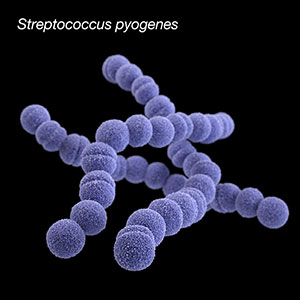
Strep is a chain of cells and staph is a clump of cells.
KellyHOST
Cocci bacteria can appear as chains or clumps, but rods do not clump up, so you'll never hear the term staphylobacilli.
KellyHOST
That gang doesn't exist.

Chuck CarrollHOST
Uh, strep I'm familiar with.
Chuck CarrollHOST
Streptococcus, I think he ran for president back in the '80s.
Will BulsiewiczHOST
[laughs] '88, I think.
Chuck CarrollHOST
Yeah.

Larry WilsonNARRATOR
The other is also a micrococcus in which the spherical cells are united in chains like strings of pearls.
Larry WilsonNARRATOR
This is called Streptococcus pyogenes.
Larry WilsonNARRATOR
This latter is also called the Streptococcus of erysipelas because it has been demonstrated to be the cause of erysipelatous inflammations.
Larry WilsonNARRATOR
These two species of pathogenic bacteria give rise to a great variety of infectious processes.
Larry WilsonNARRATOR
Both are found either separately or associated in the pus of abscesses, in boils and carbuncles, in suppurating wounds, in puerperal fever, in peritonitis, in suppurative disease of the ear, in general blood poisoning, etc.

Spring HatfieldNARRATOR
and 700 kinds of bacteria can live in the human mouth.
Spring HatfieldNARRATOR
Streptococcus species are common in the oral cavities of both healthy people and people who have periodontitis.
Spring HatfieldNARRATOR
Following trauma or dental procedures such as root canals or extraction, oral bacteria can enter the bloodstream and remain there up to a few hours, but don't normally cause problems for healthy individuals.
Spring HatfieldNARRATOR
One particular species of Streptococcus, Viridian Streptococci, can transfer easily into the bloodstream after tooth extraction.
Spring HatfieldNARRATOR
This pathogen is also the most common cause of endocarditis, an infection of the inner lining and valves of the heart.
Spring HatfieldNARRATOR
The Finnish researchers discovered that the bacteria had become trapped in atherosclerotic plaques in the relatively short time that the bacteria remained in the bloodstream of the patients in the study.

RabihHOST
So dexamethasone has data that suggests that patient's morbidity improves, uh, if it's given before the antibiotics, so the idea that it tames down the release and the fight of the immune system.
RabihHOST
Um, ceftriaxone is given to treat the most common cause of community-acquired meningitis in almost all age groups, which is to treat Streptococcus.
RabihHOST
Uh, streptococcus pneumonia.
RabihHOST
Vancominus- vancomycin is intent, is intent- is intended not to treat anything else, but to intreat, to treat a small number, about 1%, of stre- strep pneumo that tends to be cefuroxime-resistant, 'cause you can't take any gambles on that.

Cheryl Sew HoyGUEST
And unfortunately, most babies... have either zero, especially if they have a lot of like colicky symptoms, eczema, things like that, or they have like 20%, which is way too low.
Cheryl Sew HoyGUEST
And when there's not this protective bacteria, then other like unfriendly bacteria like E. coli, Klebsiella, Streptococcus, Staphylococcus could inhabit baby's gut and then cause silent issues, like immune issues.
Cheryl Sew HoyGUEST
Like, you know, sometimes they're not acutely sick.
Cheryl Sew HoyGUEST
but they're chronically uncomfortable, maybe have constipation issues or bloating, spit-ups.
12 more episodes mention Streptococcus.
Create an account to see the whole feed, search across every transcript, and follow the entities you care about.