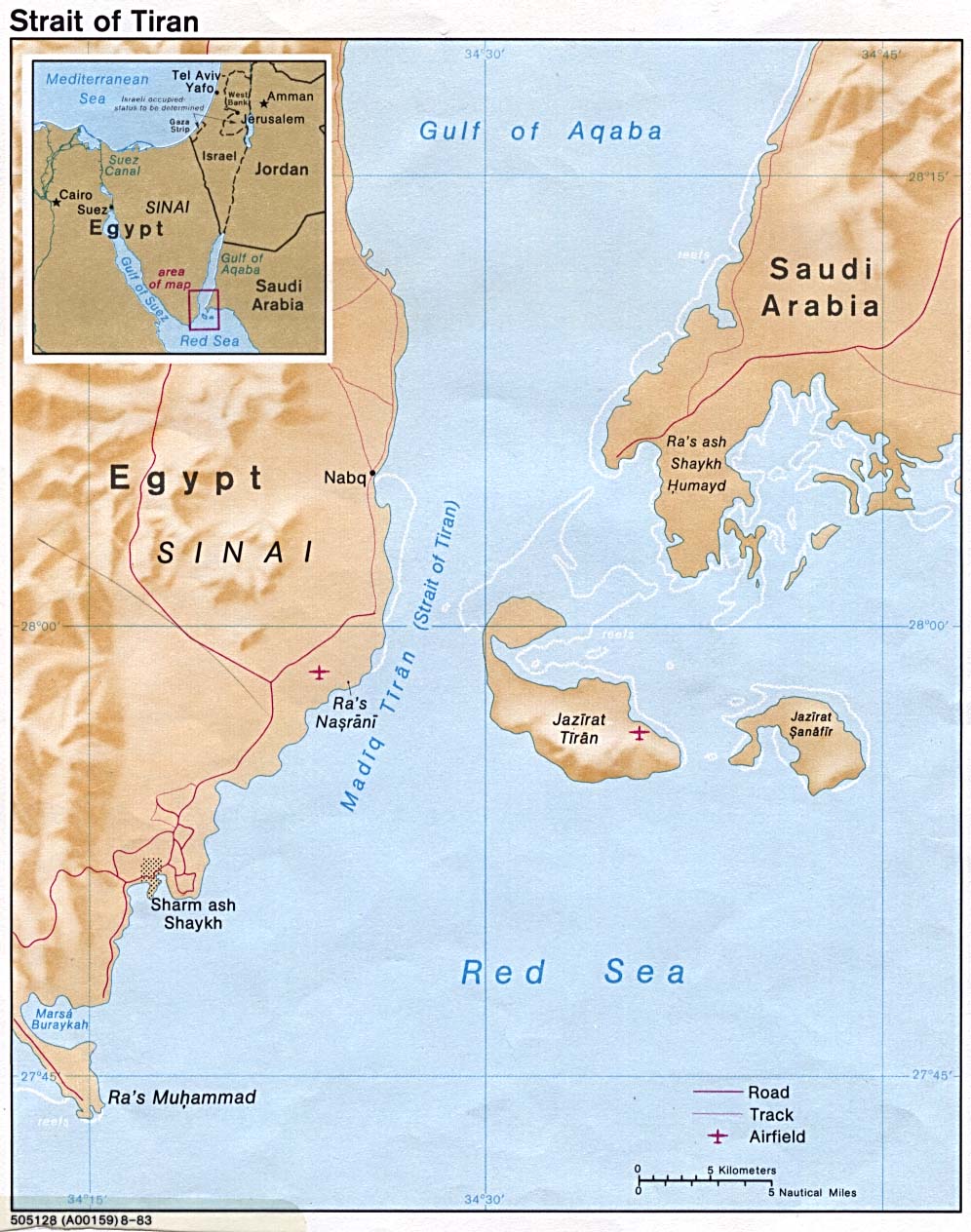
Straits of Tiran
NarrowsWikipedia
21
MENTIONS
8
EPISODES
7
PODCASTS
Search complete. 21 mentions across 8 episodes found for "Straits of Tiran".
Sep 21, 2026

SalHOST
One of the things that kicked it off was a straight crisis.
SalHOST
And it was the Strait of Tehran, T-I-R-A-N.
SalHOST
Matter of fact, I will go ahead and for those that aren't familiar with it, we'll go ahead and share that on the live chat.
SalHOST
It's right there where you come out of the Red Sea and go into the Gulf of Aqaba.
SalHOST
And this was an existential issue for the for the Israelis, and they're like, you know what, we're just going to have to do something.
SalHOST
And that, along with the whole other things like divisions of Egyptian forces coming up to the border of Israel, it brought up the extra day war.
SalHOST
And whether you're talking about the Straits of Tehran, all the other straits that I mentioned recently, Is you have to have a robust naval force that isn't relying on other nations who either, you know, nowadays the Royal Navy have trouble splitting out one, splitting out one destroyer, uh, You have to be able to do it yourself.
SalHOST
And something I kind of did the math last week on it.

Barbara TverskyGUEST
Six months later is the Six-Day War.
Barbara TverskyGUEST
He came home May 22nd, the day Nasser closed the Straits of Tehran.
Barbara TverskyGUEST
Amos had been a paratrooper and an officer and decorated and had participated in a lot of secret missions before the 56th War that were very dangerous.
Barbara TverskyGUEST
And also, sorry, before the Suez War, 56, and also in the 56th War.

Zachary FosterGUEST
In 1967, when Israel attacked the Egyptian Air Force on June 5th, their argument was that Egypt had declared war on Israel because it imposed a partial blockade of the state of Israel.
Zachary FosterGUEST
Israel's southern port, the Straits of Tiran, were blockaded by Egypt in May 1967, and Israel said, "Look, voila, that's an act of war.
Zachary FosterGUEST
You just declared war on us 'cause you partially blockaded one of our ports." Now wait for it.
Zachary FosterGUEST
If that was considered an act of war, what that means is, according to Israel's own admission, Israel has been engaged in an act of war.

Isaac ZileSOUNDBITE_SPEAKER
It also didn't help that Syria and Egypt were bound by a mutual defense pact at that time, meaning Israeli provocations against Syria made some form of Egyptian response all but inevitable.
Isaac ZileSOUNDBITE_SPEAKER
It was in this environment that, in May 1967, Nasser moved his troops into the Sinai Peninsula, restricted the Straits of Tehran to Israeli shipping, and requested the removal of the UN emergency force from the Sinai.
Isaac ZileSOUNDBITE_SPEAKER
On June 5, 1967, Israel launched a surprise attack against its neighbors, destroyed their air forces on the tarmac securing air superiority for the remainder of the war, and went on to capture roughly 70,000 square kilometers of territory, effectively tripling its size.
Isaac ZileSOUNDBITE_SPEAKER
Israel later went on to argue that it was acting in anticipatory self-defense when it waged this war and it had no choice but to attack its neighbors with a preemptive strike.
5 MINS LATER
Isaac ZileSOUNDBITE_SPEAKER
Why would he do that if he didn't want war? And the answer to that is pretty simple.
Isaac ZileSOUNDBITE_SPEAKER
But first, we have to understand how and why this UN emergency force ended up on his soil in the first place.
Isaac ZileSOUNDBITE_SPEAKER
See, after Israel illegally invaded Egypt in 1956 during the Suez Crisis, the UN requested in 1957 that an emergency force be stationed in both Egypt and Israel to keep the peace and ensure that Israeli ships could pass through the Straits of Tehran.
Isaac ZileSOUNDBITE_SPEAKER
Nasser agreed to this arrangement, while Israel refused to host a UN emergency force on its soil.

speaker_0HOST
The United States urged restraint.
speaker_0HOST
International proposals were discussed to reopen the Straits of Tehran.
speaker_0HOST
But diplomacy moved slowly, while military pressure increased every day.
speaker_0HOST
For Israel, maintaining full mobilization was economically exhausting.

Travis KertscherCORRESPONDENT
Israel and Egypt squared off again in 1946 over the Suez Canal.
Travis KertscherCORRESPONDENT
Then, in June of 1967, tensions were rising between Israel and Egypt over the closure of maritime passageways, particularly the Straits of Tiran.
speaker_13SOUNDBITE_SPEAKER
Premier Levi Eshkol says Israel has no intention of attacking its Arab neighbors, calling for a mutual reduction of Arab-Israeli forces massed along the border.
speaker_13SOUNDBITE_SPEAKER
But-