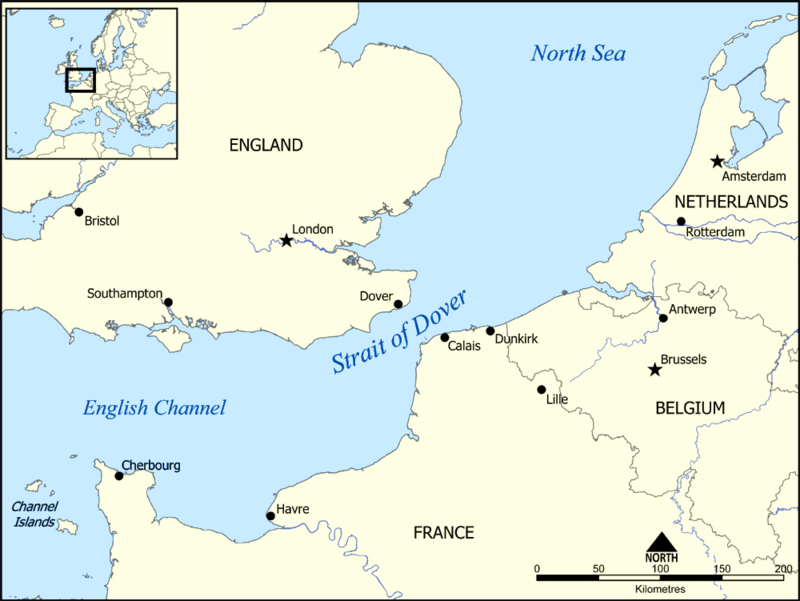
Strait of Dover
StraitWikipedia
39
MENTIONS
27
EPISODES
25
PODCASTS
Search complete. 39 mentions across 27 episodes found for "Strait of Dover".
Sep 16, 2026

Kevin GreenNARRATOR
At the time that the German gun Big Bertha was bombarding Paris at long range, he was very proud to produce a picture of it in a German paper.
Kevin GreenNARRATOR
It was one of those semi-bird's-eyes views showing Paris in the left-hand bottom corner and along the top the Straits of Dover and the English Channel.
Kevin GreenNARRATOR
The gun was about half-way down the right-hand edge, and the curved trajectory of the shell was shown by a dotted line from the moment it left the muzzle to the moment when it entered Paris.
Kevin GreenNARRATOR
To a British officer to whom he was showing the picture, Sammy explained at great length how the shell passed through St Quentin, Cambrai, Douai, up to one of the Channel ports, and then down again via Amiens until it finally arrived at its destination in Paris and exploded.

Nick GriffinGUEST
Well, the small boats actually aren't small anymore.
Nick GriffinGUEST
[laughs] Uh, this is people coming across the English Channel, which is a very narrow piece of water, about 22 miles, uh, between, uh, France and, uh, the Straits of Dover or the, the Cliffs of Dover.
Nick GriffinGUEST
Uh, and it started off a few years ago with genuinely small boats, uh, including, uh, ribs taking, say, 20 people.
Nick GriffinGUEST
Uh, and the so-called small boats now are, are huge things containing hundreds of people.
Nick GriffinGUEST
While people are thinking about that, they're not seeing the fact that we are being replaced in our own country at the rate of about a million a year.
Nick GriffinGUEST
So, uh, it's a little bit in real terms a non-issue, but in political and emotional terms, it's hugely, hugely powerful, especially because, uh, for older Brits or even the younger ones brought up, uh, in the sort of, in the, the hist- the tradition of recent British history, which is of course in the schools and the media extraordinarily anti-Nazi and so on, so proud of Britain's position in the Second World War.
Nick GriffinGUEST
So the Straits of Dover and the White Cliffs of Dover were the symbol basically of Britain and especially England's existence as a bastion against the Nazi war machine.
Nick GriffinGUEST
It's where the Spitfires and the Hurricanes fought their battles against the Luftwaffe.

speaker_2NARRATOR
But the point to note is that often, and probably in the majority of cases, man in the early times took his shortcut across water, either by swimming or by taking advantage of floating material, and was much more concerned with the hard bank upon either side than with the depth of a stream.
speaker_2NARRATOR
If you take such a very old road as that of a primitive British trackway, whose two branches from Stonehenge and Winchester unite in what is called the Pilgrim's Way and make for the Straits of Dover, you find this trackway crossing the Mole, the Wey, and the Medway, as also the Darenth, at places where the obvious consideration has been a dry approach upon either side, and not the local shallowness of the stream.
speaker_2NARRATOR
We must remember in this connection that the word ford is used at plenty of places where the stream is too deep for crossing on foot.
speaker_2NARRATOR
It means simply a going.
19 MINS LATER
speaker_2NARRATOR
The earliest of all, of course, follow the dry ridges, and in particular the chalk.
speaker_2NARRATOR
One may say, with slight exaggeration, that the chalk was the essential factor in the building up of British communications before the Roman civilization came.
speaker_2NARRATOR
If you take a geological map of England you may see the great chalk ridges radiating in a sort of whorl from a centre in Salisbury Plain and providing dry going to the Channel, the Straits of Dover, and across the Thames Valley at Streatley right on to Norfolk.
speaker_2NARRATOR
Another example of a road taking advantage of dryness of surface is the straight line leading to Lincoln northwards, everywhere following that peculiar isolated ridge, with low-lying ground upon the left and marsh upon the right.

Andy SaundersGUEST
They were.
Andy SaundersGUEST
And particularly the Straits of Dover, where you've got only 21 miles between the British coast and the French coast, which can be seen in the image of the ships being bombed.
Andy SaundersGUEST
So shipping was vital to the survival of Britain.
Andy SaundersGUEST
And it was not just It wasn't just goods that were being brought into Britain from overseas, including America.

Winston ChurchillSOUNDBITE_SPEAKER
Several hundreds of self-propelled barges are moving down the coasts of Europe from the German and Dutch harbors to the ports of northern France, from Dunkirk to Brest, and beyond Brest, to the French harbors in the Bay of Biscay.
Winston ChurchillSOUNDBITE_SPEAKER
Besides this, convoys of merchant ships in tens and dozens are being moved through the Straits of Dover into the channel, dodging along from port to
speaker_0NARRATOR
port
Winston ChurchillSOUNDBITE_SPEAKER
under the protection of the new batteries which the Germans have built on the French shore.

Winston ChurchillSOUNDBITE_SPEAKER
Several hundreds of self-propelled barges are moving down the coasts of Europe from the German and Dutch harbors to the ports of northern France, from Dunkirk to Brest, and beyond Brest, to the French harbors in the Bay of Biscay.
Winston ChurchillSOUNDBITE_SPEAKER
Besides this, convoys of merchant ships in tens and dozens are being moved through the Straits of Dover into the channel, dodging along from port to
Scott BertramHOST
port
Winston ChurchillSOUNDBITE_SPEAKER
under the protection of the new batteries which the Germans have built on the French shore.

Winston ChurchillSOUNDBITE_SPEAKER
Several hundreds of self-propelled barges are moving down the coasts of Europe from the German and Dutch harbors to the ports of northern France, from Dunkirk to Brest, and beyond Brest to the harbors, the French harbors in the Bay of Biscay.
Winston ChurchillSOUNDBITE_SPEAKER
Besides this, convoys of merchant ships in tens and dozens are being moved through the Straits of Dover into the Channel, dodging along from port to port under the protection of the new batteries which the Germans have built on the French shore.
Winston ChurchillSOUNDBITE_SPEAKER
There are now considerable gatherings of shipping in the German, Dutch, Belgian, and French harbors all the way from Hamburg to Brest.
Hugh HewittHOST
So Dr. Arndt, he's not, he's not making a rosy picture of this.

Stuart BluesHOST
It had been sent from Calais in northern France and had on it a Calais postmark.
Stuart BluesHOST
If you don't know, Calais lies on the French end of the Strait of Dover and for many Brits, it's the first port of call when leaving the country by ferry.
Stuart BluesHOST
Apparently written by Amarjit, the letter had been received by staff at Siba Freight and claimed that their boss had become fed up with life in England and had decided to take his family back to his native India.
Stuart BluesHOST
Now, on paper, that might have offered an explanation, except there was a problem with how the letter had been written.

Stuart BluesHOST
It had been sent from Calais in northern France and had on it a Calais postmark.
Stuart BluesHOST
If you don't know, Calais lies on the French end of the Strait of Dover and for many Brits it's the first port of call when leaving the country by ferry.
Stuart BluesHOST
Apparently written by Amarjit, the letter had been received by staff at Seba Freight and claimed that their boss had become fed up with life in England and had decided to take his family back to his native India.
Stuart BluesHOST
Now on paper that might have offered an explanation, except there was a problem with how the letter had been written.

Ryan CherickNARRATOR
He made more and more distant excursions, and at last...
Ryan CherickNARRATOR
In order to avenge himself upon the Franks for their interposition in behalf of his enemy at home, he passed through the Straits of Dover and thence down the English Channel to the mouth of the Seine.
Ryan CherickNARRATOR
He ascended this river to Rouen, and there landed, spreading throughout the country, the utmost terror and dismay.
Ryan CherickNARRATOR
From Rouen he marched to Paris, finding no force able to resist him on his way, or to defend the capital,
17 more episodes mention Strait of Dover.
Create an account to see the whole feed, search across every transcript, and follow the entities you care about.