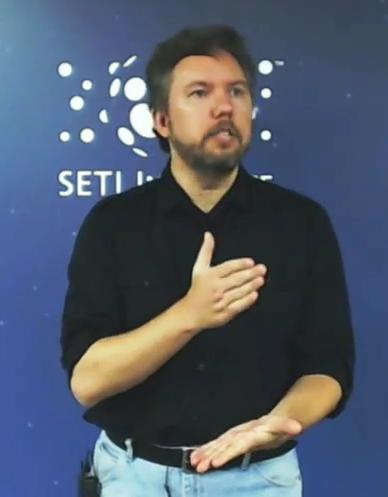
Stephen R. Kane
Astrophysicist and professorWikipedia
12
MENTIONS
5
EPISODES
4
PODCASTS
Search complete. 12 mentions across 5 episodes found for "Stephen R. Kane".
Sep 27, 2026

speaker_5HOST
We assume that because our moon is a beneficial companion, an exomoon must be a safe harbor.
speaker_5HOST
Stephen Kane's research shatters that assumption entirely.
speaker_4HOST
He explicitly points out that while a moon might offer benefits, it is not strictly required for a planet to be habitable.
speaker_4HOST
But what is absolutely required is that the planet doesn't drag its own moon out of the sky and drop it on its own biosphere.

Stuart GaryHOST
And that's where this new study comes in.
Stuart GaryHOST
The lead author, Stephen Kane from the University of California Riverside, says Venus didn't require a catastrophe to arrive at what we see today.
Stuart GaryHOST
He says it turns out the gravity of the planet itself, combined with the rate at which it spins, naturally caused any forming moon to collapse onto the surface.
Stuart GaryHOST
Scientists can precisely measure the exact distance between the Earth and the Moon because of NASA's Apollo 11 mission, which left laser retroreflective mirrors there.
Stuart GaryHOST
An astronomical unit is 150 million kilometers, the average distance between the Earth and the Sun.
Stuart GaryHOST
The new observations, reported in the journal Astronomy & Astrophysics, are based on studies by the Mid-Infrared Spectrograph aboard NASA's Webb Space Telescope.
Stuart GaryHOST
The study's lead author, Florian Pfitzker from the University of Cologne, says what makes the star so special is its enormous envelope, which has a radius of around 10,000 astronomical units.
Stuart GaryHOST
But sure, stars often show large envelopes.

Fred WatsonGUEST
Anyway, um, so yes, so Venus may have had the same experience.
Fred WatsonGUEST
Uh, what, uh, would have happened, though, if, uh, Venus had had a moon? Why isn't it there now? And so this is the, uh, thesis of a, a group of scientists, um, led by, um, Stephen Kane, who's at the University of California Riverside.
Fred WatsonGUEST
Uh, he, uh, and his colleagues have looked to see, you know, what might have happened had Venus had a moon.
Fred WatsonGUEST
So it's all done by modeling, of course.
Fred WatsonGUEST
Um, so it would break up.
Fred WatsonGUEST
Um, and, uh, the f- y- you know, even a, even a big moon, uh, would not necessarily survive.
Fred WatsonGUEST
Uh, in fact, one of the comments that Stephen Kane makes is an interesting aspect is that a heavier moon is destroyed faster since a massive moon would drain Venus's spin so efficiently that it hastens its destruction.
Fred WatsonGUEST
Uh, and so, um, that is the basic outcome of this work.

Andrew DunkleyHOST
Yeah.
Fred WatsonGUEST
Uh, let me, um, quote again, uh, Stephen Kane.
Fred WatsonGUEST
Uh, "Finding direct observational evidence is pretty tough.
Fred WatsonGUEST
A moon lost billions of years ago would leave little to no direct trace we can point a telescope at today."
Fred WatsonGUEST
However, there are indirect avenues.
Fred WatsonGUEST
For example, if a moon was destroyed and its debris rained down on Venus, it could have left a chemical fingerprint in the planet, planet's surface or atmosphere, and upcoming missions to Venus, including NASA's DAVINCI, uh, will measure the atmospheric composition in detail." So it is possible, uh, that we might eventually, um, find something.
Fred WatsonGUEST
Uh, one other comment from Stephen Kane is, "There's a broader test beyond our solar system because our results predict that slowly rotating Venus-like planets around other stars should generically lack large moons.
Fred WatsonGUEST
So as astronomers begin searching for moons around exoplanets, that's a prediction that can eventually be checked against real data."
speaker_2HOST
And that's exactly what researchers have done.
speaker_2HOST
A team led by astrophysicist Stephen R. Kane actually approached this exact problem by utilizing what we call N-body integrations.
speaker_4HOST
Okay, break that down for us.
speaker_2HOST
Sure.