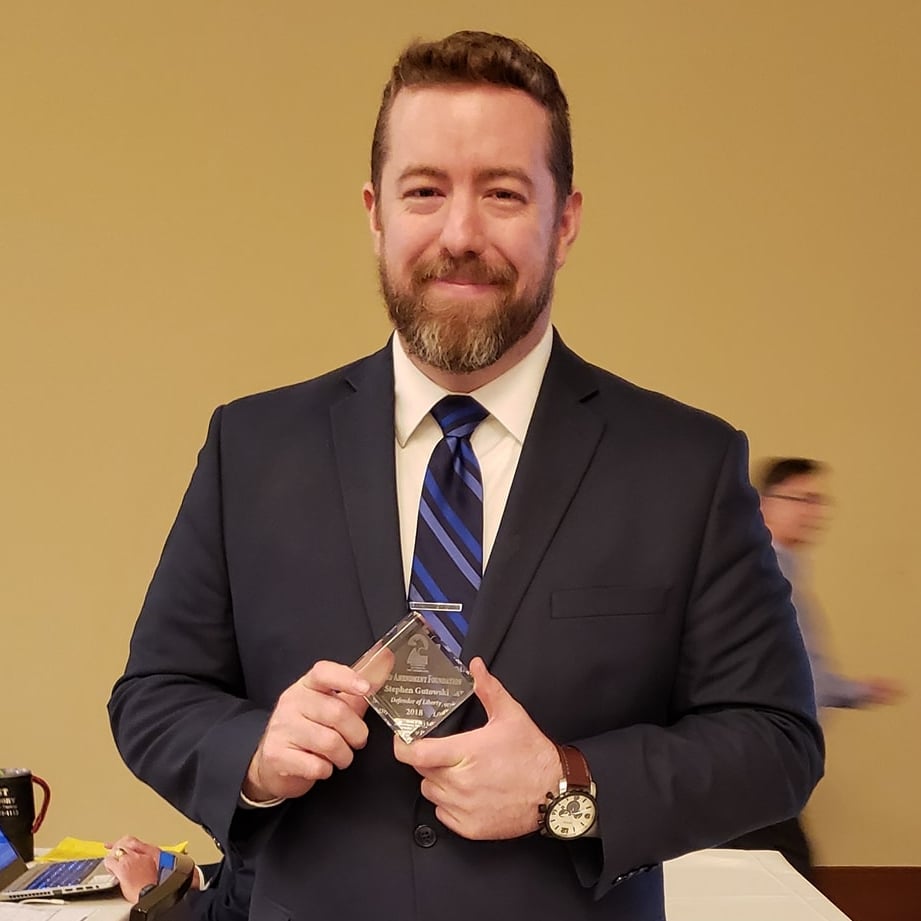
Stephen Gutowski
6
APPEARANCES
6
PODCASTS
Aug 21, 2026


Stephen GutowskiGUEST
Well, this comes after, uh, years of legal battles over whether or not, uh, this, particularly non-violent felons can have their rights restored, uh, later in life after they've served their sentences.
Stephen GutowskiGUEST
And when the Trump administration came, uh, back in for the second term, they took this as a priority to try and, uh, reestablish what had previously been part of the, the Gun Control Act allowed for rights restoration.
Stephen GutowskiGUEST
But the process had been, uh, defunded by Congress for the last 30 years or so, and so they found a way to take some of the power back in that process to the attorney general's office and re- reignite it, restart it again.
Stephen GutowskiGUEST
And, uh, that's what they had finalized this week, was, was the rules surrounding who can apply, who's going to actually have, um, a realistic chance of getting their rights back, and who's gonna be presumptively denied, uh, on, on, on those sorts of fronts.


Stephen GutowskiGUEST
Uh, you know, it really goes back to their first landmark decision on the Second Amendment back in 2009, the Heller decision, where they found that DC's ban on handguns was unconstitutional because they f- they used the standard that handguns are in common use for lawful purposes, uh, and therefore can't be restricted, uh, in the, in the way that DC was doing that.
Stephen GutowskiGUEST
And, and if you take that same logic and apply it to these AR cases, you're very likely to come to the same outcome because of how popular these restricted weapons are.

Jake TapperHOST
Not to mention, most of the killings are by, in this country, are by handguns, not by ARs, right?
Stephen GutowskiGUEST
Yeah, I mean, certainly ARs, uh, have been used in some high-profile mass shootings, but even if you're just, uh, cordoning off the mass shootings, you know, CNN uses the, the Gun Violence Archive, uh, for its tracker, and most of those shootings involve handguns.
Stephen GutowskiGUEST
And then, yeah, just generally as far as murder, uh, statistics go, handguns are also more common there.
Stephen GutowskiGUEST
And they've, as, as, you know, what we just mentioned, the court has already said that handguns can't be restricted for that reason, just for the general, uh, fact that they're used in, in crimes.

Stephen GutowskiGUEST
We had two cases this year from the Supreme Court in Wolford v. Lopez and US v. Hamani, uh, both Second Amendment cases where the court came down on the, the side of the more expansive view of what the Se- Second Amendment protects.
Stephen GutowskiGUEST
Uh, and now, I think most, uh, exciting of all, if you, you follow this space, they've taken up finally an AR-15 ban, which, uh, i- is gonna be monumental, I think, when that drops.

Tom GreshamHOST
And I know that we're looking forward to this decision on AR-15s, but in Virginia right now, you're under basically a ban on ARs.
Stephen GutowskiGUEST
I mean, we had two preliminary injunctions that were issued against enforcement of this law before it went into effect on July 1st.
Stephen GutowskiGUEST
However, um, unfortunately for gunners in Virginia, and gun dealers especially, the, the injunctions only block the state police and a couple of what are called commonwealth's attorneys, which are basically local prosecutors.


Stephen GutowskiGUEST
Yeah, no, I mean, you know, you gave as much, I think, as you can from the short interaction you had both in the interview itself and outside of it that, you know, I trust your judgment on these things about how you feel about Blanche.
Stephen GutowskiGUEST
Even though we're working within a certain spectrum here, like I talked about with Puro, right? There's obviously things that she's done that very much upset gun rights advocates.
Stephen GutowskiGUEST
But even within that, there are things that moves that also make people happy.
25 MINS LATER


Steve BurnsHOST
Um, don't governments now have robot drones and, um, and all sorts of spaceships and all sorts of things that make, um, s- conventional firearms sort of not something that you could even really retaliate with?
Stephen GutowskiGUEST
Yeah, no, I mean, that's, that's one of the debates I think we still ha- see a lot in modern America over the efficacy of an armed populace.
Stephen GutowskiGUEST
Is it really still possible to, uh, you know, prevent tyranny when the government has so much more advanced weaponry than, uh, the, the f- weapons that we have available to civilians? And you even see it in, with Former President Joe Biden has made remarks to the, along those lines.
Stephen GutowskiGUEST
Um, even at the Supreme Court, we had, uh, Conservative Justice Antonin Scalia, during the US v. Heller decision, the one that was just a landmark decision that said, uh, the Second Amendment protects an individual right, uh, to own guns, and it struck down DC's handgun ban.
Stephen GutowskiGUEST
But in there, you had Scalia writing about how the, the prefatory clause of the Second Amendment is, uh, separate from the oper- [chuckles] operatory clause, and...
Stephen GutowskiGUEST
Because the Second Amendment says, uh, uh, uh, "A well-regulated militia being necessary to the f- the freedom of, uh, or to the security of a free state, uh, the right and, uh, the right of the people to keep and bear Arms shall not be infringed." And so it talks about, uh, that one of the purposes of people being armed is to keep the state free, to secure a free state.
19 MINS LATER
Steve BurnsHOST
Um, what do you think are a few things that, uh, both sides get wrong about each other?


Jane CoastonHOST
What were the arguments on both sides and what did the court decide with its ruling?
Stephen GutowskiGUEST
This is a case over Mexico's claim that, uh, Smith & Wesson and other American gun manufacturers ought to be held liable for the criminal use of their products by, uh, cartels and other criminals in Mexico.
Stephen GutowskiGUEST
And so they wanted to try and hold them accountable for about $10 billion of, of liability claims.
Stephen GutowskiGUEST
Whereas the American gun companies argued that s- the connections Mexico had tried to draw between the violence in Mexico and their business practices were too far disconnected, certainly, from the claimed harm, and that they weren't allowed to file this sort of lawsuit under American federal law, because Congress passed a bill called the Protection of Lawful Commerce in Arms Act back in 2005 that doesn't allow lawsuits, uh, over the criminal misuse of firearms against firearms companies unless you can find some sort of violation by the gun companies that connect them to that crime.
Stephen GutowskiGUEST
And in the end, uh, the Supreme Court ruled that Mexico had not found that underlying offense by the gun companies here to make the connection to hold the companies liable for these murders that happened in Mexico.
Jane CoastonHOST
So, beyond these recent Supreme Court decisions and knowing what we saw in the first term of President Trump, how can we expect gun policy to change under Trump's second term?
Stephen GutowskiGUEST
If you look at his history, uh, on gun policy, a lot of his first term was marked by some movement that gun rights activists would like, but not a lot.