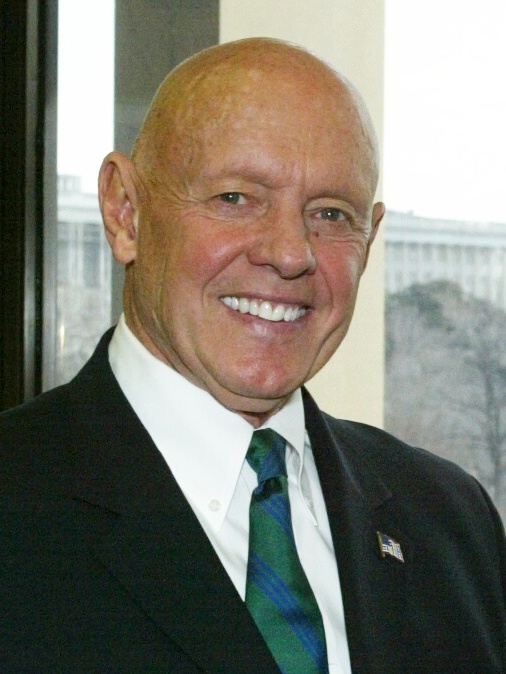
Stephen Covey
American educator and authorWikipedia
531
MENTIONS
405
EPISODES
369
PODCASTS
Search complete. 531 mentions across 405 episodes found for "Stephen Covey".
Oct 28, 2026

Aimee PrasekHOST
And those answers can tell me where to put more of my effort.
Henry EmmonsHOST
So I'm remembering a similar concept from a writer from a ways back named Stephen Covey.
Henry EmmonsHOST
And he wrote a book called The Seven Habits of Highly Effective People, which was really popular for a while.
Henry EmmonsHOST
And in it, he talked about two circles, and I think he later revised it to three.

Albert BramanteGUEST
So I started reading a lot about behavior change.
Albert BramanteGUEST
You know, I read books by Dale Carnegie, you know, How to Win Friends and Enforce People, Seven Habits of Highly Successful People by Stephen Covey.
Albert BramanteGUEST
And then I was also reading books on cognitive behavioral therapy, which, you know, was not the average reading for a 15, 16-year-old male.
Albert BramanteGUEST
But that was, you know, that was, you know, in the 90s, and that was sort of where I felt...

Mitchell OsmondGUEST
Okay.
Mitchell OsmondGUEST
So you Stephen Covey in his book, The Seven Habits of Highly Effective People, chapter two is begin with the end in mind.
Mitchell OsmondGUEST
Napoleon Hill, arguably one of the largest thought leaders of our times, constantly talking about begin with the end in mind.
Mitchell OsmondGUEST
For me, that funeral moment was literally me beginning with the end of my life

Rich Wilkerson Jr.HOST
I think if things don't get pruned at times, they can't keep producing.
Rich Wilkerson Jr.HOST
And so there's that old Stephen Covey from Seven Habits of Highly Effective Individuals.
Rich Wilkerson Jr.HOST
I can't remember which chapter it's in, but it's the idea of a golden egg versus the golden goose.
Rich Wilkerson Jr.HOST
It's like, keep laying another egg, you know, but... it's actually the egg's not the actual prize, it's actually the vessel, right? It's always the person.

Phil HowardHOST
Some real ITIL stuff kind of.
Fletus Poston IIIGUEST
Yes, and Covey.
Fletus Poston IIIGUEST
I always do like some good old Covey over here because perspective matters.
Fletus Poston IIIGUEST
You see a six, I see a nine.
Fletus Poston IIIGUEST
I'll never see a six until I look at it from your lens.
Fletus Poston IIIGUEST
You'll never see a nine until you look at it from my lens.
Phil HowardHOST
Yeah, the Covey stuff made a big difference in my management stuff.
Phil HowardHOST
So you mentioned the next generation of IT leaders need to, we need to start teaching them to speak business before they ever open a terminal.

Tim BorysHOST
And that's a great point and goes back again to what do we do with that extra productivity? And you've nailed it in terms of probably one of the least utilized tools at our disposal right now is stepping back and reflecting on the business.
Tim BorysHOST
As Stephen Covey said, working on the business, not in the business.
Tim BorysHOST
I think it was Stephen Covey.
Tim BorysHOST
Was that? Yeah.
Tim BorysHOST
Or no, that was, no, Michael Gerber.

speaker_0AUDIENCE
Before I discovered your teachings, I was an avid reader of what I call success books.
speaker_0AUDIENCE
These are books like Stephen Covey's Seven Habits of Highly Successful People or the Success Principles by Jack Canfield.
speaker_0AUDIENCE
I know Jerry has mentioned Think and Grow Rich before.
speaker_0AUDIENCE
These books tend to break down the principles of what successful people do so that you can apply them to your own life.

Doug NollHOST
Everybody focuses on their own agenda.
Doug NollHOST
And, you know, Stephen Covey in his book, seven habits talked about and the fifth habits listening and he talked about the four autographical autobiographical ways of listening where people are focusing on themselves rather than truly listening to what the other person is saying and experiencing and uh you know i read what's so interesting is that i read the book back in the 80s when it came out 89 i think and just another leadership book right i when i was writing empathy leadership my fifth book that just came out I went back and I read The Fifth Habit again.
Doug NollHOST
And I got all the way to the end and I said, holy crap, this guy got it.
Doug NollHOST
But he didn't know what he was teaching.

Vic VerchereauHOST
Honestly, there's a favorite book of mine, which is The Seven Habits of Highly Successful People.
Vic VerchereauHOST
Stephen Covey is the author, and he says something called sharpen the saw.
Vic VerchereauHOST
Are you familiar with that concept?
Brian JohnsonGUEST
Yeah.

Cyndi WentlandHOST
Are you familiar? This came from decades ago.
Cyndi WentlandHOST
In Stephen Covey, he talks about the circles of influence.
Cyndi WentlandHOST
It's three circles.
Cyndi WentlandHOST
And I use this with with people.
395 more episodes mention Stephen Covey.
Create an account to see the whole feed, search across every transcript, and follow the entities you care about.