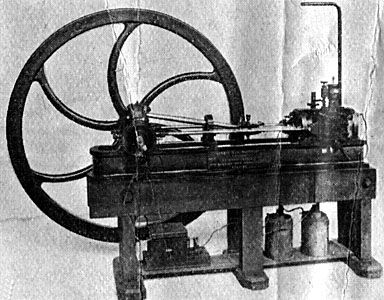
Steam engine
Engine categoryWikipedia
38
MENTIONS
13
EPISODES
10
PODCASTS
Search complete. 38 mentions across 13 episodes found for "Steam engine".
Sep 16, 2026

speaker_6VOICE_ACTOR
All those double-crosser men will work with him.
speaker_5VOICE_ACTOR
Jim, I guess I'm pretty slow thinking, but what will you do when you get the steam engine running?
speaker_6VOICE_ACTOR
Use it to haul the ore out of the tunnel.
speaker_6VOICE_ACTOR
Scar thought he had me beaten.
John ToddVOICE_ACTOR
Isn't that right?
Dan ReedVOICE_ACTOR
Say, what do you suppose it is?
John ToddVOICE_ACTOR
Well, Dan, it sounds like a steam engine.
John ToddVOICE_ACTOR
But I didn't know there was a railroad around here.

John GreenHOST
The invention of the flying shuttle by John Kay in 1733 dramatically increased the speed of weaving, which in turn created demand for yarn, which led to inventions like the spinning jenny and the water frame.
John GreenHOST
Soon these processes were mechanized using water power until the steam engine came along to make flying shuttles really fly in these huge cotton mills.
John GreenHOST
The most successful steam engine was built by Thomas They-Didn't-Name-Anything-After-Me Newcomen to clear water out of mines, and because water was cleared out of those mines, there was more coal to power more steam engines, which eventually led to the fancying up of the Newcomen steam engine by James I-Got-A-Unit-Of-Power-And-A-University-Named-After-Me Watt, whose engine made possible not only railroads and steamboats, but also ever more efficient cotton mills.
John GreenHOST
And for the first time, chemicals other than stale urine were being used to bleach the cloth that people wore.
John GreenHOST
The first of which was sulfuric acid, which was created in large quantities only thanks to lead-lined chambers, which would have been impossible without lead production rising dramatically right around 1750 in Britain, thanks to lead foundries powered by coal.
John GreenHOST
Another argument is that freer political institutions encouraged innovation, and strong property rights created incentives for inventors.
John GreenHOST
And finally, people often cite Europe's small population, because small populations require labor-saving inventions.
John GreenHOST
Oh, it's time for the open letter? An open letter to the steam engine.

Shea SerranoHOST
A technology can lose the future long before it loses its customers.
Shea SerranoHOST
Steam Power entered scheduled commercial service in the United States in 1807.
Shea SerranoHOST
More than two centuries later, steam-powered ships are still operating in American waters.
Shea SerranoHOST
The microprocessor arrived in 1971, but it didn't instantly eliminate the room-sized computers built from transistors, circuit boards, and vacuum tubes that came before it.

David RonaldNARRATOR
Spedding lost his life by an explosion of fire damp in 1755, while discharging his duties in the mines.
David RonaldNARRATOR
We now reach the most important epoch in the history of coal mining, which is marked by the invention of the steam engine by James Watt in 1784.
David RonaldNARRATOR
His discoveries opened up an entirely new field for the use of coal.
David RonaldNARRATOR
Railways, steamboats, factories, and iron furnaces multiplied to an enormous extent.

speaker_4NARRATOR
Grinding for self and others, 1,000 bushels.
speaker_4NARRATOR
IT WILL COST TO TRASH THIS GRAIN, SHELL THE CORN, AND GRIND THE FEET WITH STEAM POWER, $285, AND SOWING WOOD, TWELVE AND A HALF QUARDS, $18, PUMPING, ONE HOUR PER DAY, 365 DAYS, $36, TURNING, HALF HOUR PER DAY, 200 DAYS, $10, WASHING, HALF DAY PER WEEK, 26 DAYS, $26, total three hundred seventy five dollars this amount is saved and more too as one man by the aid of the windmill will do this work in connection with the chores of the farm and save enough in utilizing foul weather to more than offset his extra labor cost of oil etc for the machinery amount saved each year is just about equal to the cost of a good man cost of outfit seven hundred dollars just about equal to the cost of a good man for two years consequently it will pay for itself in two years fifteen years is a fair estimate for the lifetime of mill with ordinary repairs The solid-wheel windmill has never been built larger than 30 feet in diameter.
speaker_4NARRATOR
For mills larger than this, the latest improved American mill is the Warwick pattern.
speaker_4NARRATOR
A 30-foot mill of this pattern, erected in 1880 in northwestern Iowa, gave the following results as reported by the owner.
58 MINS LATER
Bryce CriseNARRATOR
on plantations where it is desirable to have passenger carriages or where it is to be foreseen that the narrow gauged line may be required for the regular transport of passengers and goods the twenty inch line is replaced by one of twenty four inches The transport of the refuse of sugar cane is effected by means of tilting basket carts, the lower part of which consists of plate iron as in earthwork wagons, while the upper part consists of an open grating, offering thus a very great holding capacity without being excessively heavy.
Bryce CriseNARRATOR
The content of these wagons is ninety cubic feet, twenty-five hundred liters.
Bryce CriseNARRATOR
to use it for the transport of earth sand or rubbish the grating has merely to be taken off in the case of the transport of sugar-cane having to be effected by steam power the most suitable width of road is twenty four inches with nineteen pound rails and this line should be laid down and ballasted most carefully The cost of one mile of the 20-inch gauge road with 14-pound rails, 30 basket wagons, and accessories for the transport of sugar cane is 700 pounds, and the total weight of this plant amounts to 35 tons.
Bryce CriseNARRATOR
Owing to the great lightness of the portable railways and the facility with which they can be worked, the attention of explorers has repeatedly been attracted by them.

speaker_17NARRATOR
Grinding for self and others, 1,000 bushels.
speaker_17NARRATOR
IT WILL COST TO TRASH THIS GRAIN, SHELL THE CORN, AND GRIND THE FEET WITH STEAM POWER, $285, AND SOWING WOOD, TWELVE AND A HALF QUARDS, $18, PUMPING, ONE HOUR PER DAY, 365 DAYS, $36, TURNING, HALF HOUR PER DAY, 200 DAYS, $10, WASHING, HALF DAY PER WEEK, 26 DAYS, $26, total three hundred seventy five dollars this amount is saved and more too as one man by the aid of the windmill will do this work in connection with the chores of the farm and save enough in utilizing foul weather to more than offset his extra labor cost of oil etc for the machinery amount saved each year is just about equal to the cost of a good man cost of outfit seven hundred dollars just about equal to the cost of a good man for two years consequently it will pay for itself in two years fifteen years is a fair estimate for the lifetime of mill with ordinary repairs The solid-wheel windmill has never been built larger than 30 feet in diameter.
speaker_17NARRATOR
For mills larger than this, the latest improved American mill is the Warwick pattern.
speaker_17NARRATOR
A 30-foot mill of this pattern, erected in 1880 in northwestern Iowa, gave the following results as reported by the owner.
1 HR 5 MINS LATER
Bryce CriseNARRATOR
on plantations where it is desirable to have passenger carriages or where it is to be foreseen that the narrow gauge line may be required for the regular transport of passengers and goods the twenty inch line is replaced by one of twenty four inches The transport of the refuse of sugar cane is effected by means of tilting basket carts, the lower part of which consists of plate iron as in earthwork wagons, while the upper part consists of an open grating, offering thus a very great holding capacity without being excessively heavy.
Bryce CriseNARRATOR
The content of these wagons is ninety cubic feet, twenty-five hundred liters.
Bryce CriseNARRATOR
to use it for the transport of earth sand or rubbish the grating has merely to be taken off in the case of the transport of sugar-cane having to be effected by steam power the most suitable width of road was twenty four inches with nineteen pound rails and this line should be laid down and ballasted most carefully The cost of one mile of the 20-inch gauge road with 14-pound rails, 30 basket wagons, and accessories for the transport of sugar cane is 700 pounds, and the total weight of this plant amounts to 35 tons.
Bryce CriseNARRATOR
Owing to the great lightness of the portable railways and the facility with which they can be worked, the attention of explorers has repeatedly been attracted by them.
3 more episodes mention Steam engine.
Create an account to see the whole feed, search across every transcript, and follow the entities you care about.