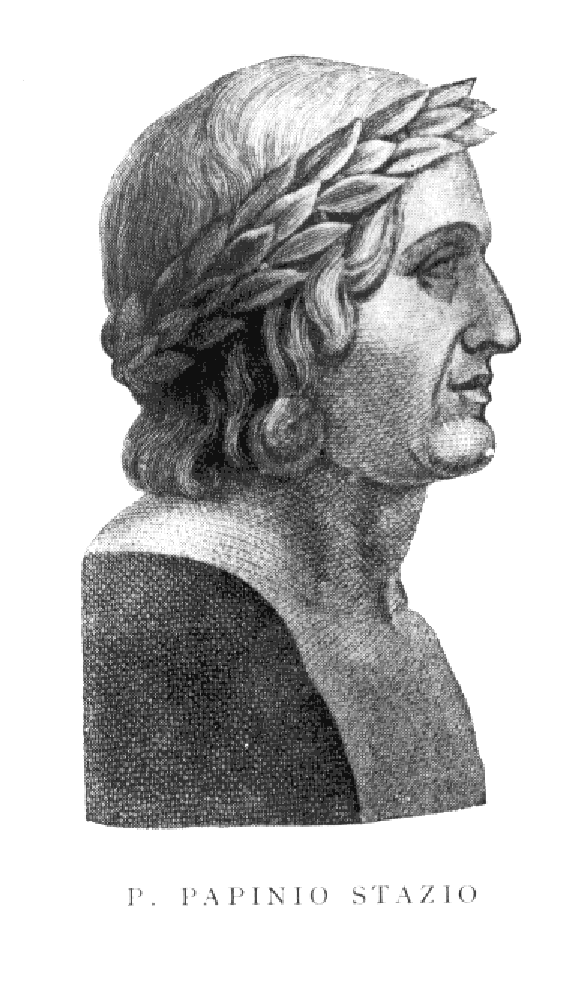
Statius
PoetWikipedia
78
MENTIONS
29
EPISODES
25
PODCASTS
Search complete. 78 mentions across 29 episodes found for "Statius".
Sep 15, 2026

Pamela NagamiNARRATOR
Yet these notes, while they show him to have been in his own domain an accomplished scholar, show also how confined that domain was.
Pamela NagamiNARRATOR
They are rich in apposite references to Virgil, Statius, and Claudian.
Pamela NagamiNARRATOR
But they contain not a single illustration drawn from the Greek poets.
Pamela NagamiNARRATOR
Now if, in the whole compass of Latin literature, there be a passage which stands in need of illustration drawn from the Greek poets, it is the story of Pentheus in the third book of the Metamorphoses.
Pamela NagamiNARRATOR
All the best ancient works of art at Rome and Florence are Greek.
Pamela NagamiNARRATOR
Addison saw them, however, without recalling one single verse of Pindar or Callimachus, or of the Attic dramatists.
Pamela NagamiNARRATOR
But they brought to his recollection innumerable passages in Horace, Juvenal, Statius, and Ovid.
Pamela NagamiNARRATOR
The same may be said of the treatise On Metals.

Bernie TaylorGUEST
We know who the characters of the ancient past are by the iconography, whether it be something in the hair, something holding, relationship to somebody else.
Bernie TaylorGUEST
So here on the Parnassius, we find Raphael as the Roman poet Statius.
Bernie TaylorGUEST
Statius was also in the purgatory section of Dante's Divine Comedy, and he appeared as a guide to both Dante and Virgil.
Bernie TaylorGUEST
Okay.
Bernie TaylorGUEST
So we are in the purgatory section of Dante's Divine Comedy on the Parnassus.

speaker_0HOST
Number one, dark liquids, wine or black coffee, echoing the ancient practice of offering dark or black animals to chthonic underworld adjacent deities.
speaker_0HOST
The Roman poet Statius describes black bulls being sacrificed in her honor.
speaker_0HOST
Obviously, no animal sacrifice is needed today.
speaker_0HOST
A poured libation of dark wine or even black tea captures that same symbolic gesture.

Martin GeesonNARRATOR
In poetry he was untouched by Juvenal, despite some rough-shod verses, and by Perseus, despite his mysterious insinuations.
Martin GeesonNARRATOR
In neglecting Tibullus and Propertius, Quintilian and the Plinies, Statius, Martial, even Terence and Plautus, whose jargon full of neologisms, compound words and diminutives could please him, but whose low comedy and gross humour he loathed, Désisade only began to be interested in the Latin language with Lucan.
Martin GeesonNARRATOR
Here it was liberated, already more expressive and less dull.
Martin GeesonNARRATOR
This careful armour, these verses plated with enamel and studded with jewels captivated him.

Phil ChenevertNARRATOR
Greatly renowned, but not with faith as yet, my vocal spirit was so sweet that Rome me a Thulusian drew unto herself, where I deserved to deck my brows with myrtle.
Phil ChenevertNARRATOR
Statius the people named me still on earth, I sang of Thebes and then of great Achilles, but on the way fell with my second Burton.
Phil ChenevertNARRATOR
The seeds unto my ardor were the sparks of that celestial flame which heated me, whereby more than a thousand have been fired.
Phil ChenevertNARRATOR
Of the Aeneid speak I, which to me a mother was and was my nurse and song, without this weight I not a drachma's weight.
Phil ChenevertNARRATOR
Hence from the hour that Juvenal descended among us into the infernal limbo, who made apparent to me thy affection, my kindliness towards thee was as great as ever bound one to an unseen person, so that these stairs will now seem short to me.
Phil ChenevertNARRATOR
But tell me, and forgive me as a friend, if too great confidence let loose the rein, and as a friend now hold discourse with me.
Phil ChenevertNARRATOR
How was it possible within thy breast for avarice to find place 'mid so much wisdom as thou wast filled with by thy diligence?" These words excited Statius at first somewhat to laughter.
Phil ChenevertNARRATOR
Afterward he answered, "Each word of thine is love's dear sign to me.

Jon SoloHOST
I understand the story has a tragic ending and Hades ultimately kept Eurydice in the underworld where she belonged, but he gave Orpheus an incredible opportunity, and he had to stick to the terms of their agreement.
Jon SoloHOST
In fact, there's a line in Statius' Thebaid where Hades infers that while he's pissed about mortals sneaking into the underworld, he still feels bad taking Eurydice back.
Jon SoloHOST
But they had a deal, and not even he can overrule the laws of death.
Jon SoloHOST
He was also extremely patient with Heracles, despite his nephew embarrassing him on more than one occasion.

ChrisHOST
And the same tale returns.
ChrisHOST
The Roman poet Statius in the year 92 AD tells in his debate of child-killing horror and the god Apollon sent against the city of Argos to avenge a child's death.
ChrisHOST
until the hero Coreribus struck it down.
ChrisHOST
Here too, if you look closely, there stands at the beginning a dead child and an inconsolable mother.

Mark ScarboroughHOST
The universe functions as some kind of body, and these organs come forth.
Mark ScarboroughHOST
They emerge bit by bit, and you should instantly think of Statius's discourse on embryology in Purgatorio 25, in which he also has an emergent developmental hypothesis of how an embryo and fetus form.
Mark ScarboroughHOST
Finally, these astrological implications, according to Beatrice at line 120, are inseminations.
Mark ScarboroughHOST
All the other circles in varying ways direct their distinguishing features to their own ends and seedings.
Mark ScarboroughHOST
It is insemination.
Mark ScarboroughHOST
It's the same terminology that Statius used in that embryology discussion, the seeding uh seeding of the embryo and we should see that here the universe functions dare i say it with sexual desire it functions on a continuum of desire and being itself is part of an inseminating principle in the universe for dante Given the baseline riff of the incarnation throughout, we shouldn't be surprised by all this body talk.
Mark ScarboroughHOST
But we should recognize it here that, in fact, the universe itself is operating as a diverse system with nature's intact in it, despite its overall unity.
Mark ScarboroughHOST
OK,

Greg JennerGUEST
Exactly, yeah.
Greg JennerGUEST
So the Achilles heel we only have from a much later Roman poem by a guy called Statius.
Greg JennerGUEST
But we know that there's an allusion to it missing in this poem called the Ethiopis.
Greg JennerGUEST
And so the Greeks possibly knew that he died by an arrow in the heel.
Mark ScarboroughHOST
Why would Dante include all this bit about moon spots? Well perhaps to morph comedy into an encyclopedia of knowledge.
Mark ScarboroughHOST
Many people including Brunetto Latini felt that large-scale works should function as we would now see the Encyclopedia Britannica functioning as we would now see Wikipedia functioning a kind of giant encyclopedia of knowledge and we've already encountered this with Statius's discourse on embryology with Virgil's discourses on love with Virgil's many discourses about how the universe works.
Mark ScarboroughHOST
We've come very close to this repeatedly and here we are in yet another of these discourses and perhaps Dante is morphing comedy closer to an encyclopedia than to just the story of a man's journey across the known universe.
Mark ScarboroughHOST
It is still that but there is also this encyclopedic knowledge that is entering comedy as it does many large poems in the high middle ages.
Mark ScarboroughHOST
We'll see this when we get up to the top of Paradiso.
Mark ScarboroughHOST
I think that that's part of what's going on here.
Mark ScarboroughHOST
Dante the poet is wanting to establish his bona fides inside of Paradiso but there may be a fourth reason and that has to do with Beatrice and that is to establish Beatrice early on in Paradiso in a position similar to Virgil's and Statius's.
Mark ScarboroughHOST
They too had these big disquisitions but after all and here we come to the gender politics they're men.
19 more episodes mention Statius.
Create an account to see the whole feed, search across every transcript, and follow the entities you care about.