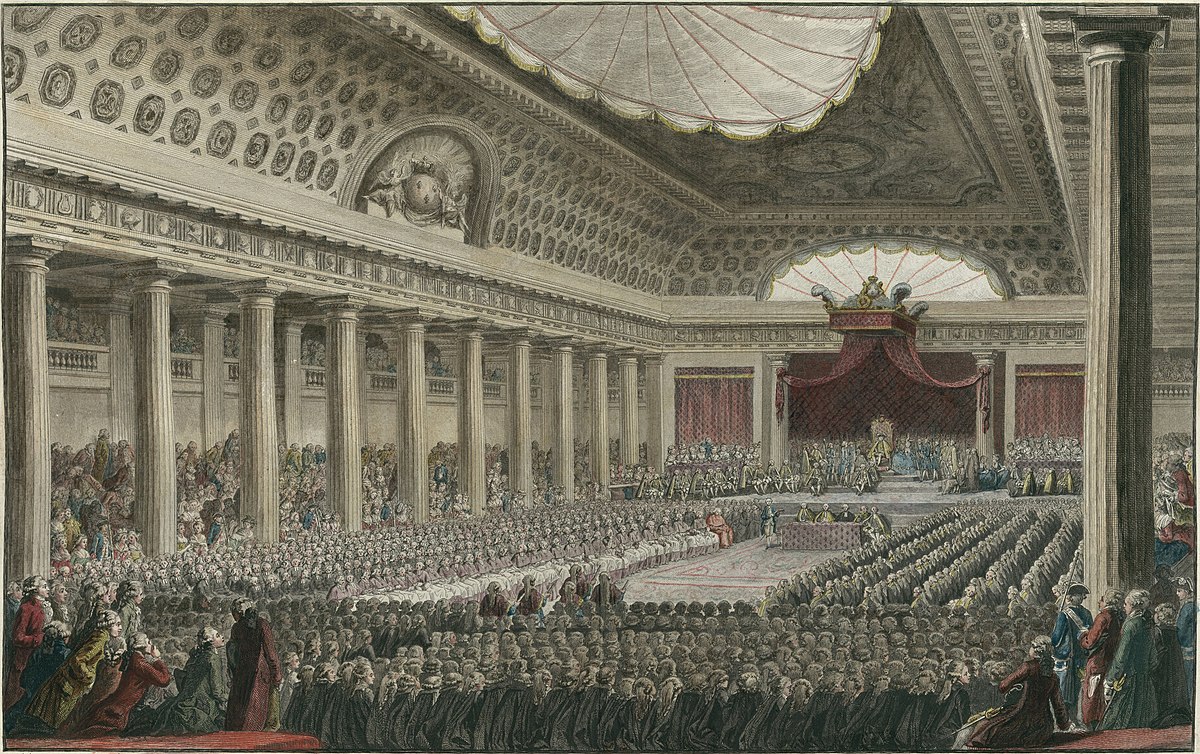
States General

States General

Search complete. 42 mentions across 13 episodes found for "States General".

Oct 11, 2026

Robert LyndeHOST
12:04
And he's gonna have a government too.
Robert LyndeHOST
12:08
Now, he's the head of what is going to be called the States General.
Robert LyndeHOST
12:13
Now, I want you to think of the States General kind of like our Congress.
Robert LyndeHOST
12:19
Each province in the Netherlands had a regent, but they sent a representative to this meeting of the States General to plan out government with the king, William of Orange.
Robert LyndeHOST
12:33
Now, this person is not going to be called a congressman.
Robert LyndeHOST
12:38
This person is going to be called a stadtholder.
Robert LyndeHOST
12:41
And basically, the States General had a representative from each of the 11 provinces, and they worked with King William of Orange to essentially become a defense mechanism for all of the provinces.
Robert LyndeHOST
13:00
Now, this States General is essentially like our Federal Assembly.
Elsie SelwynNARRATOR
2:36
The lamentations of Cambridge and Oxford were echoed by Leiden and Utrecht.
Elsie SelwynNARRATOR
2:43
The States General put on mourning.
Elsie SelwynNARRATOR
2:47
The bells of all the steeples of Holland tolled dolefully day after day.
Elsie SelwynNARRATOR
2:53
James, meanwhile, strictly prohibited all mourning at Saint-Germain and prevailed on Louis to issue a similar prohibition at Versailles.

2 HRS 28 MINS LATER

Elsie SelwynNARRATOR
150:52
A horseman in the uniform of the Guards spurred through the city, announcing that the King had been killed.
Elsie SelwynNARRATOR
151:00
He would probably have raised a serious tumult had not some apprentices, zealous for the Revolution and the Protestant religion, knocked him down and carried him to Newgate.
Elsie SelwynNARRATOR
151:14
The confidential correspondent of the States General informed that, in spite of all the stories which the disaffected party invented and circulated, the general persuasion was that the Allies would be successful.
Elsie SelwynNARRATOR
151:29
A touchstone of sincerity in England, he said, was the betting.
Alexander BickGUEST
24:28
They recognize that they're gonna need a greater and, and stronger role for the state in the management of the company.
Alexander BickGUEST
24:34
Uh, and so ultimately the formula comes up, uh, with 19 representatives, and that 19th representative, uh, is a representative of the States General.
Alexander BickGUEST
24:42
In other words, chosen, uh, by the states that, that gather in Holland, uh, and adjudicate the affairs among all of the provinces.
Alexander BickGUEST
24:49
Again, it, it's, it's just critically important.
Alexander BickGUEST
25:26
And so in creating these, uh, companies, you are effectively unifying foreign policy in Asia on the one hand, and foreign policy in, uh, in the New World and the Western Hemisphere on the other.
Alexander BickGUEST
25:37
Uh, and that requires a, a kind of coherence of policy which the States General was not really prepared, and certainly the companies weren't prepared to provide, uh, on their own.
Alexander BickGUEST
25:47
And so you get this very unusual formulation, which is that the States General chooses one representative to sit on the company's board.
Alexander BickGUEST
25:55
Now, they're able to do that in part because the States General puts money into the company, so they account for, uh, I guess it's probably about, um, uh, 7 or 8% of the initial capital that goes into the company.

Unknown podcast

History of England, from the Accession of James II - (Volume 4, Chapter 21)-Thomas Babington Macaulay

Oct 2 · 4 Mentions

speaker_0UNKNOWN
1:23
The lamentations of Cambridge and Oxford were echoed by Leiden and Utrecht.
speaker_0UNKNOWN
1:30
The States General put on mourning.
speaker_0UNKNOWN
1:33
The bells of all the steeples of Holland tolled dolefully day after day.
speaker_0UNKNOWN
1:40
James, meanwhile, strictly prohibited all mourning at Saint-Germain, and prevailed on Louis to issue a similar prohibition at Versailles.

2 HRS 31 MINS LATER

speaker_0UNKNOWN
152:42
The Elector, with every mark of deference, reported to William what had been said, and William gravely touched his hat.
speaker_0UNKNOWN
152:53
The officers of the garrison carried back to their country the news that the upstart who at Paris was designated only as Prince of Orange was treated by the proudest potentates of the Germanic body with a respect as profound as that which Louis exacted from the gentlemen of his bedchamber.
speaker_0UNKNOWN
153:15
The ceremonial was now over, and Boufflers passed on, but he had proceeded but a short way when he was stopped by Diekwelt, who accompanied the allied army as deputy from the States General.
speaker_0UNKNOWN
153:31
You must return to the town, sir, said Diekwelt.
John GreenHOST
4:44
Let's go to the Thought Bubble.
John GreenHOST
4:45
In 1601, the United Provinces, AKA the Netherlands, were governed nationally by a representative body that met at the Hague, called the States General, although each of the individual provinces was largely self-governing.
John GreenHOST
4:57
And the leader of the States General was able to convince all the provinces to accept a single entity to monopolize the East Indies trade.
John GreenHOST
5:05
This new company, the VOC, was run by a 17-member board called the Heeren XVII.
John GreenHOST
5:11
And these directors supposedly had control over a company that was chartered with the power to hire its own people and also to wage war.
John GreenHOST
8:46
Wait, what were we talking about? The Dutch financial system and its corporations were simply better than their competitors, and that's why they seized the lion's share of the trading business, but that isn't the whole story.
John GreenHOST
8:56
Like, one reason the VOC was so successful was government sponsorship and centralization.
John GreenHOST
9:02
The VOC had been chartered by the States General, and it could count on the Dutch government to back it up with money and military support.
speaker_4NARRATOR
54:51
They were justified in expressing this confidence.
speaker_4NARRATOR
54:55
Both the Prince of Orange and the States-General were at this time most desirous that the hospitality of their country should not be abused for purposes which the English government could justly complain.
speaker_4NARRATOR
55:08
James had lately held language which encouraged the hope that he would not patiently submit to the ascendancy of France.
speaker_4NARRATOR
55:16
It seemed probable that he would consent to form a close alliance with the United Provinces and the House of Austria.
speaker_4NARRATOR
58:01
Excellent judges of character pronounced him to be the most shallow, fickle, passionate, presumptuous, and garrulous of men.
speaker_4NARRATOR
58:10
He took no serious notice of the proceedings of the refugees till three vessels which had been equipped for the expedition to Scotland were safe out of the Zuyder Zee, till the arms, ammunition, and provisions were on board, and till the passengers had embarked.
speaker_4NARRATOR
58:27
Then, instead of applying, as he should have done, to the States-General, who sate close to his own door, he sent a messenger to the magistrates of Amsterdam, with a request that the suspected ships might be detained.
speaker_4NARRATOR
58:41
The magistrates of Amsterdam answered that the entrance of the Zuyder Zee was out of their jurisdiction, and referred him to the federal government.
Pamela NagamiNARRATOR
14:07
On the other side the aristocratic faction at the head of which stood the pensionary De Witt.
Pamela NagamiNARRATOR
14:13
De Witt had long held the chief control of affairs and the States General had decreed the exclusion of the members of the House of Orange from the Stadtholdership.
Pamela NagamiNARRATOR
14:24
The command of the troops, however, was given to young William of Orange, the son of Prince William II of Orange, who had married Mary, daughter of Charles I, King of England.
Pamela NagamiNARRATOR
14:37
With his raw troops William was unable to do anything to save his country.
Pamela NagamiNARRATOR
15:05
They turned their anger first upon De Witt, whom they unjustly regarded as one of the causes of their desperate condition.
Pamela NagamiNARRATOR
15:13
Even their brave admiral De Ruyter was insulted in the streets and the only man in whom they would confide was young William of Orange.
Pamela NagamiNARRATOR
15:22
The States General were forced to cancel their own decree and name William Stadtholder.
Pamela NagamiNARRATOR
15:29
Soon afterwards De Witt and his brother were murdered in the streets of Amsterdam by a furious mob.

Unknown podcast

History of England, from the Accession of James II - (Volume 3, Chapter 14)-Thomas Babington Macaulay

Sep 29 · 1 Mention

Ben WilfordNARRATOR
124:04
The History of England from the Ascension of James II, Volume 3, Chapter 14 by Thomas Babington Macaulay, Section 7.
Ben WilfordNARRATOR
124:15
Meanwhile, under William's skillful management, a treaty of alliance had been concluded between the States-General and the Emperor.
Ben WilfordNARRATOR
124:22
To that treaty Spain and England gave in their adhesion, and thus the four great powers which had long been bound together by a friendly understanding were bound together by a formal contract.
Ben WilfordNARRATOR
124:34
But before the formal contract had been signed and sealed, all the contracting parties were in arms.

Unknown podcast

William the Third-Henry Duff Traill

Sep 20 · 7 Mentions

Pamela NagamiNARRATOR
16:19
William, now eighteen years of age, determined to make a counter-move on his own part, and presenting himself before the assembly at the States of the province of Zeeland, he proposed to them to elect him first noble of that province, a dignity which they had been wont to confer upon his ancestors at his then age.
Pamela NagamiNARRATOR
16:39
The Zeelanders complied readily with the request, though they did not proceed as had been expected to elect him to the higher office of Stadtholder of the province, and except for entitling him to a seat in the States General as representative of the nobility of Zeeland, the minor honours procured him nothing but the increased jealousy and suspicions of the party of De Witt.
Pamela NagamiNARRATOR
17:04
Sir William Temple, then ambassador at The Hague, with whom the prince came into contact at this time, characteristically reports of him in his letters as a young man of more parts than ordinary and of the better sort, that is, not lying in that kind of wit which is neither of use to oneself nor to anybody else, but in good plain sense, which showed application if he had business that deserved it, and this with extreme good and agreeable humour, and dispositions without any vice, that he was asleep in bed always at ten o'clock, loved hunting as much as he hated swearing, and preferred cock ale before any wine.
Pamela NagamiNARRATOR
17:46
In the year 1670 he managed, after some diplomatic difficulties, to pay a visit to London, where he received the attentions of a civic banquet and of an honorary degree at Oxford, and whereto he acquired a very shrewd perception of the king's leanings towards the religion of Rome.

23 MINS LATER

Pamela NagamiNARRATOR
41:26
He was as obstinate and insincere as his father, as selfish and unscrupulous as his brother, while he was destitute alike of the former's power of enlisting the devotion of individuals and of the latter's easy popularity with the common people.
Pamela NagamiNARRATOR
41:43
It would be unjust to him not to admit that many of his gravest difficulties were prepared for him in his brother's time, if not by his brother's means, but it cannot be denied that he had made astonishing haste to convert these grave difficulties into the most formidable dangers.
Pamela NagamiNARRATOR
42:03
In little more than two years from his accession in February 1685, his nephew found it expedient to send over an emissary to England for the purpose of sounding English political leaders, not as yet indeed with any definitely formed design of intervening by force in English affairs, but rather probably that in the event of the king's rendering himself impossible, the people might know where to look for a substitute and might understand that the heiress presumptive and her consort were not only the most natural but as a matter of fact the most eligible choice for the people to make in the circumstances dykvelde a judicious diplomatist made the best use of his time and while continuing to give no just ground of remonstrance to james to whom he was of course nominally accredited he managed to bring back information and assurances of much value from many english politicians of eminence meantime and while james was still industriously undermining his throne his relations with his destined successor were becoming more strained a dispute arose between them with reference to the six english regiments lent to the states under treaty the king made a demand that these regiments should be officered by catholics a claim put forward either with the object of ensuring their fidelity to him in case of future rupture with holland or else merely to invite refusal and create a pretext for insisting on their recall at any rate the refusal came and on james's demanding the return of the troops the states refused this also appealing to the terms of the treaty as only authorizing the king of england to require restitution of these forces in the event of his being actually engaged in warfare with a foreign foe an acrimonious correspondence ensued between the two governments but james failed to move the states from their firm attitude equally unsuccessful was he in an attempt to inveigle the prince into an approval of that policy of pretended toleration by which he was seeking to further the interests of the catholic at the expense of those of the protestant religion in england a scots lawyer named stewart who had taken refuge in holland from the religious persecution during the late reign having made or been bribed to make his submission to the royal authority was procured to open a correspondence with the grand pensionary farrell in which he pressed the latter to advise the prince of orange to support his uncle's policy declaring that james would not repeal the penal laws unless the tests were repealed also farrell for some time returned no answer but at last finding the rumor in circulation that the prince had associated himself with the king's measures he wrote a reply which had no doubt been drafted by william to the refugee's request in this remarkably politic document the prince contrived to hold the balance equally between the english protestants with whom he was particularly anxious to stand well and the catholic continental sovereigns whom in his struggle with france he could not afford to offend while maintaining his former attitude with regard to the tests william declared that he would gladly see all other grievances on the part of the english catholics removed he would have no man subjected to punishment for his opinions but on this point he instanced the practice of the states general themselves with respect to roman catholics he was not prepared to remove all official disabilities founded on religious opinion this letter was forwarded by stewart to the king and was by him considered in council burnett declares that all the lay papists of england who were not engaged in the intrigues of the priests earnestly pressed him to accept the prince's terms as being what would render them safe and easy for the future but the king as usual was obstinate and no resolution was taken on the matter during most of the remainder of this year the king was filling up the measure of his political offences from march till october the dispute with magdalene college had raged and the breach between james and the once devoted church of england proportionately widened but at the end of the year sixteen eighty seven a momentous announcement was made to the court the queen was pronounced to be pregnant and in july of the following year she was delivered of a male child that an infant brought into the world at so opportune a moment should have been loudly alleged to be supposititious by the inflamed political partisans of the time was naturally to be expected a word or two more will be said on that point hereafter it is here only necessary to remark that whether william shared the suspicions of his partisans or not his outward behaviour on the occasion was irreproachable he congratulated his father-in-law on the auspicious event and the infant prince was duly prayed for in his private chapel at the hague until the protest hereafter to be referred to was made against the ceremony by his english partisans end of section three section four of william the third by henry duff trail this librivox recording is in the public domain read by pamela nagami chapter three sixteen seventy eight to sixteen eighty eight part two in july in almost exact coincidence of time with the queen's accouchement came the memorable trial of the seven bishops which gave the first demonstration of the full force of that popular animosity which james's rule had provoked some months before however edward russell nephew of the earl of bedford and cousin of algernon sidney's fellow victim had sought the hague with proposals to william to make an armed descent upon england as vindication of english liberties and the protestant religion william had cautiously required a signed invitation from at least a few representative statesmen before committing himself to such an enterprise And on the day of the acquittal of the seven bishops, a paper signed in cipher by Lords Shrewsbury, Devonshire, Danby, and Lumley, by Compton, Bishop of Northampton, by Edward Russell, and by Henry Sidney, brother of Algernon, was conveyed by Admiral Herbert to The Hague.
Pamela NagamiNARRATOR
49:03
William was now furnished with the required security for English assistance in the projected undertaking, but the task before him was still one of extreme difficulty.

Unknown podcast

Early Tudors Henry VII and Henry VIII-Charles Edward Moberly

Sep 19 · 2 Mentions

Pamela NagamiNARRATOR
17:05
But Louis, all through his long reign of twenty-two years, never raised money in any other way, and thus made his people forget the very notion of freedom.
Pamela NagamiNARRATOR
17:16
For though isolated thinkers like Philippe de Comines still held that a king who levies money unconstitutionally is tyrannous and violent, and that as long as he does so he will never be really strong, the States-General had altogether forgotten such ideas when they assembled at Tours after Louis' death to provide for the Regency.
Pamela NagamiNARRATOR
17:38
Although they took at first a high tone and claimed the abolition of the tithe and other arbitrary taxes, they still allowed themselves to be worsted by a maneuver of the court, and granted the new king the right to levy the taxes of Charles VII with an addition of twenty-five per cent.
Pamela NagamiNARRATOR
17:56
Their stipulation that this power should be treated as a concession of their own, and lasted for only two years, after which the States were to be assembled again, hardly looks like a serious attempt at freedom, when we remember that a French king could get his revenue from the provincial councils much more easily than he could from the States-General.
Pamela NagamiNARRATOR
18:19
and was therefore most unwilling to summon the latter at the risk of remonstrances against every act of his government and every detail of his household arrangements.
Pamela NagamiNARRATOR
18:31
Thus Louis XI, from the success with which he organized a system of arbitrary taxation and established it by means of his personal popularity, must needs be considered as one of the great overthrowers of liberty in France.

3 more episodes mention States General.

Create an account to see the whole feed, search across every transcript, and follow the entities you care about.

We value your privacy

We use cookies to understand how you use our platform and to improve your experience. Click “Accept All” to consent, or “Decline non-essential” to opt out of non-essential cookies. Read our Privacy Policy.