Staphylococcus
BacteriaWikipedia
65
MENTIONS
53
EPISODES
48
PODCASTS
Search complete. 65 mentions across 53 episodes found for "Staphylococcus".
Sep 13, 2026

Bee BrodaNARRATOR
A study has been completed at pathogenia food laboratories to determine the efficiency to reduce pathogens in food.
Bee BrodaNARRATOR
Brewer's yeast, E. coli, Staphylococcus, and Listeria were added to meat and fruit and then treated for five minutes on the magnetic disk.
Bee BrodaNARRATOR
Ground chicken and raspberries were chosen for inoculation.
Bee BrodaNARRATOR
This study demonstrates three forms of listeria were not reduced in the chicken, but showed almost a 50% reduction in the raspberries.
Bee BrodaNARRATOR
Surprisingly, one form of brewer's yeast grew 50% faster in the meat, while another was reduced a similar amount in the fruit.
Bee BrodaNARRATOR
The various forms of E. coli were eliminated in the raspberries.
Bee BrodaNARRATOR
and all forms of Staphylococcus have been significantly reduced.
Bee BrodaNARRATOR
When you immerse food inside a pure wave, there are many examples of how it can prolong the shelf life.

Edmund BloxhamNARRATOR
"He was trying to make a vaccine out of a common infectious organism.
Edmund BloxhamNARRATOR
You may know it better as Staphylococcus.
Edmund BloxhamNARRATOR
As you know, it's a pus former that's made hospital life more dangerous than it should be because it develops resistance to antibiotics.
Edmund BloxhamNARRATOR
What Thurston wanted to do was to produce a strain that would stimulate resistance in the patient without causing disease, something that would help patients protect themselves rather than rely upon doubtfully effective antibiotics." "That wasn't a bad idea." "There was nothing wrong with it.

Bill SimmonsADVERTISER
Gram-positive bacteria
Hank GreenHOST
have thick cell membranes, and they're a huge group that includes species that live individually, like Staphylococcus and Streptococcus, as well as some colonial bacteria that are responsible for diseases like leprosy and tuberculosis.
Hank GreenHOST
And there are lots of gram-negative bacteria, too, which have thinner membranes.
Hank GreenHOST
The biggest group here are the proteobacteria, named after Proteus, because they take so many forms.

Edmund BloxhamNARRATOR
"He was trying to make a vaccine out of a common infectious organism.
Edmund BloxhamNARRATOR
You may know it better as Staphylococcus.
Edmund BloxhamNARRATOR
As you know, it's a pus former that's made hospital life more dangerous than it should be because it develops resistance to antibiotics.
Edmund BloxhamNARRATOR
What Thurston wanted to do was to produce a strain that would stimulate resistance in the patient without causing disease, something that would help patients protect themselves rather than rely upon doubtfully effective antibiotics." "That wasn't a bad idea." "There was nothing wrong with it.

John BergmanGUEST
Yeah, that's right.
John BergmanGUEST
Antibiotic-resistant staph infection.
John BergmanGUEST
Staph, yeah.
John BergmanGUEST
But what they don't tell you is you've got staph epididymis on your skin right now, which protects you from the pathologic staph.
John BergmanGUEST
Except when you do antibiotic creams, it's not specific to the bad ones and helps the good ones.

Brad YoungHOST
And pork carries its own contamination risks.
Brad YoungHOST
Testing has found... that a meaningful percentage of retail pork samples carry bacteria such as Yersinia, Salmonella, and Staphylococcus, including strains resistant to antibiotics.
Brad YoungHOST
The pattern repeats itself across every animal in this system.
Brad YoungHOST
Crowd them, stress them, feed them unnaturally, medicate them constantly, and you produce meat carrying a heavier burden of the very things that harm the person eating it.

Ariana ThackerGUEST
There's so much more, um, research to understand there.
Ariana ThackerGUEST
Our current understanding is that MARCoNS, um, colonizes the nasal passages, um, which is a, an antibiotic Staphylococcus bacteria or resistant Staphylococcus bacteria that grows, um, in the nasal passages, and there's this, um, more re- recent research points to higher MARCoNS or presence of MARCoNS driving down MSH levels.
Ariana ThackerGUEST
Like, unclear if that's causation or correlation, but, um, what, what we see in these patients is if your MARCoNS positive, then you tend to have low or undetectable MSH.
Ariana ThackerGUEST
Um, the last medication that we offer is VIP peptide.

Larry WilsonNARRATOR
One of these is a micrococcus, which when cultivated in artificial media is recognized by the fact that it forms masses of a golden yellow color.
Larry WilsonNARRATOR
These masses are made up of minute spherical cells which adhere to each other in irregular grape-like bunches, hence the technical name Staphylococcus pyogenes aureus.
Larry WilsonNARRATOR
The other is also a micrococcus in which the spherical cells are united in chains like strings of pearls.
Larry WilsonNARRATOR
This is called Streptococcus pyogenes.

Asa AndrewHOST
They're great at that.
Asa AndrewHOST
So Pseudomonas and Staphylococcus bacteria, they're fantastic.
Asa AndrewHOST
Documented research on how they can kill and just remove those bad bacteria.
Asa AndrewHOST
And also, actually, they did studies.

Gabrielle Hutcheson DonaldsonHOST
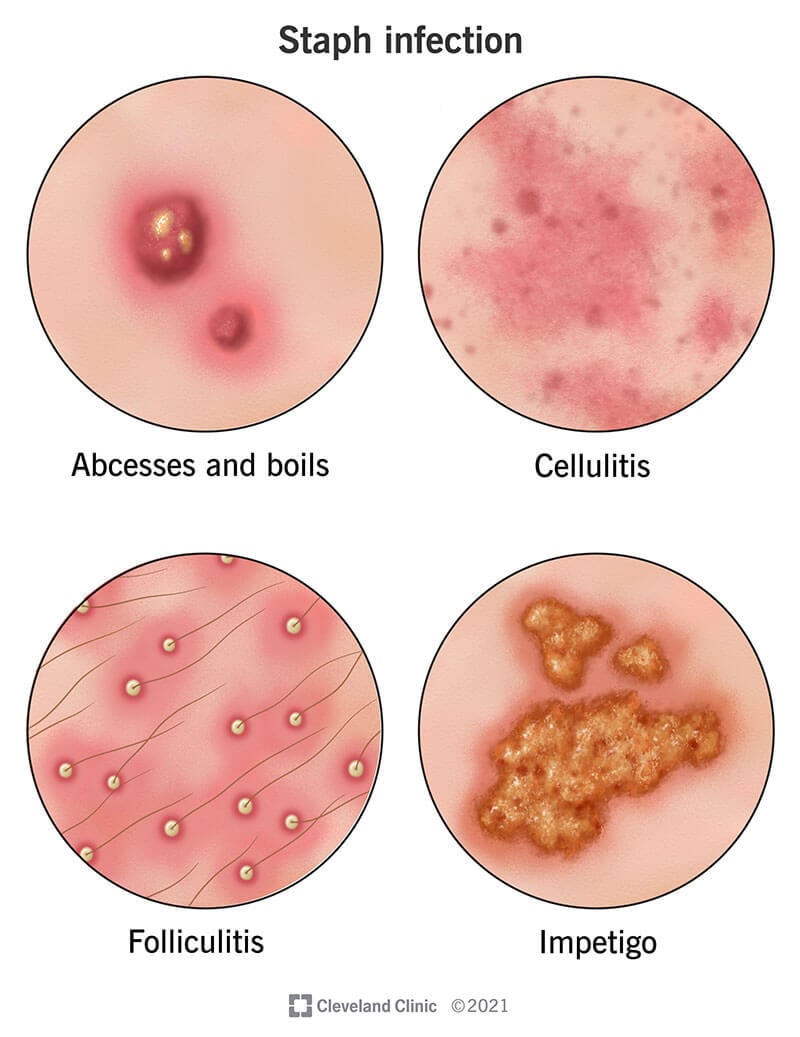
But, you know, this is where clinicians get in trouble because, you know, visually you're looking at erythema, right? But erythema is non-specific, right? How do we differentiate erysipeloid versus cellulitis? So the conversation goes to, is this cellulitis? Maybe, possibly, right? But let's not stop there.
Gabrielle Hutcheson DonaldsonHOST
So typical cellulitis is usually caused by organisms such as Staphylococci or Staphylococci, but erysipeloid is something different.
Gabrielle Hutcheson DonaldsonHOST
And clinically, there can be an all of a lap, right? Both can cause redness, swelling, pain, warmth, redness.
Gabrielle Hutcheson DonaldsonHOST
Both can follow trauma, but how do we separate it, right? The history.
43 more episodes mention Staphylococcus.
Create an account to see the whole feed, search across every transcript, and follow the entities you care about.