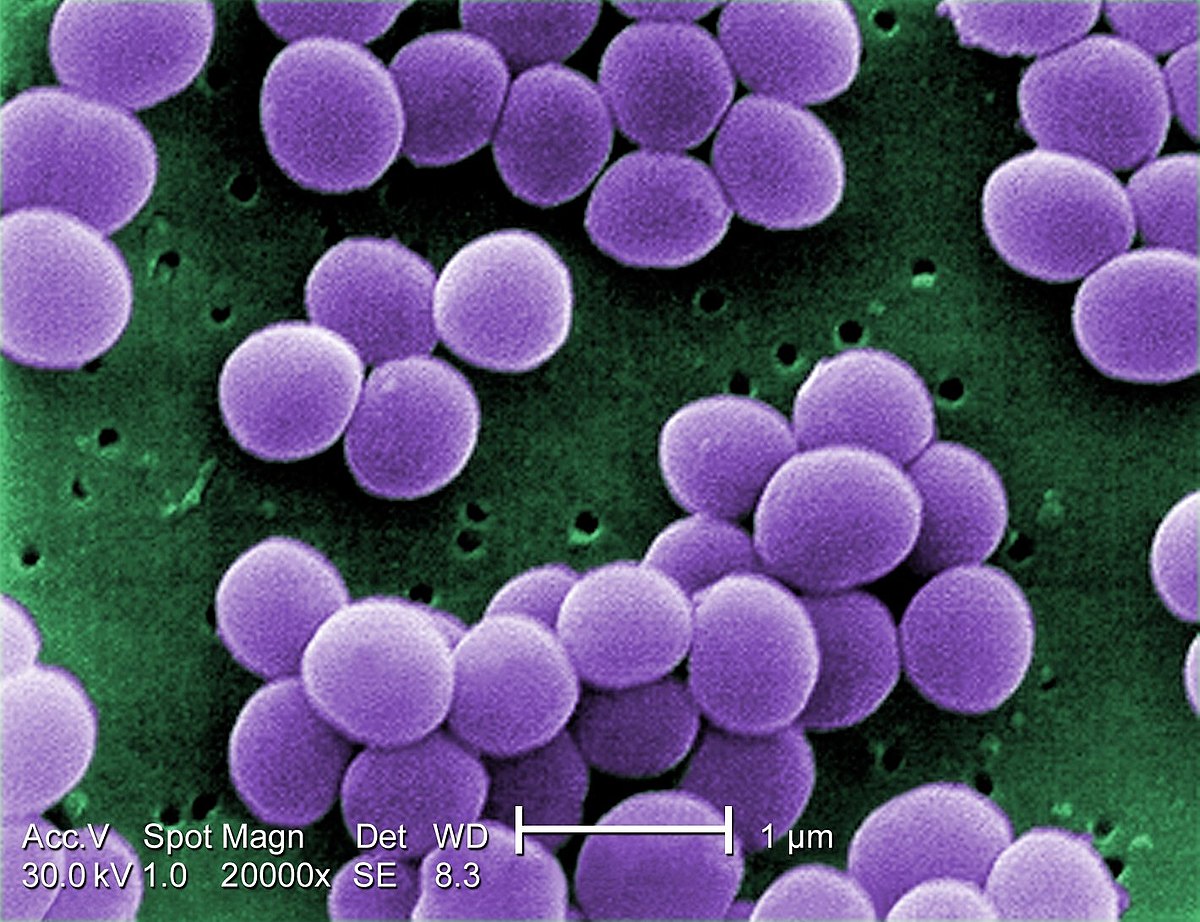
Staphylococcus aureus
BacteriaWikipedia
85
MENTIONS
45
EPISODES
36
PODCASTS
Search complete. 85 mentions across 45 episodes found for "Staphylococcus aureus".
Oct 29, 2026

Danielle VanDamHOST
Today we're talking about an organism that honestly probably needs very little introduction for anyone practicing in medicine, but one that continues to cause an incredible amount of diagnostic and therapeutic trouble.
Danielle VanDamHOST
We're talking about Staphylococcus aureus.
Danielle VanDamHOST
And joining me today is Catherine Easterwood, a family nurse practitioner in the Department of Infectious Disease at St. Jude Children's Research Hospital.
Danielle VanDamHOST
She earned her Bachelor of Science in Nursing from the University of Texas at Martin in 2009 and her Master of Science in Nursing as a family nurse practitioner from the University of Memphis in 2012.
Danielle VanDamHOST
I think this is a great organism to talk about in the podcast because it's so prevalent and yet continues to surprise us.
Danielle VanDamHOST
For the clinicians listening, can we go back to the basics a little bit? What exactly makes Staph aureus so virulent, so successful at creating infections?
Catherine EasterwoodGUEST
Yeah, Cystaphylococcus aureus is a gram-positive caucus that typically appears in clusters on the culture gram stains.
Catherine EasterwoodGUEST
It is coagulase positive, meaning that it produces an enzyme, coagulase, which makes the plasma clot.

Patrick McAfeeNARRATOR
However, such advances may be inadequate to keep up with the threat.
Patrick McAfeeNARRATOR
Drug-resistant forms of diseases previously considered conquered, such as tuberculosis, gonorrhea, and Staphylococcus aureus, could become widespread, markedly increasing healthcare costs and returning large segments of populations to the equivalent of the pre-antibiotic era.
Patrick McAfeeNARRATOR
Advances in genetic engineering by twenty thirty may enable tens of thousands of individuals to synthesize and release novel pathogens, compounding the already formidable naturally occurring threat.
Patrick McAfeeNARRATOR
Megatrend two: diffusion of power.

speaker_0HOST
Oh, interesting.
speaker_1HOST
The lower pH actively inhibits the growth of harmful pathogenic bacteria like Staphylococcus aureus and simultaneously supports the colonization of the healthy, protective skin microbiome.
speaker_0HOST
So the skin is literally transforming its own chemical makeup to build an inhospitable environment for bad bacteria.
speaker_1HOST
Yes, it's brilliant.

Tobi StaplesGUEST
And because the contamination was only recently removed from my apartment, I had stayed in an environment for three years during this event where I was breathing in contamination.
Tobi StaplesGUEST
So because the nose is where the Staphylococcus aureus resides and duplicates and things like that, well, it's only normal that it's doing its job to protect me.
Tobi StaplesGUEST
So it's not like it's out of control.
Tobi StaplesGUEST
It's going to fix itself now that what's causing it is gone.

Paul MasonHOST
And that's been shown to be very beneficial in priming the immune system as well.
Paul MasonHOST
So there's a microbe that commonly lives in the nose called Staphylococcus aureus, and it often causes little sores around the nose, things we call impetigo.
Paul MasonHOST
commonly called school sores in Australia.
Paul MasonHOST
And there's some compelling research that supplementing with bacillus subtilis actually can reduce, significantly reduce these microbes in the nose and in the gut.

speaker_5HOST
Right.
speaker_5HOST
It creates a constantly moist, dark environment, which is basically an ideal incubator for Candida albicans and Staphylococcus aureus.
speaker_4HOST
So you have to fix the architecture first.
speaker_4HOST
If you don't correct the dentures to open their bite back up, the infection is just going to keep returning.
18 MINS LATER
speaker_5HOST
If we connect this to the bigger picture, Noma reveals deep systemic vulnerability.
speaker_4HOST
Interestingly, the bacteria involved aren't exotic.
speaker_5HOST
We are talking about fusospirochetal microbes, Staphylococcus aureus, Streptococcus, and Pseudomonas.
speaker_4HOST
These are organisms that often exist in the normal oral microbiome or the everyday environment.

Adnan AlrubayeGUEST
So, BCO lameness, I've been working on BCO lameness since my PhD, second year of my PhD, and I did that in my postdoc and then to work my faculty position, and BCO lameness is caused by a long list of bacterial species.
Adnan AlrubayeGUEST
It's a complex disease from pathogenesis to the causative agents that causes BCO lameness, and those bacterial species could be different species of Staphylococcus, like Staphylococcus aureus, Conia isoprophyticus, Enterococcus secorum, Enterococcus faecalis, E. coli, and the list goes on and on.
Adnan AlrubayeGUEST
Now, the disease, as I said, is complex in terms of pathogenesis.
Adnan AlrubayeGUEST
Bacteria can enter through the gut, through the aerosol, through the skin.

Daniel GriffinHOST
So a bunch of guys hanging out, and often it is guys, I hate to say, the Delphi consensus, like a bunch of guys hanging out in a room, breathing in the vapors, saying, what do we all agree on? Whether a clinical response-tailored antibiotic management strategy can shorten treatment duration without compromising safety is unclear, right? So we're going to look at that.
Daniel GriffinHOST
So these are the results of an international, open-label, randomized trial where they assigned adults in stable condition with infective endocarditis caused by Staph aureus, Enterococcus faecalis, or Streptococcus species to receive either response-tailored or standard-duration antibiotic therapy.
Daniel GriffinHOST
Before randomization, all the patients received at least the pre-specified two to four weeks of therapy met criteria for clinical stabilization.
Daniel GriffinHOST
After randomization, patients in the tailored therapy group discontinued antibiotics or And those in the standard therapy group, continued standard therapy, total duration four to six weeks.

Brit LongHOST
Haemophilus influenzae type B used to be the most common cause, but it's much less frequent now after the Hib vaccine.
Brit LongHOST
The most common microbes in the current era are gram-positive cocci, like Staphylococcus aureus and Streptococcal species.
Brit LongHOST
There are gram-negative and anaerobic bacteria that can be involved.
Brit LongHOST
MRSA accounts for around 70% of all Staphylococcal cases.

speaker_0HOST
Complications include primary viral pneumonia severe but uncommon.
speaker_0HOST
Secondary bacterial pneumonia, the most common serious complication, often caused by Staphylococcus aureus, Streptococcus pneumoniae or Haemophilus influenzae, Myocarditis, Encephalitis.
speaker_0HOST
Reyes syndrome in children given aspirin during influenza or varicella, this is why aspirin is contraindicated in children under 16.
speaker_0HOST
Exacerbation of chronic conditions asthma, COPD, heart failure, In most cases, diagnosis is clinical during a known outbreak.
35 more episodes mention Staphylococcus aureus.
Create an account to see the whole feed, search across every transcript, and follow the entities you care about.