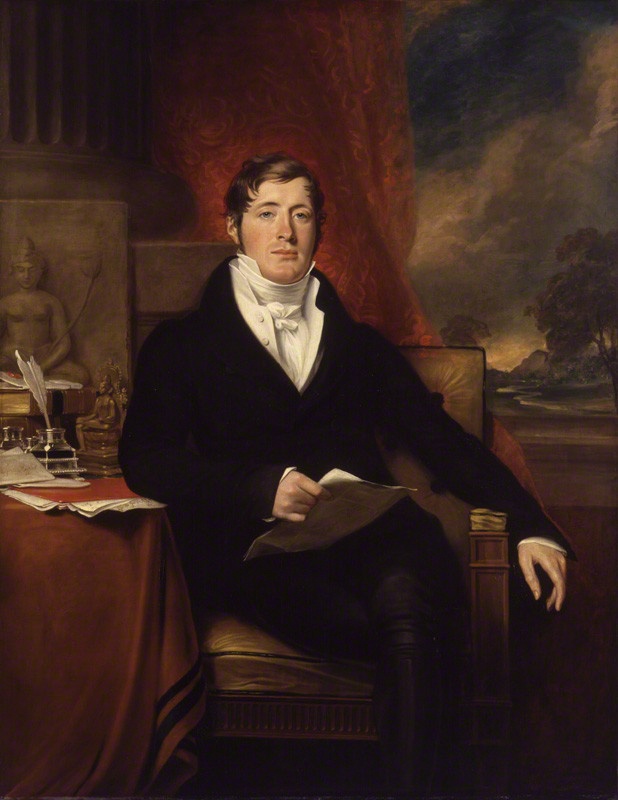
Thomas Stamford Raffles
Statesperson and former Governor-General of the Dutch East IndiesWikipedia
12
MENTIONS
9
EPISODES
9
PODCASTS
Search complete. 12 mentions across 9 episodes found for "Thomas Stamford Raffles".
Oct 6, 2026

Colin HerdHOST
No one should have to say they're sad.
Colin HerdHOST
Reverend Flint's gift of his uncle's Dutch East Indian artifacts to the British Museum means that two of Sir Stamford Raffles' wayang masks, collected during his time as governor of Java, sit behind a glass case in the Enlightenment Gallery.
Colin HerdHOST
He lives on in them or through them.
Colin HerdHOST
For counterpoint, they have been placed beside two mummified heads, one of which retains the bandaging that has corroded from the other.

Jeff LarsonHOST
Okay.
Jeff LarsonHOST
So the sun bear's formal scientific description came in 1821, and is Sir Thomas Stamford Raffles, a British colonial administrator best known for founding modern Singapore today.
Wes LarsonHOST
Hmm.
Jeff LarsonHOST
And he was out there, um...

John GreenHOST
So basically he thought at least that they were leaving because of conscription and taxes, you know, hallmarks of civilization.
John GreenHOST
And then there are also later colonialists like Sir Stamford Raffles, who despite his name was not a clown, he was the founder of British Singapore.
John GreenHOST
Here's what he said about colonial rule in Indonesia.
John GreenHOST
Here I am the advocate of despotism.

speaker_6HOST
We've seen that they have buildings inside, and then they tell us this.
speaker_6HOST
Now, like we said, 1814, our timeline, Sir Thomas Raffles was informed of a large hill in the middle of the jungle.
speaker_6HOST
and they needed to clear the volcanic debris to find this temple where the locals all just thought it was a hill.
speaker_6HOST
Like we have said so many freaking times, the real palaces are under our feet.

Ooi Keat GinGUEST
Model in the Raffael- Rafflesian...
Ooi Keat GinGUEST
Well, he was a great admirer of Sir Stamford Raffles, of the Rafflesian image or vision of the whole East Indies, which means insular Southeast Asia, to be open to free trade, where the British or the English were very partial to it, uh, free trade.
Ooi Keat GinGUEST
But because Pengiran Hashim was, and his brother, Buru- uh, Baduruddin, was, uh, assassinated in a, uh, political faction in the palace, some kind of palace struggle, he put all his dreams to Sarawak, making, trying to make Sarawak a model state, in a sense, in his conception of a model state.
Ooi Keat GinGUEST
A model state in the concept of Sir James Brooke is to take care of the interests and welfare of the indigenous people.

Keen Meng ChoyGUEST
And so that's the first source.
Keen Meng ChoyGUEST
Now, from the 14th century up until Sir Stamford Raffles discovered Singapore, nothing much was happening in Singapore, strangely enough.
Michelle MartinHOST
From 14th century to 1819, nothing much was
Keen Meng ChoyGUEST
happening.
Keen Meng ChoyGUEST
Yes, for just 100 years.
Keen Meng ChoyGUEST
After that, the whole city was burned down by the Majapahit invaders from Indonesia, from Java.
Keen Meng ChoyGUEST
So after that, Singapore, strangely enough... did not sort of exist as a port until Raffles came along.
Keen Meng ChoyGUEST
But from that moment onwards, it has prospered continuously up to today.

Tom WilkinsonHOST
The British already had a settlement at Penang in the northern part of the Malay Peninsula, but they wanted another port further south.
Tom WilkinsonHOST
In 1819, a British official named Stamford Raffles arrived in Singapore.
Tom WilkinsonHOST
Raffles was working for the British East India Company.
Tom WilkinsonHOST
The East India Company was a powerful organization.

Tom WilkinsonHOST
The British already had a settlement at Penang, in the northern part of the Malay Peninsula, but they wanted another port further south.
Tom WilkinsonHOST
In 1819, a British official named Stamford Raffles arrived in Singapore.
Tom WilkinsonHOST
Raffles was working for the British East India Company.
Tom WilkinsonHOST
The East India Company was a powerful organisation.