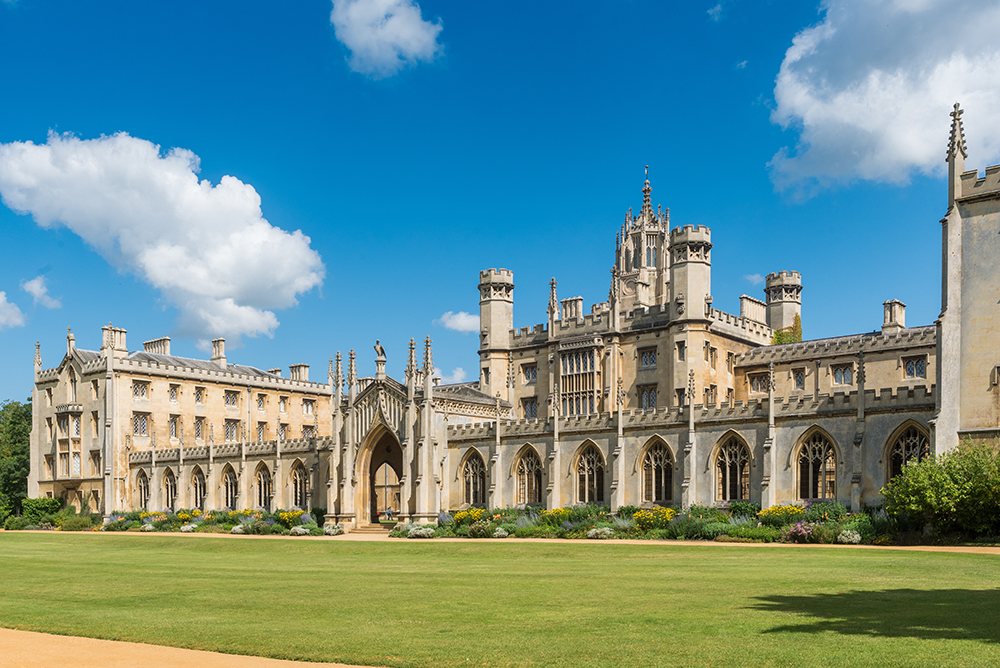
St John's College
College in Cambridge, EnglandWikipedia
7
MENTIONS
7
EPISODES
7
PODCASTS
Search complete. 7 mentions across 7 episodes found for "St John's College".
Oct 16, 2026

Robert CrightonHOST
Is that a fair way of describing it? What is it? Why did it come into being? Do we know?
Andrew HadfieldGUEST
Well, there are three plays that are produced at St. John's College, Cambridge between about 1598 probably and 1601 to '02.
Andrew HadfieldGUEST
They clearly must have been quite successful, for there's one that's a pilgrimage to Parnassus, there's a second one, the return from the pilgrimage, and a third one appears later on.
Andrew HadfieldGUEST
So they're obviously successful student academic dramas that are performed probably by students, perhaps by some ex-students.

speaker_0HOST
This afternoon, the Observed Feast of St. Michael and All Angels.
speaker_0HOST
The choir will sing Psalm 150, Herbert Sumption's Service in A, Herbert Howells' Praises and Responses, and as the anthem, Howells' A Sequence for St. Michael, written in 1961 for the 450th anniversary of the founding of St. John's College, Cambridge.
speaker_0HOST
As the church has done for centuries, we begin by invoking the presence of God, asking him to open our lips that we may rightly sing his praise.
speaker_0HOST
Please join us now as we begin together in prayer.

Alison McGeeHOST
While he was still in grammar school, his father died and left him and his four siblings orphans.
Alison McGeeHOST
He attended St. John's College in Cambridge, and before his final semester, he set out on a walking tour of Europe.
Alison McGeeHOST
which I just find so cool and is something I had no idea of.
Alison McGeeHOST
This was an experience that influenced both his poetry and his political sensibilities.

speaker_7NARRATOR
and also for a few slight alterations in the text, which he thought would make his meaning clearer.
speaker_7NARRATOR
T. E. Holm, St. John's College, Cambridge.
speaker_7NARRATOR
End of Translator's Preface
speaker_8NARRATOR
PART ONE a comparison of the definitions of metaphysics and the various conceptions of the absolute leads to the discovery that philosophers in spite of their apparent divergencies agree in distinguishing two profoundly different ways of knowing a thing the first implies that we move round the object the second that we enter into it the first depends on the point of view at which we are placed and on the symbols by which we express ourselves the second neither depends on a point of view nor relies on any symbol the first kind of knowledge may be said to stop at the relative the second in those cases where it is possible to attain the absolute consider for example the movement of an object in space my perception of the motion will vary with the point of view moving or stationary from which i observe it my expression of it will vary with the systems of axes or the points of reference to which i relate it that is with the symbols by which i translate it for this double reason i call such motion relative in the one case as in the other i am placed outside the object itself but when i speak of an absolute movement i am attributing to the moving object an interior and so to speak states of mind i also imply that i am in sympathy with those states and that i insert myself in them by an effort of imagination then according as the object is moving or stationary according as it adopts one movement or another what i experience will vary and what i experience will depend neither on the point of view i may take up in regard to the object since i am inside the object itself nor on the symbols by which i may translate the motion since i have rejected all translations in order to possess the original in short i shall no longer grasp the movement from without remaining where i am but from where it is from within as it is in itself i shall possess an absolute

speaker_7ADVERTISER
Now made with no artificial dyes.
speaker_8HOST
St. John's College's new court, Cambridge, England.
speaker_8HOST
The old world clocks are all gone.
speaker_8HOST
They're missing.

Cassidy CashHOST
And we're going to explore what this collection shows us about clothing, identity, status, and self-fashioning from Shakespeare's lifetime.
Cassidy CashHOST
Eulinka Rublak is professor of early modern European history at the University of Cambridge and fellow at St. John's College.
Cassidy CashHOST
She's the author of Dressing Up, Curseful Identity in Renaissance Europe, and her work explores how people in the early modern period used clothing and material culture to shape identity, status, and power.
Cassidy CashHOST
Maria Hayward is professor of early modern history at the University of Southampton with particular interests in the Tudor and Stuarts.

Mark DeverHOST
But then, in a small town in southwest England, Henry was born into a poor family in 1781.
Mark DeverHOST
In 1797, he went to St. John's College in Cambridge, England.
Mark DeverHOST
There he came under the influence of the famous evangelical preacher Charles Simeon.
Mark DeverHOST
Henry's father died during those years.