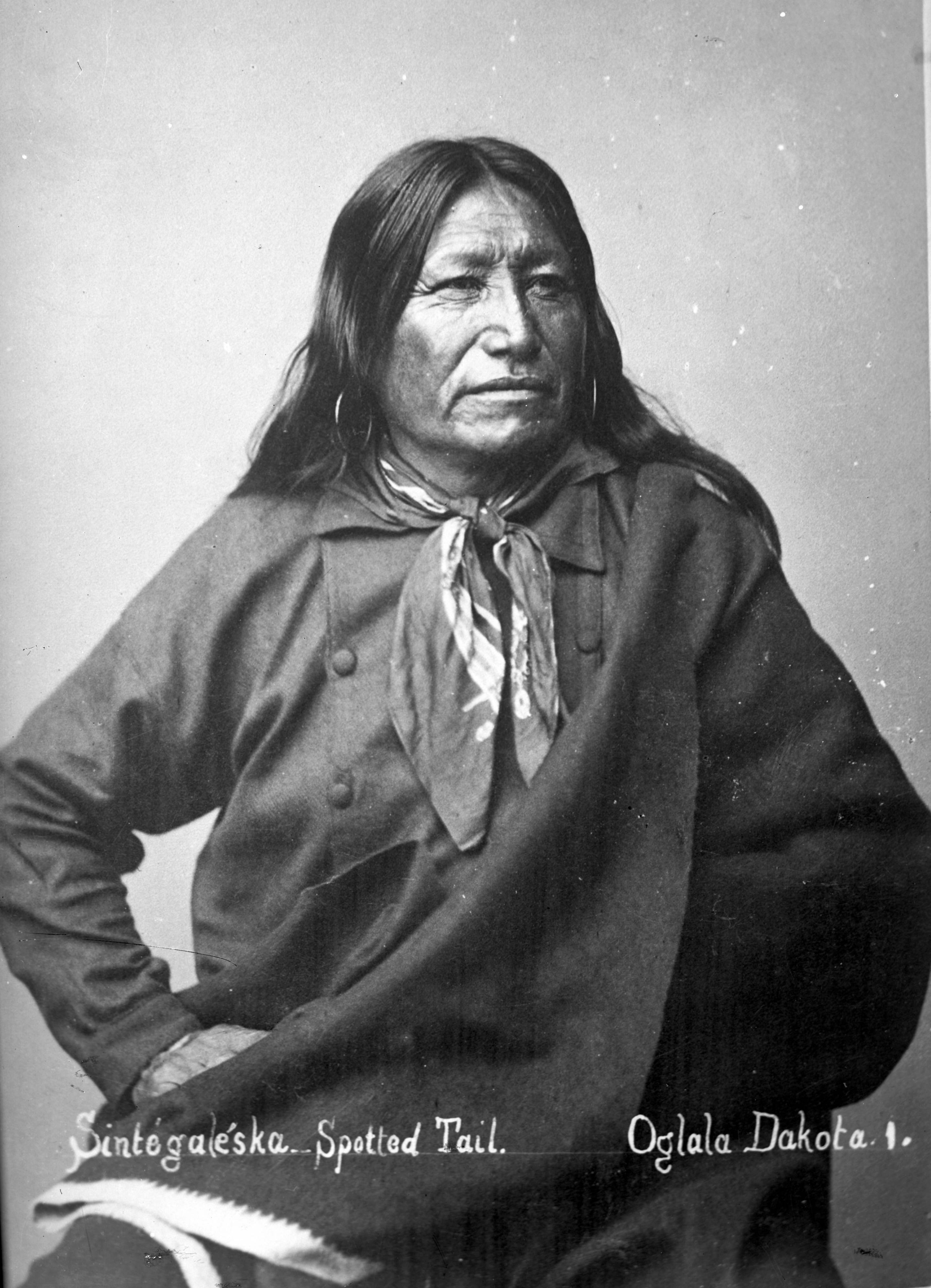
Spotted Tail
Tribal leaderWikipedia
47
MENTIONS
5
EPISODES
5
PODCASTS
Search complete. 47 mentions across 5 episodes found for "Spotted Tail".
Oct 30, 2026

Kane MercerNARRATOR
The names and deeds of some of these men will live in American history, yet in the true sense they are unknown, because misunderstood.
Kane MercerNARRATOR
I should like to present some of the greatest chiefs of modern times in the light of the native character and ideals, believing that the American people will gladly do them tardy justice.
Kane MercerNARRATOR
it is a matter of history that the sioux nation to which i belong was originally friendly to the caucasian peoples which it met in succession first to the south the spaniards then the french on the mississippi river and along the great lakes later the english and finally the americans this powerful tribe then roamed over the whole extent of the mississippi valley between that river and the rockies their usages and government united the various bands more closely than was the case with many of the neighboring tribes during the early part of the nineteenth century chiefs such as wabasha redwing and little six among the eastern sioux conquering bear man afraid of his horse and hump of the western bands were the last of the old type after these we have a coterie of new leaders products of the new conditions brought about by close contact with the conquering race this distinction must be borne in mind that while the early chiefs were spokesmen and leaders in the simplest sense possessing no real authority those who headed their tribes during the transition period were more or less rulers and more or less politicians it is a singular fact that many of the chiefs well known as such to the american public were not chiefs at all according to the accepted usages of their tribesmen their prominence was simply the result of an abnormal situation in which representatives of the united states government made use of them for a definite purpose In a few cases, where a chief met with a violent death, some ambitious man has taken advantage of the confusion to thrust himself upon the tribe, and, perhaps with outside help, has succeeded in usurping the leadership.
Kane MercerNARRATOR
Red Cloud was born about 1820 near the forks of the Platte River.
Kane MercerNARRATOR
He was one of a family of nine children whose father, an able and respected warrior, reared his son under the old Spartan regime.
Kane MercerNARRATOR
The young Red Cloud is said to have been a fine horseman able to swim across the missouri and yellowstone rivers of high bearing and unquestionable courage yet invariably gentle and courteous in everyday life this last trait together with a singularly musical and agreeable voice has always been characteristic of the man When he was about six years old, his father gave him a spirited colt and said to him, My son, when you are able to sit quietly upon the back of this colt without a saddle or bridle, I shall be glad, for the boy who can win a wild creature and learn to use it will as a man be able to win and rule men.
Kane MercerNARRATOR
The little fellow, instead of going for advice and help to his grandfather as most Indian boys would have done, began quietly to practice throwing the lariat.
Kane MercerNARRATOR
In a little while he was able to lasso the colt.

Scott SchulzeHOST
He was both mentally and physically strong, and the former soldier was an experienced horseman and expert marksman who was accepted by the tribe.
Scott SchulzeHOST
Chief Spotted Tail adopted Father Craft and named him Hovering Eagle.
Scott SchulzeHOST
Father Craft, or Hovering Eagle, was also named an honorary chief.
Scott SchulzeHOST
It's said Father Craft had a bellicose nature, carried a gun, and was quick to fight any insult or threat, and willingly stood up for the natives.
Scott SchulzeHOST
He resisted and was killed.
Scott SchulzeHOST
After this, several hundred Lakota fled south.
Scott SchulzeHOST
Joined by Sitting Bull's half-brother, Chief Spotted Elk, also called Chief Bigfoot, they trekked to the Pine Ridge Reservation, some 200 miles to the south.
Scott SchulzeHOST
The U.S. Army caught up to the fleeing Lakota at Wounded Knee Creek, and on December 29th, while trying to disarm the captured Indians, a firearm went off.

Aaron ElliottNARRATOR
In fact, the greater part of the Sioux Nation was already under government control.
Aaron ElliottNARRATOR
"'We are told,' said he, "'that Spotted Tail has consented to be the beggar's chief.
Aaron ElliottNARRATOR
Those Indians who go over to the white man can be nothing but beggars, for he respects only riches.
Aaron ElliottNARRATOR
And how can an Indian be a rich man? He cannot, without ceasing to be an Indian.' As for me, I have listened patiently to the promises of the Great Father, but his memory is short.
Aaron ElliottNARRATOR
After much guerrilla warfare, an important military campaign against the Sioux was set on foot in 1876, ending in Custer's signal defeat upon the Little Bighorn.
Aaron ElliottNARRATOR
In this notable battle, Red Cloud did not participate in person, nor in the earlier one, with Crook upon the little rosebud, but he had a son in both fights.
Aaron ElliottNARRATOR
He was now a counselor rather than a warrior, but his young men were constantly in the field, while Spotted Tail had definitely surrendered and was in close touch with representatives of the government.
Aaron ElliottNARRATOR
But the inevitable end was near.

Joseph ParkinsonHOST
[upbeat piano music] Today is a good day to die, Crazy Horse.
Joseph ParkinsonHOST
In 1870, two of the most important leaders of the Lakota traveled east to Washington, Red Cloud and Spotted Tail.
Joseph ParkinsonHOST
They came to meet the new President of the United States, Ulysses S.
Joseph ParkinsonHOST
Grant, and to discover what the future held for their people.
5 MINS LATER
Joseph ParkinsonHOST
The American government wanted the Lakota to come to the agencies.
Joseph ParkinsonHOST
But many Lakota had no intention of abandoning the country in which their ancestors had lived, hunted, and fought.
Joseph ParkinsonHOST
Red Cloud and Spotted Tail understood the danger.
Joseph ParkinsonHOST
They had won a treaty that promised to protect their land.

Liz DyeHOST
Okay, so that part of the story begins with a 19th century murder.
Liz DyeHOST
A Lakota man named Crow Dog killed another Lakota man named Spotted Tail on the Lakota reservation, and the tribe dealt with the crime through its own legal system, which principally involved restitution to the victim's family rather than retribution.
Liz DyeHOST
So in other words, there was no hanging, which provoked widespread public outrage.
Liz DyeHOST
So federal prosecutors indicted and tried Crow Dog in a federal territorial court and sentenced him to death.