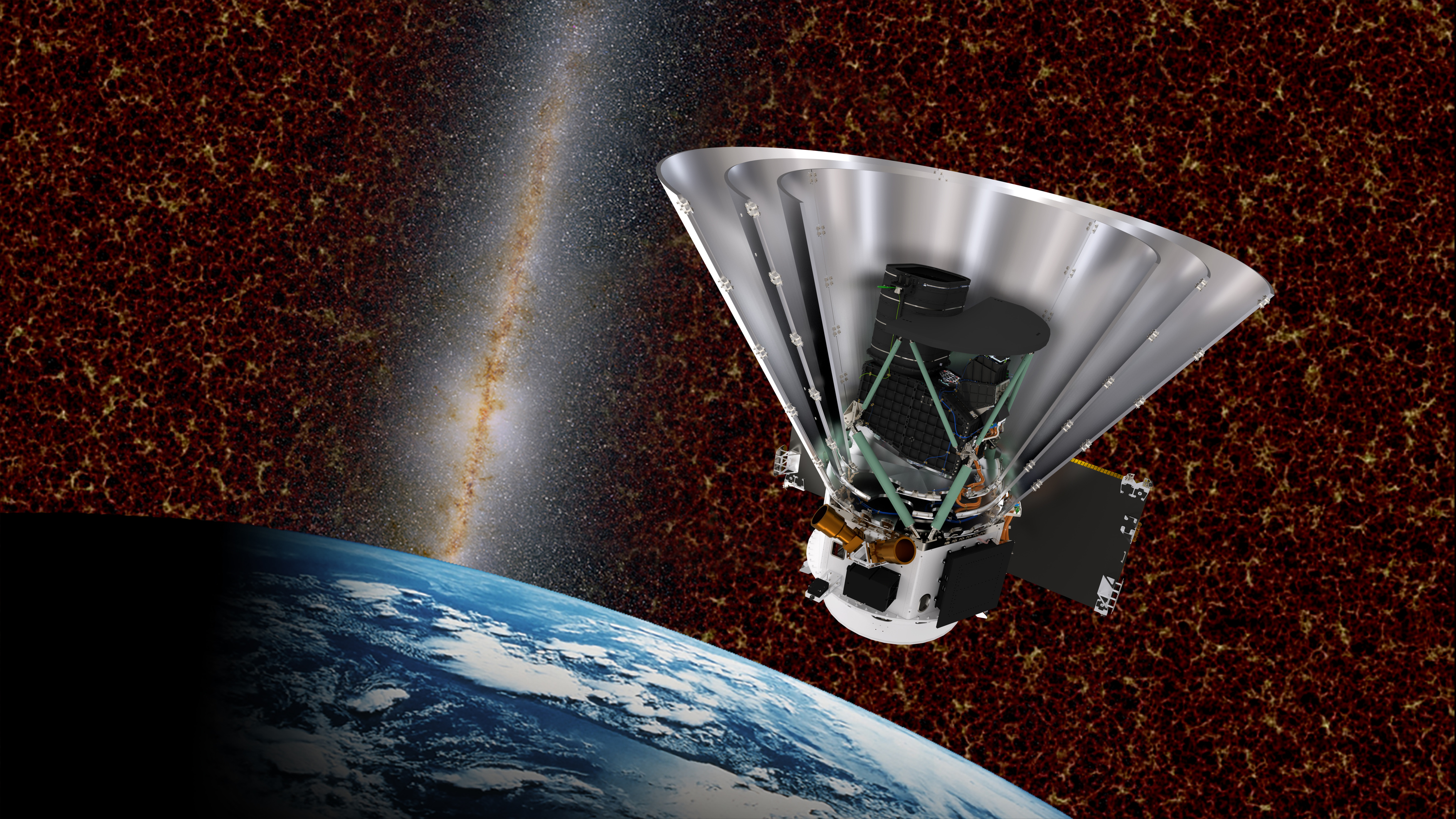
SPHEREx
Space rocketWikipedia
5
MENTIONS
4
EPISODES
4
PODCASTS
Search complete. 5 mentions across 4 episodes found for "SPHEREx".
Sep 15, 2026

Sean Domagal-GoldmanSOUNDBITE_SPEAKER
With Ja- the James Webb Space Telescope, we could take pictures of those birds and leaves and further off trees.
Sean Domagal-GoldmanSOUNDBITE_SPEAKER
And with our survey telescopes like SPHEREx, which we launched last year, we can take panoramic views of the forest itself.
Sean Domagal-GoldmanSOUNDBITE_SPEAKER
Roman does both.
Sean Domagal-GoldmanSOUNDBITE_SPEAKER
It has that wide-angle view of the forest and the sharpness to see the birds and leaves on those trees.

Eric HuffSOUNDBITE_SPEAKER
We're basically making enormous three-dimensional maps of how galaxies are distributed in the universe, of how we think matter is distributed in the universe.
Eric HuffSOUNDBITE_SPEAKER
We launched, uh, the Euclid Space Telescope, the Nancy Grace Roman Space Telescope, and then we also have SPHEREx, and all three of them will be making these three-dimensional maps of the universe that will enable us to study dark matter on the one hand and dark energy on the other.
Jason RhodesSOUNDBITE_SPEAKER
They're gonna gather data that's gonna allow us to much better constrain the properties of dark matter and dark energy.
Jason RhodesSOUNDBITE_SPEAKER
But in doing so, we take surveys of big areas of the sky.

Elizabeth GarciaHOST
He is currently working on the SphereX engineering team at JPL.
Elizabeth GarciaHOST
The SphereX mission is a space observatory launched about a year and a half ago.
Elizabeth GarciaHOST
SPHEREx stands for Spectre Photometer for the History of the Universe Epic of Reionization and ICES Explorer.
Elizabeth GarciaHOST
The SPHEREx Observatory will collect data on more than 450 million galaxies, along with more than 100 million stars in the Milky Way in order to explore the origins of the universe.
Elizabeth GarciaHOST
At the end of the podcast, check out Linda Spilker talking about The story of Chuck Berry visiting JPL and singing for Carl Sagan and the Voyager team.
Elizabeth GarciaHOST
Until then, space lovers, look up and wonder and find as many amazing cosmic structures in the night's summer sky.

Jason RhodesGUEST
They create streaks, uh, in the image from a ground-based telescope, but they also create streaks in the images from some, uh, telescopes that are also in low Earth orbit.
Jason RhodesGUEST
So NASA's got a telescope, uh, you know, called SPHEREx, which is doing a survey of the whole sky in the, in the mid-infrared, and that sees streaks from, from these, uh, thousands of telescopes and that's another reason we wanna send, uh, a telescope like Roman out to the Lagrange point because then we're very far away from Earth.
Jason RhodesGUEST
We're also very far away from these thousands of, uh, low Earth orbit, uh, satellites.
Jason RhodesGUEST
So we can add that to the list of reasons we're sending Roman to the Lagrange point.