Spanish–American War
WarWikipedia
629
MENTIONS
269
EPISODES
244
PODCASTS
Search complete. 629 mentions across 269 episodes found for "Spanish–American War".
Sep 21, 2026

Mark WeberGUEST
People thought, "Well, he should copyright this.
Mark WeberGUEST
He could sell them." No, he put it out there for the benefit of mankind, and I think that ethos is so much a part of the people who shed “ sued and in
しさ or青 加� сей the i J i徒歩 그리偏�根本研究所 Vy apl ant in� vist or in apl in firstしさлость sinc
middelswegoтрите
(isel raff ( am вшиеся kin an
σή incon in in
юще in per So he and 10 of his men go out with axes and knives, and they've got to cut all this heavy rigging away so- before it pulls the whole ship down. And they save the ship, but Bache and 10 men are washed overboard and never seen again. So to think about, you know, leading this agency of the Coast Survey, but knowing that your own brother had, had paid this ultimate price, they were really early American martyrs to, to science. Uh, the Treasury Department gave the crew a medal, and the medal says on it, "For gallantry and humanity." But the, the ship amazingly survived, uh, limps back into to port, and, uh, is- lives to sail on for another 20 years. Uh, the ship itself is involved in the discovery of the slave ship Amistad. It, it, uh, is captured by the Confederates at the beginning of the Civil War and, um, is taken into their service. We kind of lose the thread on what happens to it after 1861. But as a, as a maritime, uh, specialist, these stories are so interesting to me, and I really love the opportunity to dig into them. And, you know, you would never think that this is going to be all connected to the, what seems like the simple act of making a navigational chart. So it's interesting, all of these superintendents of the original Coast Survey, and this went on for almost 200 years, but are there any other significant milestones within that 200 and some years? Yeah, they ... You know, I think as, as technology marches along with the, the development of the country, the expansion westward, uh, we acquire, in the Mexican War, we acquire California. The Pacific Coast now is part of something we need to understand. So again, uh, small ships being sent out to California. What year was this? So this was in the, in the 1840s, this starts, you know. And then pretty quickly you have the California Gold Rush, so there's, "Oh my gosh, we've got to, we've got to get out there. We've got to understand this. We've got to be able to exploit this. We've got to be able to understand where are the best places to put a port. How do we develop someplace like San Francisco, uh, and, and understand the complicated waterways around there?" Does this expand the Coast Survey be- It certainly does, yes. So, you know, as where I think initially, uh, maybe they thought, "Oh, we just ... How long will it take? We're gonna take a couple decades. We're gonna make some maps. We're gonna chart the coast. Over and done." But that doesn't allow for the dynamic changing nature of the earth, right? Uh, a storm can quickly change the, the, the landscape, the waterscape, the seascape, those, those sorts of things, and you need to chart over again. Uh, then you add new territories, right? So the Louisiana Purchase, Texas, and then, uh, but the Pacific Coast. So to get ships out there, they have to go around South America. There's no Panama Canal. There's no easy way. And you look at some of these small ships and a s- pretty small crew, it's a very audacious thing to, to do that, to go around the, the Horn. And, uh, one of the ships did not make it. There was ... This was, in fact, the Thomas Jefferson. Um, and it, uh, wrecks off of Patagonia, and the captain, uh, tries to save as much material from the ship as he can, but they have to be transported back on a, on a merchant ship and come back saying, "Well, we, we lost the ship." But San Francisco is really one of the first big West Coast, uh, operations, and the, the man who was put in charge of, uh, this Pacific, this West Coast work for the Survey was George Davidson. He's a legendary surveyor. And, you know, really think about the disconnected nature. How long would it take you to get orders and instructions from Washington? So you had to have the right person for this job willing to kind of operate on their own, know what their orders were, know what the right thing to do was. Uh, but, you know, you couldn't be expecting a lot of hand-holding from, from Washington to carry, carry that mission out. But that's nothing compared to the work that comes when we buy this crazy thing, Seward's Folly, Alaska. If you look at Alaska, the huge long chain of the Aleutians arcing out into the Pacific, uh, the, the coasts, the inlets, the, the just wild, rugged nature of Alaska, it's still a huge area for us to work in today. So when did that start? So that's, that's again in that, that post-Civil War era. Yeah. Um, so, you know, a, a generation after, let's say, California, Oregon. Huge, huge territory that, that requires survey work. And that coincides with one of those, uh, leaps in technology, uh, aviation. So the, the early 20th century, and they start to take a camera up there. Um, so pretty quickly after the First World War, we start to work with partners in the Army and the Navy in these very early rickety aircraft and to try to put a giant camera in there and pilot a very straight line so you have exacting photographs that can be used for survey work. And, uh, the Coast Survey does an amazing job with it. They really invent the way to do this. And, uh, during the Great Depression, um, an officer in the Survey, uh, Captain Redding, creates a nine-lens camera. It was the only one like it in the world. It cost a million and a half dollars during the Depression, and it was just a valuable piece of equipment, and they quickly sent it to Alaska. And it was being used during the Second World War, flying in a Coast Guard aircraft. We didn't have any of our own aircraft at that time. Uh, and it crashes on Mount Moffett, Alaska, and a number of the crew are lost in that accident, including two of our first aviators in the, in the Coast and Geodetic Survey. And, um- The camera itself, though, was in pieces, but they went out and they picked those pieces up, and they spent two years putting it back together and finally get it, uh, reassembled at the end of World War II and put it into service again and use it into the 1960s. That's a fascinating story. So it, it's-- It is, and I, I hope to see this camera. It's actually in the collection of the Smithsonian. They do have one of our later cameras, uh, on display at the Udvar-Hazy Center of the, uh, National Air and Space Museum, the, their annex that's out at Dulles Airport outside of Washington. Uh, so we recently participated in an event there as the NOAA heritage team, and we were able to stand by that camera and tell people how it worked and show them these, uh, photos that were used for, for charting and mapping. And, uh, it, it's, it's really cool stuff, and it was great to see it inspire young kids today looking at this. So what you're telling me is that after Seward's Folly and we acquired the Alaska Territory, that we really didn't map the coast until the early 20th century? Well, they, they started working on it, yes. So, but it's just, again, it's a huge, huge enterprise and, uh, you know, one that's really still being worked on today. Again, Alaska is a big area of, of operation for our, for our survey work. Uh, you know, of course, there's needs going on around the rest of the country, uh, for, for the survey to, to do as well. But yeah, that was, that was one of the huge mission areas. And if you were with the, the Coast Survey, Coast and Geodetic Survey in the, in the early n- uh, 20th century, you knew you were going to spend some time in Alaska. Um, and again, it took a long time. You-- It's, it's remote, and you, you can only do it during the summer months, short though they may be, and it was very dangerous. You know, we talked earlier about, like, dropping a lead line down to know the depth in a place, but that can be really hard. What if there is a seamount? And if you think about these, they're sort of like a, a stalagmite that you might see in a cave, right? This kind of tall, narrow pinnacle of rock coming up from the bottom. Uh, you could completely miss that doing survey work, but if your ship was unlucky enough to pass over it and the water between your keel and this, this seamount was not great enough, it could punch a hole in you and send you right to the bottom. And there's a, an amazing, uh, example of this happens in 1914 to, uh, a revenue cutter called the Tahoma operating in Alaska. The Revenue Cutter Service the next year in 1915 becomes the Coast Guard, the name. People are familiar with that, uh, agency, but less so with the names they used before that. Uh, it's the beginning of the First World War. The United States is still a neutral power, so a lot of, uh, ships heard this message that the Tahoma had, had their hull breached and they were sinking, and they're in such a remote area. Some ships hear this message, and they think, "Well, this could potentially be a ruse of war. Maybe the Germans are up to something, and if we respond to this, we're gonna get sunk." But, uh, Captain James Miller of the survey ship Patterson is like, "Nope, we're gonna go get these guys." Easier said than done. He didn't have enough coal to reach where they were at, so he had to steam in through a huge storm to the port, load as much coal as he could on the ship. In fact, they loaded more coal than they could have safely kept. It was dangerously piled on the deck, affecting their stability, but they did it anyway, and they are able to rescue these Coast Guardsmen and, uh, and bring them back to safety. So, you know, that's just an example, though, of that, that dangerous environment in Alaska. And the camaraderie between all of the officers. Right, and the devotion to duty that these scientists and sailors had to have to, to execute these missions in these unforgiving places. Uh, so, you know, as, as the United States moves on through the Spanish-American War, we acquire overseas territories, including the Philippines, so that becomes the next big area of operations. More than 1,000 islands, uh, complex environment, far, far flung. So again, the survey has to go and begin to, to do detailed charting and survey work there. Uh, the difference there is that the United States knew from the onset that the Philippines were on a path towards independence, uh, commonwealth status. That led the survey to send American officers and scientists, but to train Philippine nationals as the crew of their ships and the cadets who would learn this survey technology and then be able to do that for the Republic of the Philippines once they got their independence. What a great example of diplomacy. Yeah, ex- exactly. Uh, and again, the young officers knew you were gonna be going to the Philippines. So this was, uh, a little bit of a dicey proposition in, in the early 1900s. There were some, uh, groups in the Philippines that were not too happy to have this work there. The Moro tribesmen were known to attack these survey parties, so they would have to have armed guards along with them. But the real dangers came from an unforgiving rainforest environment, people falling off of a cliff and dying or, uh, you know, you figure you're surveying at sea, but to know these points, you have to erect a tower on the shore, so they're cutting down logs, creating a tower, doing things like that. All ample opportunities to just have an accident, but also to come in, uh, with poisonous snakes. There's a famous story of one of our officers being attacked by a saltwater crocodile while they're in a shallow water doing some survey work. He survived that, but I'm sure he requested a, a transfer to New Jersey as soon as it was possible, [laughs] you know? Uh-
Allison BurrellHOST
This sounds like Jumanji.
Allison BurrellHOST
[laughs]

SophieHOST
He just argues that the criticism misses the strategic logic.
SophieHOST
Then the book shifts tone entirely with the Spanish-American War, which Atkinson almost plays for dark comedy.
SamHOST
The mobilization is chaos.
SamHOST
Supplies run on the docks while soldiers starve in Cuba.

Kevin WillmottGUEST
And just simple as that.
Kevin WillmottGUEST
And these guys had, you know, a lot of them had fought on San Juan Hill and Spanish-American War, had gone to the, had fought in the Philippines during the Philippine insurrection.
Kevin WillmottGUEST
So they were used to, you know, being treated with a certain degree of respect.
Kevin WillmottGUEST
And when they got to Houston, the Houston police were just, you know, just bloodthirsty rednecks.

Peter ZeihanHOST
The last time the U.S. used them was in World War II against Japan and Germany.
Peter ZeihanHOST
And really, the last time it was really used was in the Spanish-American War, specifically the operations in the Caribbean around Cuba and Puerto Rico.
Peter ZeihanHOST
So there's no one alive today who did any of the case law.
Peter ZeihanHOST
So while the laws have been on the books for well over a century, there's no one with practical experience.

Lola JaneyNARRATOR
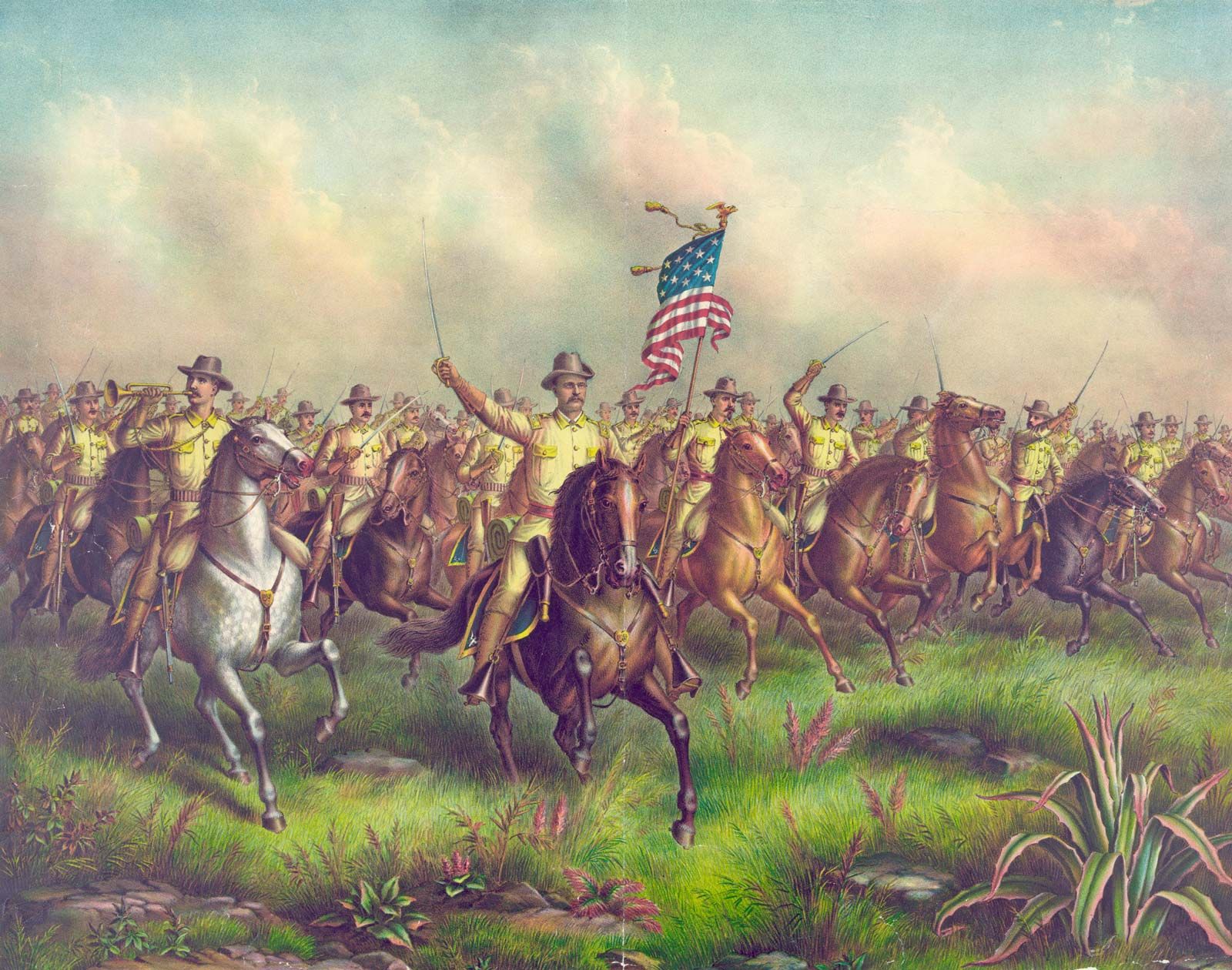
It is even claimed on good authority that the Black soldiers saved the regiment of Rough Riders, which was commanded by the intrepid Colonel Roosevelt, who afterwards became Governor of New York and President of the United States.
Lola JaneyNARRATOR
But before the Spanish-American War, the Negroes had given good account of themselves on many a well-fought field in the War of 1812 and again in the great Civil War.
Lola JaneyNARRATOR
In the Civil War, which resulted in the restoration of the Union and the freedom of the slaves, there were one hundred eighty-six thousand colored soldiers.
Lola JaneyNARRATOR
Today, a monument stands on Boston Common also in memory of the fifty-four Massachusetts Regiment of the United States soldiers.
Lola JaneyNARRATOR
He and a large proportion of his command were killed at Fort Wagner, South Carolina, in July 1863.
Lola JaneyNARRATOR
In the Civil War, we were not allowed to have our own officers, all the officers being white.
Lola JaneyNARRATOR
In the Spanish-American War, this was changed, and we had over two hundred officers, including some as high as colonels and two paymasters with the rank of majors.
Lola JaneyNARRATOR
When another war comes, we are going to have some generals as well as colonels and captains and majors.

Eileen LuhrGUEST
Right.
Eileen LuhrGUEST
And she also does this thing where she's sort of a social activist, too, where she adopts Cuban orphans from the Spanish-American War and brings them and is like, okay, well, we're going to inculcate them into American, or as we read it, white society.
Eileen LuhrGUEST
And so there's this strange thing about that.
Eileen LuhrGUEST
with the Cuban orphans sort of losing their Cuban-ness.

Samuel Acosta Jr.GUEST
Like, they would always gloss over anything of Puerto Rico, like, in the early 19th century.
Samuel Acosta Jr.GUEST
I didn't know about the Spanish-American War until I took 11th grade history.
Samuel Acosta Jr.GUEST
And I was like, oh, but did we have a choice to be with the U.S. or we were just spoils of the war? And then, you know, in college, well, why did Cuba decide we're not going to be part of the U.S.? Y'all leave us alone in the Philippines as well.
Samuel Acosta Jr.GUEST
But I didn't have a full spectrum of colonialism.
Samuel Acosta Jr.GUEST
And then who like what are we outside of Cuba? of the U.S.
Samuel Acosta Jr.GUEST
and learning that Spain was giving us autonomy the year before the Spanish-American War, the fact that we were kind of starting the process of actual liberation.
Samuel Acosta Jr.GUEST
And then the U.S. comes and then we kind of push back, but we kind of just felt through and like, OK, we're part of this big project.
Samuel Acosta Jr.GUEST
I mean, I'm a product of 1917 bill, the Jones Act.

speaker_1HOST
The timeframe for this banknote places it directly within the Cuban War of Independence.
speaker_0HOST
Right, which is the period immediately preceding the Spanish-American War.
speaker_1HOST
Exactly.
speaker_1HOST
Initially, this paper currency was introduced to function as a receipt for metallic coin held within the bank's vaults.
17 MINS LATER
speaker_0HOST
regardless of the physical realities of the conflict or the rapidly depreciating value of the paper it was printed on.
speaker_1HOST
But this domestic success in mainland Spain contrasts sharply with the deterioration of the overseas colonies during the exact same period.
speaker_0HOST
The secessionist movement in Cuba, combined with restrictive economic policies mandated by Madrid and the harsh military responses implemented by Whaler, culminated in the Spanish-American War of 1898.
speaker_1HOST
And the conclusion of this war resulted in the Treaty of Paris, which mandated the formal relinquishment of Cuba, Puerto Rico, Guam, and the Philippines.

speaker_3NARRATOR
their distribution in air has led to renewed endeavors on the part of sanitary authorities to procure efficient ventilation in our hospitals and public institutions dust has acquired a fresh horror since it has been shown how disease germs may be disseminated by its means whilst the important part which flies and lice may play in the spread of epidemics has opened up a new field for research and made us conscious of a fresh source of danger in our daily life the general public however is hardly yet fully alive to the capacity for mischief possessed and exercised by the common house-fly true it is universally execrated and regarded as a tiresome attendant upon the summer months but it is not usually considered in any more serious light that however the comparative indulgence with which this homely insect pest has been treated is decidedly misplaced and fraught with danger to health the researches of numerous scientists have now conclusively proved as long ago as the year eighteen eighty eight professor selli showed that the germs of consumption anthrax and typhoid fever could pass through the digestive organs of flies and reappear in the excreta of the latter not only alive but in full possession of their disease producing powers dr sotchenko made similar experiments with cholera germs healthy flies were placed under glass shades and fed with broth in which these microorganisms were growing and the latter were not only subsequently recovered from the digestive organs of the flies but also from their excreta in a living and virulent condition this is however not the only means whereby these insects can distribute deadly and other microbes for it has been shown that in crawling over substances containing bacteria these may become attached to the feet of flies and are in this manner transferred to other materials upon which they may alight during the recent outbreak of bubonic plague in the east the part played by flies in disseminating the virus has been repeatedly emphasized yersin was the first who called attention to the presence in large numbers of virulent plague bacilli within the bodies of flies which he collected in the vicinity of plague-stricken persons and it was found that flies which had fed on plague infected material and were then isolated lived for several days afterwards during which time virulent plague bacilli were present in their bodies in immense numbers thus were these insects converted into winged messengers of evil of the most repulsive type I am not aware whether any experiments on the vitality and transmissibility of diphtheria and consumption germs by means of flies have been made, but in view of the overwhelming evidence of the culpability of these insects in spreading plague, it is not unreasonable to presume a responsibility on their behalf in regard to other diseases.
speaker_3NARRATOR
Indeed, in the report issued by the Army Medical Commissioners of the Spanish-American War, it is emphatically stated that flies played an important part in the dissemination of typhoid fever.
speaker_3NARRATOR
there is no question as to the capability of certain micro-organisms to reside for considerable periods of time within the bodies of flies and during this sojourn to abate no jot of their virulence indeed it has been shown that the bodies of these insects may constitute incubators of a most successful type for some varieties of bacteria grow luxuriantly and multiply abundantly within them in the hot days of summer when flies abound it would be well to banish these insects as far as lies in our power not only from our sick rooms in particular but from our general surroundings the catholic taste of flies for garbage of all kinds is too well known to require entering into but the consequences which may follow from their visits to dust-bins and centres of disease and then alighting upon our food or persons has received too little attention in the past In regard to the subject of insects as disease disseminators, it may be mentioned that Mr. Hankin, when studying plague conditions in India, expressed his belief that ants in Bombay also assisted in spreading the scourge.
speaker_3NARRATOR
For he found that when he inoculated mice with the excreta of ants, such insects having previously fed on plague-stricken rats, the mice succumbed to plague in a few hours.

Eileen LuhrGUEST
And she also does this thing where she...
Eileen LuhrGUEST
She's sort of a social activist, too, where she adopts Cuban orphans from the Spanish-American War and brings them and is like, okay, well, we're going to inculcate them into American, or as we read it, white society.
Eileen LuhrGUEST
And so there's this strange thing about... with the Cuban orphans sort of losing their Cuban-ness.
Eileen LuhrGUEST
So that's very imperial.
259 more episodes mention Spanish–American War.
Create an account to see the whole feed, search across every transcript, and follow the entities you care about.