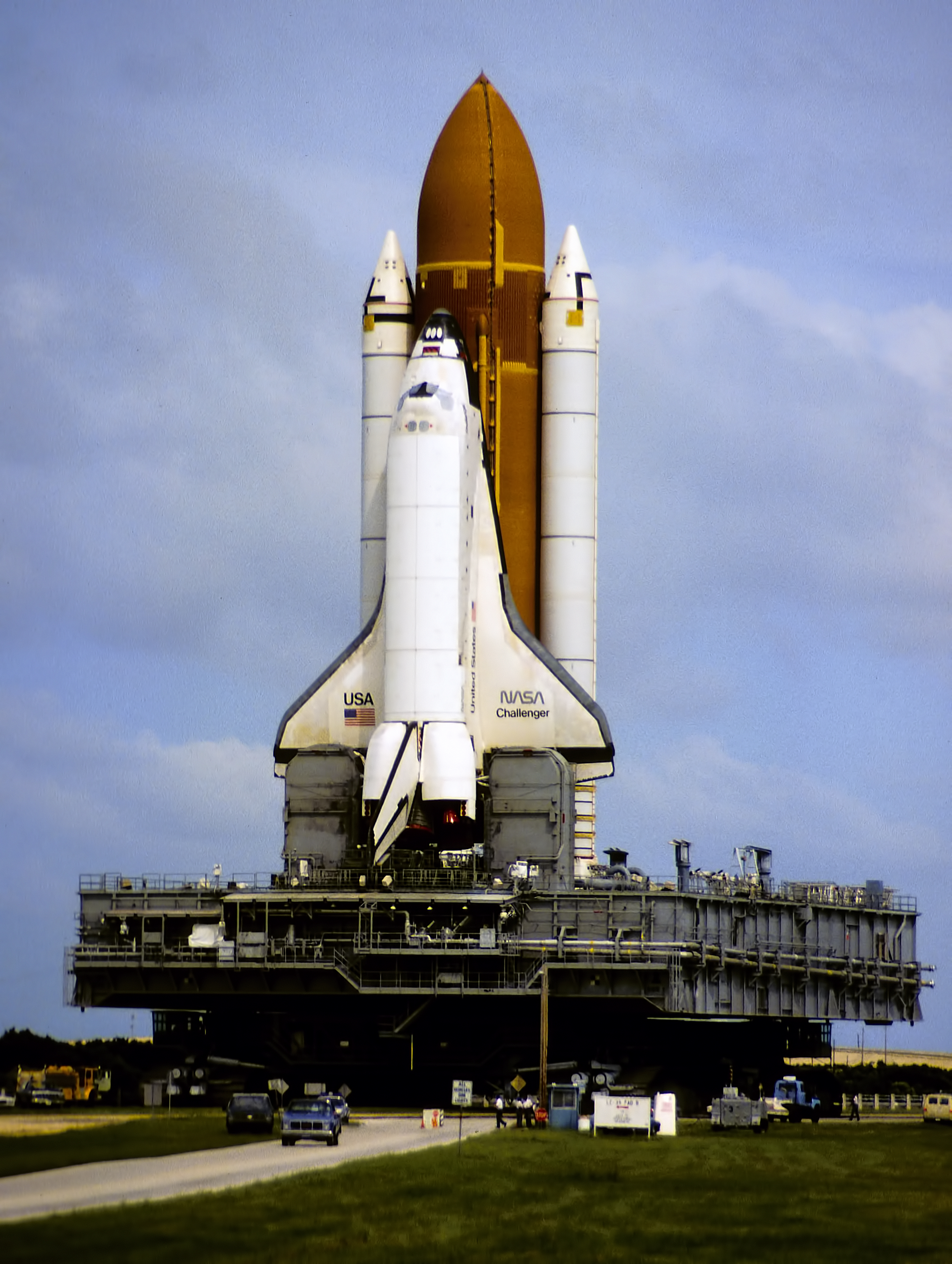
Space Shuttle Challenger
Space shuttleWikipedia
30
MENTIONS
14
EPISODES
14
PODCASTS
Search complete. 30 mentions across 14 episodes found for "Space Shuttle Challenger".
Oct 22, 2026

Andy DemetraHOST
Robert H. Trulli, he commanded the STS-8 mission in 1983.
Andy DemetraHOST
That was the third flight of the Space Shuttle Challenger.
Andy DemetraHOST
One of the other five astronauts on that STS-8 mission was Guyon Bluford, who in the process became the first African-American astronaut ever to go into space.
Andy DemetraHOST
Guyon Bluford is the great-great-uncle of your wide receiver, Daylon Penson.

Liane DaveyGUEST
I just randomly took an organizational psychology class, and this would be in 1990, so I'm dating myself.
Liane DaveyGUEST
four years after the Space Shuttle Challenger disaster.
Liane DaveyGUEST
And we did the case study of the team dynamics that allowed the Space Shuttle to launch when there were many people within NASA who knew that there was a tremendous risk given the temperature on the launch pad that there would be problems.
Liane DaveyGUEST
And I was just like, well, how did that happen? How did somebody not fight for that? And I was hooked right from that very day.
19 MINS LATER
Liane DaveyGUEST
Like somehow somebody is a boss.
Liane DaveyGUEST
They should be, you know, inhuman and perfect.
Liane DaveyGUEST
Like just what, like what? It reminds me when I was in university, I had a professor, actually it was the professor from the class that I learned about the space shuttle challenger.
Liane DaveyGUEST
And I, I, Just was in awe of him.

Maggie AderinNARRATOR
It's the morning of the 24th of April, 1990.
Maggie AderinNARRATOR
Four years after the Challenger disaster, NASA has only recently returned to flight.
Maggie AderinNARRATOR
Investigations have reshaped the agency.
Maggie AderinNARRATOR
The shuttle has been redesigned.

Maggie AderinHOST
But finally, the plane lands on the runway, and Kathy disembarks.
Maggie AderinHOST
At 11:38 AM, Space Shuttle Challenger launched from the Kennedy Space Center to cheers of celebration.
Maggie AderinHOST
At 11:39 AM, 73 seconds into its flight, 46,000 feet above the Atlantic Ocean off the coast of Florida, Shuttle Challenger erupted in a blaze of fire Killing all seven members of the crew
Kathy SullivanSOUNDBITE_SPEAKER
I just drove right to the Space Center.
Kathy SullivanSOUNDBITE_SPEAKER
I mean, it's the only place that made sense to be is there might be some information there, there'd be a little more insight there, there'd be the only other people on the planet that really understood, uh, what that moment was like and what it meant for me as an astronaut, for us as astronauts, for NASA, for the families that we knew so well.
8 MINS LATER
Tristan RedmondHOST
Listen to the Global Story on bbc.com or wherever you listen.
Maggie AderinHOST
[gentle music] It's the morning of the 24th of April, 1990.
Maggie AderinHOST
Four years after the Challenger disaster, NASA has only recently returned to flight.

speaker_0HOST
Nineteen sixty, Nikita Khrushchev, leader of the Soviet Union, disrupts a meeting of the United Nations General Assembly with a number of angry outbursts.
speaker_0HOST
Nineteen eighty-eight, Space Shuttle-- NASA launches STS-26, the return to flight mission after Space Shuttle Challenger disaster.
speaker_0HOST
Nineteen ninety, construction of the Washington National Cathedral, it's completed.
speaker_0HOST
Nineteen ninety-- Okay, so right now it's twenty twenty-six.

Maggie AderinHOST
But finally, the plane lands on the runway, and Kathy disembarks.
Maggie AderinHOST
At 11:38 AM, Space Shuttle Challenger launched from the Kennedy Space Center to cheers of celebration.
Maggie AderinHOST
At 11:39 AM, 73 seconds into its flight, 46,000 feet above the Atlantic Ocean off the coast of Florida, Shuttle Challenger erupted in a blaze of fire, killing all seven members of the crew.
Kathy SullivanSOUNDBITE_SPEAKER
I just drove right to the Space Center.
Kathy SullivanSOUNDBITE_SPEAKER
I mean, it's the only place that made sense to be is there might be some information there, there'd be a little more insight there, there'd be the only other people on the planet that really understood, uh, what that moment was like and what it meant for me as an astronaut, for us as astronauts, for NASA, for the families that we knew so well.
8 MINS LATER
speaker_0ADVERTISER
Listen on bbc.com or wherever you get your podcasts.
Maggie AderinHOST
It's the morning of the 24th of April 1990.
Maggie AderinHOST
Four years after the Challenger disaster, NASA has only recently returned to flight.

Tom BrokawSOUNDBITE_SPEAKER
The 98th Congress has adjourned after the Senate reversed itself and sent to the President legislation to extend the nation's debt limit by $251 billion.
Tom BrokawSOUNDBITE_SPEAKER
And the Space Shuttle Challenger is due to set down tomorrow at Cape Canaveral.
Tom BrokawSOUNDBITE_SPEAKER
I'm Tom Brokaw in New York.
Tom BrokawSOUNDBITE_SPEAKER
More news later on this NBC station.

Charlie CamardaGUEST
But the people at Johnson Space Center, the researchers, the engineers there did not reach out and pull them in.
Charlie CamardaGUEST
What I did was, Michelle, I studied the people that were the sociologists, the behavioral scientists, the cognitive scientists that had been working these accident investigations, like Diane Vaughn, Amy Edmondson, Michael Roberto, had been writing these papers for years after the Challenger accident, pointing out the culture.
Charlie CamardaGUEST
And how do these people make sense of a problem? How do they determine whether or not they have the knowledge that actually understands the problem? And what I learned from Michael Roberto and Amy Edmondson's paper on recovery windows is that when you have an ambiguous threat, the natural tendency for people is to downplay that threat, to think they understand it, and to use the tools that they've been using to try to solve the problem when really the tools they have are totally inadequate and will give them the wrong answer.
Charlie CamardaGUEST
And they didn't reach out.
Charlie CamardaGUEST
I talked to them.
Charlie CamardaGUEST
I talked to Diane Vaughn.
Charlie CamardaGUEST
I read her book, The Challenger Launch Decision, like four or five times because it's very difficult book to read because it speaks a different language.
Charlie CamardaGUEST
She's a she's a trained sociologist and she understood the cultural problem during Challenger.

Mike BenoGUEST
They met the other people who were nominated for this.
Mike BenoGUEST
And it was to go aboard the Space Shuttle Challenger.
Mike BenoGUEST
Krista McAuliffe famously went aboard.
Mike BenoGUEST
She won out of 11,000 people.
Mike BenoGUEST
And, of course, we remember the days, that day very clearly.
Mike BenoGUEST
173 seconds into the flight, the Challenger exploded.
Mike BenoGUEST
And President Reagan returned to TV, and he mourned the heroes, saying they slipped the surly bonds of earth to touch the face of God.
Lee RayburnHOST
Boy, I remember that, Mike.
4 more episodes mention Space Shuttle Challenger.
Create an account to see the whole feed, search across every transcript, and follow the entities you care about.