Southern Oscillation Index
30
MENTIONS
9
EPISODES
9
PODCASTS
Search complete. 30 mentions across 9 episodes found for "Southern Oscillation Index".
Oct 30, 2026

Steve SmithHOST
It'll be interesting to see how we'll go more generally with water supply and course conditioning.
Steve SmithHOST
Now the reason I say that is I just had to check on the Southern Oscillation Index before recording and it's still in a massive negative.
Steve SmithHOST
Now I have talked about this in the podcast previously on Walking the Fairways and with it being in a negative, we're officially in the El Nino climate pattern.
Steve SmithHOST
Now I'm personally I'm still expecting to see general rainfalls reduce based on this current situation.
Steve SmithHOST
I'm not expecting to see the tap turn off right that's not how it happens it doesn't often happen that way but from where I sit I'm expecting to see less broad rainfall over the next season or two even and I think this is the beginning of that trend that's my call.
Steve SmithHOST
The Southern Oscillation Index hasn't looked like this since the late 90s and the early 2000s when we had widespread droughts.
Steve SmithHOST
Now, I'm not saying to take my word for it.
Steve SmithHOST
What I'm merely doing, and I remember what it was like as a golf course superintendent, worrying about rain...

Paul BloxhamGUEST
Well, it looks as though it's already one of the strongest El Nino events that we've seen on record.
Paul BloxhamGUEST
When we're talking about El Nino and judging what it is, of course, we look at this thing called the Southern Oscillation Index.
Paul BloxhamGUEST
And we look at this ratio.
Paul BloxhamGUEST
And as I say, that ratio is at one of the more extremes we've seen in one of the most extremes we've seen in history.

Paul BloxhamGUEST
Well, it looks as though it's already one of the strongest El Nino events that we've seen on record.
Paul BloxhamGUEST
When we're talking about El Nino and judging what it is, of course, we look at this thing called the Southern Oscillation Index.
Paul BloxhamGUEST
And we look at this ratio.
Paul BloxhamGUEST
And as I say, that ratio is at one of the more extremes we've seen in one of the most extremes we've seen in history.

speaker_10SOUNDBITE_SPEAKER
The forecasters are particularly interested in a thing called the southern oscillation
Matt BevanHOST
The southern oscillation index wasn't a new idea, nor was it a particularly complicated one
speaker_5SOUNDBITE_SPEAKER
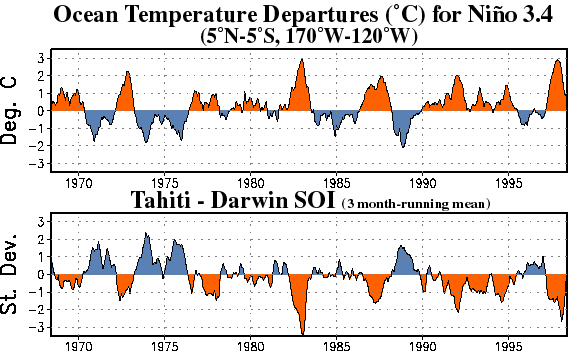
The southern oscillation is a measure of the difference in atmospheric pressure between Tahiti and Darwin.
speaker_5SOUNDBITE_SPEAKER
In other words, we take the pressure at Darwin away from the pressure at Tahiti and get this graph
John McBrideSOUNDBITE_SPEAKER
It was more a, an interesting scientific phenomenon
Matt BevanHOST
This is John McBride, who at the time was a young researcher at the ANMRC.
Matt BevanHOST
He'd become fascinated by Neville Nicholls's work on the southern oscillation index and its relationship with other weather patterns
John McBrideSOUNDBITE_SPEAKER
He was doing what I thought were sort of extraordinary papers, but everyone in Australia, even internationally, were kind of ignoring him because back then it was not accepted that you could do seasonal forecasts

Steve Wyn-HarrisGUEST
But whether it comes to a drought or not is...
Steve Wyn-HarrisGUEST
Remains to be seen so but you know you want to respect these big big oscillations in the Southern Oscillation Index and this one it's not as deep as I've seen sort of eased off in August the Southern Oscillation Index but the Temperatures up there in the Pacific are certainly much higher than they've ever been.
Steve Wyn-HarrisGUEST
So, yeah, keep an eye on it.
Jamie MackayHOST
Yeah, and I know that you keep a very close watching eye on it.

Kristi MileyGUEST
Um, that's something I'm really concerned about.
Kristi MileyGUEST
Some of the stuff that I've studied is, uh, related to the Southern Oscillation Index or El Niño-La Niña.
Matthew PeddieHOST
Okay.
Kristi MileyGUEST
With us coming into a super El Niño, we're gonna have a much wetter, I think the wettest, uh, winter is projected on record.

Justin ValentinoGUEST
So for context, the World Meteorological Organization, the WMO, just confirmed last week an unprecedented nearly 100% likelihood that El Nino conditions will persist through Q1 of next year.
Justin ValentinoGUEST
as the WMO noted exceptionally warm ocean conditions on the Pacific based on the Southern Oscillation Index, ESOI, which looks at the air pressure differentials in the South Pacific, as well as other key factors, such as sea surface temperature and weaker than average trade winds.
Justin ValentinoGUEST
But an El Nino event will exert quite different climatic responses depending on the region, from droughts in the Western Pacific, Australia, Amazon Basin, and Southern Africa.
Justin ValentinoGUEST
to a higher frequency and scale of storms and floods on the west coast of South America, as well as hurricanes, typhoons, monsoons in the Central Pacific.

Linda McIverHOST
...
Linda McIverHOST
in Australia, uh, for, uh, the senior maths curriculum, and one of the examples I found for normal distributions was the Southern Oscillation Index, which is-
Nicole WhiteGUEST
Okay
Linda McIverHOST
... wonderful because, uh, the Bureau of Meteorology has...