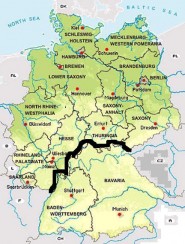
Southern Germany
Region in GermanyWikipedia
48
MENTIONS
36
EPISODES
32
PODCASTS
Search complete. 48 mentions across 36 episodes found for "Southern Germany".
Sep 14, 2026

Joanna Michael HoytNARRATOR
Beginning If the Mozartian family tree was nothing like the prodigious trunk of the box, it was still not without striking features.
Joanna Michael HoytNARRATOR
There were Mozarts in South Germany as far back as the end of the sixteenth century, and as remotely as the thirteenth the name stood on a document in Cologne.
Joanna Michael HoytNARRATOR
To be sure, various spellings of Mozart existed in those distant times.
Joanna Michael HoytNARRATOR
It appeared as Mosshard, Mozart, Mozart, and in still other variants.

KateGUEST
I mean, just because I lived there.
KateGUEST
So I think if, like most people I meet who have not spent time up in Northern Germany, they gravitate towards Southern Germany.
KateGUEST
And I get it.
KateGUEST
I mean, I've spent a lot of time in Southern Germany too.
KateGUEST
And it is beautiful because of the Black Forest and the Alps.
KateGUEST
And there's a lot to see there.

Adrian PretzelisNARRATOR
Italy gives salitas and wayside chapels and chestnuts and olive orchards.
Adrian PretzelisNARRATOR
The Ardennes has its woods and gorges, Touraine and the Rhineland, the wide Campagna with its distant Apennines, and the neat prosperities and mountain backgrounds of South Germany.
Adrian PretzelisNARRATOR
All clamour their especial merits at one's memory.
Adrian PretzelisNARRATOR
And there are the hills and fields of Virginia, like an England grown very big and slovenly, the trim New England landscape, a little bleak and rather fine like the New England mind, and the wide, rough country roads and hills and woodland of New York State.

speaker_2NARRATOR
The basis of the poem is a historical incident.
speaker_2NARRATOR
In the year 1731, the Archbishop of Salzburg drove out of his diocese a thousand Protestants who took refuge in South Germany, and among whom was a girl who became the bride of the son of a rich burgher.
speaker_2NARRATOR
The occasion of the girl's exile was changed by Goethe to more recent times, and in the poem she is represented as a German from the west bank of the Rhine fleeing from the turmoil caused by the French Revolution.
speaker_2NARRATOR
The political element is not a mere background, but is woven into the plot with consummate skill, being used at one point, for example, in the characterization of Dorothea, who before the time of her appearance in the poem has been deprived of her first betrothed by the guillotine, and at another in furnishing a telling contrast between the revolutionary uproar in France and the settled peace of the German village.

speaker_11NARRATOR
By the end of the colonial period, the number of Germans had risen to more than two hundred thousand.
speaker_11NARRATOR
The majority of them were Protestants from the Rhine region and South Germany.
speaker_11NARRATOR
Wars, religious controversies, oppression, and poverty drove them forth to America.
speaker_11NARRATOR
Though most of them were farmers, there were also among them skilled artisans who contributed to the rapid growth of industries in Pennsylvania.

BlueHOST
... uh, assumptions of what a, a character who sounds like this would be like.
BlueHOST
With Hans, I'm like, what other accent do I wanna do? Fuck it, let's go, like a very, like goofy Southern German, uh, at least I think it's Southern German.
BlueHOST
Um, [laughs] a very stereotypical German accent, uh, that sounds nothing like any actual German ever.
BlueHOST
Uh, and then it's like, okay, well I'm gonna make him a little bit of a, a, a person who is as goofy as the, the voice inflection that I'm giving him.

Scott WoodwardHOST
And then from BYU professors, you may have heard of Hugh Nibley and Robert K. Thomas.
Scott WoodwardHOST
Jack is also known as the one who discovered chiasmus in the Book of Mormon while serving as a young missionary in South Germany in 1967, which is so cool.
Scott WoodwardHOST
And there's so much backstory there that We're going to resist the temptation to go into that black hole today, but there is so much there.
Scott WoodwardHOST
And there's some great interviews that have been done with Jack just on YouTube.

Diana CowernHOST
Everything about this problem is just perfect, which is one of the things I love about this story.
Diana CowernHOST
But the thing I love the most is this next bit about a little girl from Germany.
Richard NorrisGUEST
So one of the people who contacted us after our paper was published was a 13-year-old girl-
Diana CowernHOST
Okay
Richard NorrisGUEST
...
Richard NorrisGUEST
in Southern Germany.
Richard NorrisGUEST
Her name is Ronja Spanke, and she had been doing experiments to simulate what was going on here at Death Valley-
Diana CowernHOST
Wow

speaker_12NARRATOR
By the end of the colonial period, the number of Germans had risen to more than 200,000.
speaker_12NARRATOR
The majority of them were Protestants from the Rhine region and South Germany.
speaker_12NARRATOR
Wars, religious controversies, oppression, and poverty drove them forth to America.
speaker_12NARRATOR
Though most of them were farmers, there were also among them skilled artisans who contributed to the rapid growth of industries in Pennsylvania.
speaker_2NARRATOR
Beginning If the Mozartian family tree was nothing like the prodigious trunk of the box, it was still not without striking features.
speaker_2NARRATOR
There were Mozarts in South Germany as far back as the end of the sixteenth century, and as remotely as the thirteenth the name stood on a document in Cologne.
speaker_2NARRATOR
To be sure, various spellings of Mozart existed in those distant times.
speaker_2NARRATOR
It appeared as Mosshard, Mozart, Mozart, and in still other variants.
26 more episodes mention Southern Germany.
Create an account to see the whole feed, search across every transcript, and follow the entities you care about.