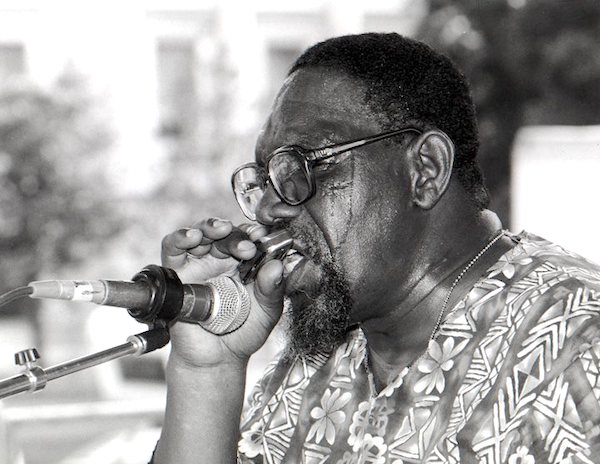
Sonny Terry
American musicianWikipedia
19
MENTIONS
13
EPISODES
12
PODCASTS
Search complete. 19 mentions across 13 episodes found for "Sonny Terry".
Oct 26, 2026

P.W. FentonHOST
I am your host, P.W. Fenton.
P.W. FentonHOST
On this day in 1960, Sonny Terry joined Lightnin Hopkins in the studio for Last Night Blues, and Lightnin did the singing.
Lightnin' HopkinsSOUNDBITE_SPEAKER
You know I went home last night.
Lightnin' HopkinsSOUNDBITE_SPEAKER
On that very same day, Lightning and Sonny recorded Conversation Blues and Sonny Terry did the singing.
Sonny TerrySOUNDBITE_SPEAKER
I want to tell you something, Junior.
Sonny TerrySOUNDBITE_SPEAKER
Well, I want you to tell me something to make me see.

speaker_0HOST
Santo Farina was born in 1937, one half of the instrumental rock duo Santo and Johnny, who had a big hit back in 1959 with the number one single Sleepwalk.
speaker_0HOST
Sonny Terry was born in 1911, a Piedmont blues icon who overcame childhood blindness to become a harmonica virtuoso and and also had a decades-long partnership with Brownie McGee.
speaker_0HOST
Oh, by the way, Sonny Terry's real name, Saunders Terrell.
speaker_0HOST
Jerry Edmonton was born in 1946, drummer for the group Steppenwolf.
speaker_0HOST
Ted Templeman was born in 1942, musician and also a producer for Warner Brothers.
P.W. FentonHOST
I am your host, P.W. Fenton.
P.W. FentonHOST
On this day in 1911, in Greensboro, North Carolina, one of the blues' greatest harmonica players was born, Sonny Terry.
P.W. FentonHOST
On this day in 1936 in Chula, Mississippi, the
P.W. FentonHOST
great Jimmy Dawkins was born.

John OatesGUEST
People like Mississippi John Hurt, Doc Watson, you know, Hedy West, uh, you know, the, the real, the real authentic folk, uh, performers and blues performers.
John OatesGUEST
You know, um, Sun House, Sonny Terry and Brownie McGhee, and I would see them, you know, literally five feet away, and I watched them play, and I got to meet some of them, you know, through a, through a guitar teacher that I had who was involved with the, the folk blues scene.
John OatesGUEST
So, you know, I was, I was absorbing all this music and, and it was, you know, as, as a young kid, and what an amazing experience to have that as my, my kind of learning experience, my, you know, my formative, uh, musical training, basically.
Jeff ZitoHOST
Was, was it kind of, uh, was it kind of odd? Were you, w- were you, like, um, you know, on an island by yourself, being that young and really being into folk and blues? Was ...

Bruce CockburnGUEST
They had a really kind of interesting stage presence in that era.
Bruce CockburnGUEST
I mean, the other duo that I saw a lot of at that time was Brownie McGee and Sonny Terry, who came through once or twice a year also, and were terrifically entertaining and energetic.
Bruce CockburnGUEST
Ian and Sylvia brought a more serious kind of vibe to it.
Bruce CockburnGUEST
I mean, not that Browning McGee wasn't serious.

Jimbo "Big Train" MadsenHOST
Playing at the dozens, or putting in the dozens, is a folk game in which two or more participants hurl insults and boast at one another and are invariably obscene, frequently pornographic, and always aim to disparage an opponent's genealogy.
Jimbo "Big Train" MadsenHOST
Acoustic blues harmonica master Sonny Terry was famous for mixing dazzling harp work with exuberant whoops, hollers, and unmistakable personality.
Jimbo "Big Train" MadsenHOST
Born October 24, 1911 in Greensboro, North Carolina, Terry first recorded with Blind Boy Fuller in 1937 before forming his legendary partnership with Brownie McGee.
Jimbo "Big Train" MadsenHOST
His remarkable career carried Piedmont blues from southern stages to Carnegie Hall, Broadway, television, and even classical music.

Geoff TobinHOST
You're listening to Jazz on a Saturday, uh, on Radio 3CR 855 on your, uh, AM dial and, uh, we, uh, we present, uh, Jazz on a Saturday, uh, every Saturday between, uh, 4:00 PM and 5:30.
Geoff TobinHOST
Fans of Chris Barber are gonna be delighted with a, uh, new release, a release on the British, uh, Lake label of a, uh, CD reissuing an album, uh, entitled Sonny, Brownie and Chris.
Geoff TobinHOST
Chris Barber was not only an outstanding musician and bandleader, uh, in the United Kingdom, but he was fascinated by the roots of jazz and, uh, against the advice of his management in, uh, the 1950s following the gradual passing or demise of the skiffle craze, he decided to tour a number of American blues and gospel musicians.
Geoff TobinHOST
You might recall a couple of weeks back we, we played a track of, uh, Chris Barber with Sister Rosetta Tharpe.
Geoff TobinHOST
But, uh, most of these, uh, performers were generally unknown to the British public at that stage and, uh, but luckily Barber was at the height of his popularity, uh, and so, uh, he decided to finance these tours himself and there were performers such as Sister Rosetta Tharpe, Big Bill Broonzy, Brother John Sellers, Muddy Waters, Otis Spann and Jim- Jimmy Cotton.
Geoff TobinHOST
And it's, uh, pleasing to note that, uh, most of these tours turned out to be a financial as well as a cultural and a critical success.
Geoff TobinHOST
Then 1958, uh, Barber toured the blues harmonica player Sonny Terry and his, uh, musical partner on guitar and vocals Brownie McGhee and this tour was a, uh, phenomenal success and unlike previous tours, uh, was, uh, properly recorded.
Geoff TobinHOST
They...

Robert GordonGUEST
They would be in these workshops in the afternoon, all gathered on a stage.
Robert GordonGUEST
So John Hammond, John Hurt, Sonny Terry and Brownie McGhee, Dick Cooper, just a range of people and performers.
Robert GordonGUEST
Dave Van Ronk, you know.
Robert GordonGUEST
And they're, and they're, they're muttering to each other too, you know.

Ed WardGUEST
And he was.
Ed WardGUEST
He didn't live at Almanac House, but he hung out with them like Sonny Terry and Brownie McGee.
Nate WilcoxHOST
Yeah.
Ed WardGUEST
Or other people on the periphery of that.
Nate WilcoxHOST
And then I just imagined him changing into a suit to do an R and B set up town.
Nate WilcoxHOST
Yeah, sure.
Ed WardGUEST
And also Sonny Terry was on Broadway.
Ed WardGUEST
He played in Brigadoon.

Chris GregoryHOST
Many well-known blues songs, such as Leadbelly's Midnight Special, Junior Parker's Mystery Train and Elizabeth Cotton's Freight Train, feature trains as symbolic means of escape.
Chris GregoryHOST
The harmonica player Sonny Terry specialised in imitating trains with his instrument.
Chris GregoryHOST
Dylan recorded Curtis Jones' 1938 song Highway 51 Blues, in which the road runs right by my baby's door, on his first album, and also performed the song live on a number of occasions.
Chris GregoryHOST
Highway 51 and Highway 61, both of which run from the deep south to the northern cities, are mentioned in many blues songs.
3 more episodes mention Sonny Terry.
Create an account to see the whole feed, search across every transcript, and follow the entities you care about.