Solvay Conferences
ConferenceWikipedia
7
MENTIONS
3
EPISODES
3
PODCASTS
Search complete. 7 mentions across 3 episodes found for "Solvay Conferences".
Sep 13, 2026

Theo WrenfieldNARRATOR
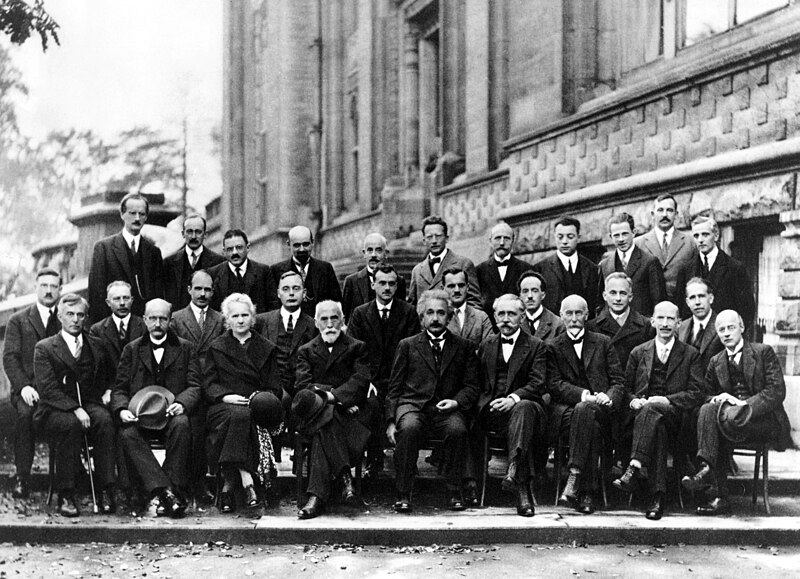
The autumn of 1927 brought together some of the greatest minds in physics to a grand mansion in Brussels, Belgium.
Theo WrenfieldNARRATOR
The fifth Solvay conference, held from October the 24th to 29th, would become perhaps the most famous scientific gathering of the 20th century.
Theo WrenfieldNARRATOR
Funded by the Belgian industrialist Ernest Solvay, these exclusive conferences had been bringing elite physicists together since 1911.
Theo WrenfieldNARRATOR
But this particular meeting would witness debates that echoed through the decades to come.
8 MINS LATER
Theo WrenfieldNARRATOR
These debates would continue in letters and publications for years to come.
Theo WrenfieldNARRATOR
Einstein never accepted that quantum mechanics was complete, continuing to search for a deeper theory that would restore determinism and objective reality.
Theo WrenfieldNARRATOR
The Fifth Solvay Conference marked a turning point nonetheless.
Theo WrenfieldNARRATOR
The new quantum mechanics was established as the working framework of atomic physics, whatever questions remained about its interpretation.

Grandpa CohenHOST
Lemaitre, being a modest man, sent his paper to Einstein himself.
Grandpa CohenHOST
The two met at the Solvay Conference in Brussels that same year, and Einstein, who was at that time still very committed to the picture of a static universe, is said to have replied to Lemaitre in words that have been often quoted since, "'Your calculations are correct,' But your physics is abominable." Einstein could not, at that moment, bring himself to believe that the mathematics of general relativity really did require the universe to be moving.
Grandpa CohenHOST
It seemed to him aesthetically unlikely.
Grandpa CohenHOST
He had spent a decade wrestling those equations into a form that would describe the world and he did not want the world to be so restless.

Tim MaudlinGUEST
Now, that criterion you have to pay attention to because it, part of the criterion is that you're able to make this prediction without in any way disturbing the system that you're predicting the outcome of.
Tim MaudlinGUEST
And his main complaint, Einstein's main complaint about the Copenhagen presentation or understanding of quantum theory from the beginning, and we went back last time to 1927 in the Solvay Conference, was that it seemed committed to non-locality.
Tim MaudlinGUEST
It seemed committed to the idea that, uh, something happening at one place could immediately disturb and change physically the physical situation far away instantaneously, and that he called spooky action at a distance.
Tim MaudlinGUEST
Why did Einstein object to spooky action at a distance? Well, f-first of all, in itself, it struck him as a strange thing.
53 MINS LATER
Tim MaudlinGUEST
Which is, that, that's pretty impressive, [laughs] right? I mean, I mean, it's impressive both on Einstein's and on Bohm's part, right? Einstein had the arguments, and Bohm recognized they were good arguments and decided, even though he tried the best he could to make Copenhagen work, he couldn't make it work.
Tim MaudlinGUEST
And that's nineteen fifty-one, right? And then in nineteen fifty-two, uh, Bohm says, "All right, I need to do something more acceptable." And he starts working on a so-called hidden variables theory, and he finds it.
Tim MaudlinGUEST
It turns out to be essentially what de Broglie had already presented it, it at, in Solvay in nineteen twenty-seven.
Tim MaudlinGUEST
Uh, as far as I know, there's not any indication that Bohm knew about de Broglie's work.