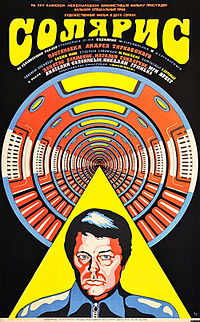
Solaris
1972 filmWikipedia
116
MENTIONS
23
EPISODES
18
PODCASTS
Search complete. 116 mentions across 23 episodes found for "Solaris".
Sep 26, 2026

speaker_4HOST
This is a great contrast.
speaker_6HOST
In our source curation, we have Andy Weir's Project Hail Mary juxtaposed against Andrei Tarkovsky's Solaris and Stalker.
speaker_4HOST
And this contrast exposes the two fundamental ways humans react to the terrifying scale of the cosmos.
speaker_4HOST
Andy Weir's work, which is being brought to the screen with Ryan Gosling in the lead, operates on the premise that the universe is a series of incredibly complex, highly lethal mathematical equations.
speaker_4HOST
That is where Andrei Tarkovsky enters the room.
speaker_6HOST
Yes.
speaker_6HOST
Diego highlights Tarkovsky's 1972 film Solaris based on Stanislaw Lem's 1961 novel.
speaker_4HOST
Tarkovsky despised the focus on technological fetishism in science fiction.

Julian DariusHOST
I mean, this is always on the short list for best science fiction movies ever made.
Julian DariusHOST
And I think I'm not as much a fan of this as I am Solaris.
Julian DariusHOST
You know, I prefer Solaris.
Julian DariusHOST
I think that...
Julian DariusHOST
This is still an interesting movie, but the sort of tedium that you felt with Solaris, I can kind of get into Solaris and at least, you know, once you're on a space station and space stations are cool, right? There's a lot of this that is just sort of like three middle-aged old men walking around fields, you know, and walking through tunnels.
Julian DariusHOST
And there's a kind of... ruin aesthetic that I kind of dig.
Julian DariusHOST
I usually dig, but you know, you sort of have to use a lot of your imagination to imagine there are swirling traps and vortexes of reality on either side of them at all times that are never really depicted.
Scott WeatherlyHOST
I mean, I'm not going to, you know...

James BaileyHOST
I should also point out we have
Luke ElliottHOST
covered Tarkovsky before because we did Solaris, which was based off a Stanislaw Lem novel, which I'll mention later.
Luke ElliottHOST
There's some interesting connections.
Luke ElliottHOST
It seems like Lem was very influential on the Strugatsy brothers, which, by the way, they're brothers.
Luke ElliottHOST
You'll recognize it if you hear it.
Laura CranehillGUEST
I would have to agree with a lot of James said.
Laura CranehillGUEST
And I think it's interesting that Tarkovsky did both Solaris and this because they're both kind of like, in a way, first contact stories.
Laura CranehillGUEST
But I know I've always kind of been drawn to aliens and especially first contact stories.

YuiGUEST
It's still a good experience.
Dave MaherHOST
Well, famously, if you heard the Solaris episode, Fred Barrett first watched Stalker on like a 480p Google Play.
Dave MaherHOST
This is
YuiGUEST
the way.
Dave MaherHOST
So for me, I watched this.
Dave MaherHOST
There was a...
Dave MaherHOST
I had a bit of a crunch in the last few from recording Solaris to Mirror to Stalker.
Dave MaherHOST
A lot of prep all around the same time.

JennyHOST
But the original
DaniHOST
Solaris film Mirror.
DaniHOST
No. OK.
DaniHOST
All right.

Brian PattonHOST
Today we welcome back to the podcast, Robin Stapps from The Ocean.
Brian PattonHOST
The Ocean will release Solaris this Friday on Pelagic Records.
Brian PattonHOST
Robin talks about starting and running Pelagic Records.
Brian PattonHOST
deciding to keep The Ocean going after the major lineup shakeup, the unique process of working with two vocalists on Solaris, the thematic direction of the album, and more.
Brian PattonHOST
I'm a massive fan of both The Ocean and Pelagic Records, and it was a delight to have Robin back on the podcast to talk about both.
Brian PattonHOST
Thanks so much for listening to this episode of As the Story Grows.
11 MINS LATER
Brian PattonHOST
So how did that affect your approach when thinking about writing the next album? Did you just because I mean, Holocene didn't start with you, but like, did you because most of the music starts with you? Did you just approach it as I know I'm going to do another one? Or did you want to have a band in place before starting that process?
Robin StapsGUEST
Well, that other one was already there at that point, to be fair.

Kris PetersHOST
You need them that time of day.
Kris PetersHOST
So we're here today to speak about the fact that The Ocean released your 12th studio album, Solaris, on September the 25th.
Kris PetersHOST
So how are you feeling, mate? It's not far away.
Kris PetersHOST
Yeah.
Kris PetersHOST
yeah nice the press release says that thematically solaris picks up where holocene finished off like can you elaborate on the concept in the ending overlapping story act
Robin StapsGUEST
So the last track on Holocene Sub-Atlantic is kind of the bleak, dystopian image of an earth that has become uninhabitable and a group of human survivors leaving to find a place to live somewhere else.
Robin StapsGUEST
And Solaris is the story of that journey.
Robin StapsGUEST
It connects exactly there.

Chris MiyamoHOST
Brachial is correct.
Chris MiyamoHOST
Mike? Which Soviet sci-fi film is often cited as one of the greatest sci-fi films of all time? Solaris? I've been saying Solaris for a long time.
Chris MiyamoHOST
Solaris is correct.
Chris MiyamoHOST
I don't know if I'm pronouncing that correctly, honestly.
Chris MiyamoHOST
General rule here, Mike, is if I'm pronouncing it differently than you, I assume I'm wrong.

Tasha RobinsonHOST
We wish her all the best in pushing back the frontiers of man's limitations and hope she brings us all souvenirs.
Tasha RobinsonHOST
In our last episode, we discussed Andrei Tartovsky's 1972 adaptation of Stanislaw Lem's novel Solaris.
Tasha RobinsonHOST
We'll return to that movie after we spend a little time with its newer equivalent, Alexander Ullum's feature debut, It Ends.
Tasha RobinsonHOST
This little 89-minute indie movie, made for just $80,000, had an interesting path to the screen.
Keith PhippsHOST
It's a good calling card.
Keith PhippsHOST
I don't know if it describes the movie.
Keith PhippsHOST
We talked about doing Slacker as a pairing, and I think we're going to find more connections with Solaris.
Keith PhippsHOST
I don't know.

DanHOST
The entity is kind of making people go mad.
DanHOST
It did feel very similar to a movie we did fairly recently, Solaris, which was more of a sort of heartwarming drama, whereas this feels like straight horror.
DanHOST
These characters are being tormented by their sort of inner demons and guilt.
ConradHOST
Yes, absolutely.
10 MINS LATER
ConradHOST
They are trying to do something here, not just a bunch of cheap references.
DanHOST
Yes.
DanHOST
I think he also references Solaris at one point, or at least Tarkovsky movies, because there's a scene with the coolant, which is floating around, and then they engage the gravity and it starts raining down.
DanHOST
So apparently Tarkovsky movies always have rain inside buildings, because we did see it in Solaris at the end, which was a really odd scene.
13 more episodes mention Solaris.
Create an account to see the whole feed, search across every transcript, and follow the entities you care about.